(To request a bound copy of this report, click here.
To see a complete list of Milbank reports, click here.
When ordering, be sure to specify which report you want,
your name, mailing address, and phone number.)
To print this report click here for the pdf version.
Leaders in the public and private sectors accord high priority to getting the best health care for the best price for the people for whom their organizations purchase services. Many of these organizations are using systematic knowledge, strategies, and techniques they call value purchasing as an alternative to exhortation, competition, or regulation in their relationships with health plans and provider organizations.
The Milbank Memorial Fund commissioned the case studies in this report in order to communicate to a broad audience what seven very different organizations have accomplished through value purchasing and what they regard as opportunities for and impediments to further progress. These organizations are General Electric, purchasing coalitions of employers in Central Florida, Denver, and Minneapolis—St. Paul, Massachusetts Medicaid, and two federal health programs, Medicare and the TRICARE program of the Department of Defense.
Leaders of these organizations facilitated the case writers' access to colleagues and documents, reviewed several drafts of each case and draft findings from the cases, and participated in a daylong discussion of the report. At the end of this meeting they agreed on recommendations for action to encourage other organizations to make greater use of the methods of value purchasing. These persons are listed in the Acknowledgments, along with others who reviewed the cases and findings.
David Kindig, a program officer of the Fund, organized and led the project. He developed the findings and then incorporated the recommendations in an essay that introduces the report. Mary Darby, Janet Firshein, and Linda Loranger of Burness Communications wrote the cases, supervised by Kindig and Andy Burness.
Daniel M. Fox
President
Samuel L. Milbank
Chairman
The following leaders of the seven organizations and other experts met in October 2000 to discuss the findings from the cases and make recommendations for next steps. They are listed in the positions they held at the time of their participation.
John R. Aguilar, Captain, Medical Corps, U.S. Navy; Robert Berenson, Director, Center for Health Plans and Providers, Health Care Financing Administration; Becky Cherney, President and Chief Executive Officer, Central Florida Health Care Coalition; Jeremiah Cole, Director, Planning and Development, Division of Medical Assistance, Massachusetts Executive Office of Health and Human Services; Irene Fraser, Director, Center for Organization and Delivery Studies, Agency for Healthcare Research and Quality; Robert S. Galvin, Director, Corporate Health Care and Medical Programs; General Electric Company; Clarion E. Johnson, Medical Director, ExxonMobil Company USA; Patricia MacTaggart, Director, Quality and Performance Management, Center for Medicaid and State Operations, Health Care Financing Administration; Tom Rockers, Chief Executive Officer, The Alliance; H. James Sears, Executive Director, TRICARE Management Activity; Cathy Van Doren, Director of Managed Care, The Alliance; Steve Wetzell, Executive Director, Buyers Health Care Action Group.
The following persons reviewed this report in draft. They are listed in the positions they held at the time of their participation.
Michael H. Bailit, President, Bailit Health Purchasing; Robert Brook, Director, Health Care Sciences Program, RAND; Lee Greenfield, Principal Administrative Assistant, Hennepin County Health and Human Services Policy Center, Minnesota; George J. Isham, Medical Director, Health Partners; John H. James, Chief Executive, Kensington & Chelsea and Westminister Health Authority, U.K.; James R. Knickman, Vice President, The Robert Wood Johnson Foundation; Ed Martin, Senior Vice President, Enterprise and Health Solutions Sectors; Arnold Milstein, Managing Director, Health and Welfare Practice, William M. Mercer, Inc.; Jim Mortimer, President, Midwest Business Group on Health; Lee Newcomer, Executive Vice President and Chief Medical Officer, Vivius; Sally K. Richardson, Associate Vice President and Executive Director, Center for Healthcare Policy and Research, West Virginia University; Charles H. Roadman II, President and CEO, American Health Care Association; Bruce Vladeck, Professor of Health Policy and Senior Vice President for Policy, The Mount Sinai Medical Center.
Value Purchasers in Health Care: Pioneers or Don Quixotes?
David A. KindigAt the turn of the century, health care value purchasing in the United States is a young, diverse, and growing movement in which both the private and public sectors have invested considerable financial resources and human energy. Leaders of these purchasing initiatives hope to accomplish through a variety of strategies what unmanaged market forces and regulation have failed to do: maximize the benefits of our health care system at a reasonable cost.
That is a tall order indeed. And although substantial inroads have been made, clearly a great deal of work remains to be done.
In an effort to probe beneath the surface of the value purchasing movement, the Milbank Memorial Fund commissioned seven case studies of what has come to be called value purchasing. The Fund's goal was to document the experiences of these initiatives in case study reports and to identify crosscutting themes and lessons that could be useful to future purchasing efforts.
These studies are based on interviews conducted at the seven sites from mid–1999 to mid–2000. The initiatives described in this report are:
- The Central Florida Health Care Coalition (CFHCC), based in Orlando, was established in 1984 and represents 131 public- and private-sector purchasers with more than 1 million covered lives. One of the country's oldest and largest health care coalitions, CFHCC focuses on providing its employer members with data they can use to promote quality improvement at the health plan, hospital, and physician levels.
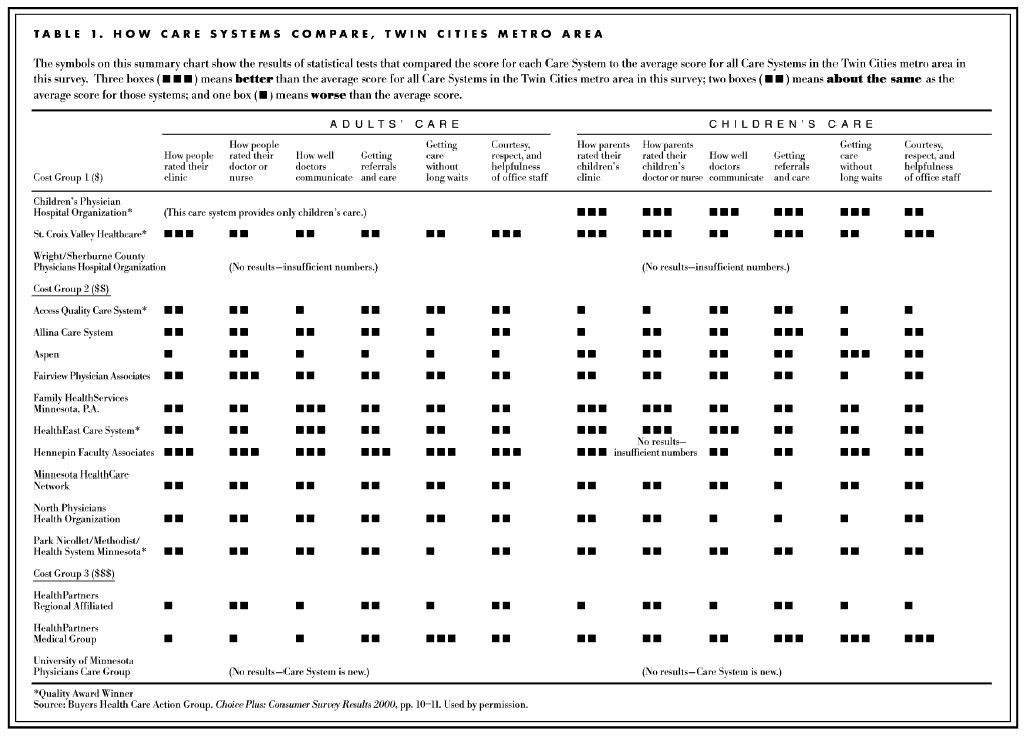
- The Buyers Health Care Action Group (BHCAG), a coalition of Minnesota's largest employers, established in 1988, operates a unique health care purchasing program in which 28 health care delivery systems contract directly for the care of members' employees. BHCAG's purchasing activities account for 10 percent of the Twin Cities' commercial health insurance market, about 150,000 covered lives.
- General Electric (GE), the corporate leader that "brings good things to life," spends about $1 billion a year on health care services for 700,000 covered lives in the United States. In 1986, GE began using its purchasing muscle to improve the value of those services.
- The Alliance, a Denver-based employer coalition established in 1988, operates a purchasing cooperative aimed at providing an affordable choice of health plans to small businesses. The Cooperative for Health Insurance Purchasing (CHIP) currently represents about 27,000 covered lives and $50 million in annual premiums.
- The Massachusetts Medicaid program administers a $4.5 billion annual health care budget on behalf of 920,000 beneficiaries. Since 1992, the Commonwealth's Division of Medical Assistance (DMA) has been a leader in value purchasing.
- The Department of Defense (DoD) provides and purchases care for 8.2 million active-duty members, family members, survivors, and retirees. DoD is in the midst of reengineering its TRICARE Military Health System (MHS), with a major focus on population health and outcomes management.
- Medicare, the $220 billion federal health insurance program for the elderly and disabled, is striving to develop and implement ways of improving health care value.
Value purchasing is defined in this report as an organized attempt by a private- or public-sector purchaser to ensure quality and to improve health outcomes, as well as negotiating prices, as an explicit part of its health care buying strategy. In simplest terms, value purchasing means "getting the best care for the best price." Quality encompasses not only those aspects of service quality that are frequently reflected in customer satisfaction measures but also technical or clinical quality, for which a multitude of indicators and measures have been developed. These definitions are similar to those in Theory and Reality of Value Based Purchasing: Lessons from the Pioneers (AHCPR 1997). This report defined the concept of value-based purchasing to be "that buyers should hold providers of health care accountable for both cost and quality of care," in contrast to more limited efforts to "negotiate price discounts, which reduce costs but do little to ensure that quality of care is improved."
Findings
Following are the major crosscutting lessons and findings I drew from the experiences of the seven diverse initiatives that we examined for this project, as well as from selectively reported findings and opinions of leading researchers and analysts, where relevant. Participants in a meeting of the principals of the organizations that are the subjects of the case studies (described in more detail below) reviewed, improved, and concurred with these findings.
1. During the past decade, value purchasing pioneers have made significant progress in developing and implementing strategies aimed at improving health care quality and efficiency.
Examples from our case studies include the following:
- After nearly 15 years of using data to drive provider and plan improvement, CFHCC in Orlando is now on the point of launching a unique pay-for-performance model that could revolutionize health care purchasing.
- In Minnesota, BHCAG's efforts to create a system in which providers compete on price and customer satisfaction scores has resulted in some migration of beneficiaries to higher-performing care systems.
- GE has made performance criteria a fact of life for contracting health plans, which are at risk for a significant portion of their administrative fees if they fail to meet agreed-upon improvements.
- In Denver, The Alliance has provided choice at reasonable price to Colorado small businesses.
- In Massachusetts, the Medicaid program has incorporated quality standards and improvement goals into its contracting procedures.
- Medicare has been instrumental in the development and implementation of important new measurement instruments, like the Consumer Assessment of Health Plans Survey (CAHPS) for both fee-for-service and managed care.
- DoD is still in the early stages of its reengineering efforts, but top health care administrators there appear to have fully embraced the tenets of population health and outcomes improvement.
These experiences largely document successes for the value purchasing movement as well as the individual organizations. However, these are carefully selected examples representing different organizational types and extent of experience. The extent of activity and accomplishment in other settings cannot be estimated; almost by definition, there will be much less than seen in pioneering and more experienced organizations such as the ones we studied and other similar substantial efforts.
Leadership is critical to the success of these initiatives, and the energy and commitment that the principals at all seven sites brought to their efforts were impressive. In Orlando, Becky Cherney, who heads CFHCC, noted that "the number one reason why coalitions fold up is that the leader leaves." She recommended developing a training program at the national level so that fledgling or struggling initiatives can benefit from the experiences of others.
2. Despite this activity and accomplishment, there is no standard conceptual or operational definition of health care value.
Typically, definitions of value center on some relationship between the cost of care and the quality or outcomes of care. But it appears that value may be in the eyes of the beholder. Purchasers and consumers, those in the public or private sector, and health plans or providers may approach this concept differently. "Our philosophy is that you inform [consumers] as much as possible and then let them buy according to their value system," said David Wessner, president and CEO of Health System Minnesota. Holding with the more traditional view, GE's Robert Galvin described value as "the highest quality at the most competitive price."
But Alliance CEO Tom Rockers had a more market-based perspective. "Every market is driven by an underlying premise," he said. In Denver, where small businesses form the overwhelming majority of employers, that premise is choice of plans, he asserted. Those purchasers would like to have quality, but choice and cost are more important factors in their equation for value. In keeping with DoD's enthusiasm for population health tenets, Captain John Aguilar believes that value means providing "the right interventions at the right time for the right patient."
A major barrier to reaching consensus on a definition for value is the lack of consensus on a definition for quality. Literally thousands of outcomes measures, indicators of care, and performance benchmarks have been developed to quantify and compare health care quality. The Health Plan Employer Data and Information Set (HEDIS) has become an industry standard in both the public and private sectors, and in consumer and other mass market publications. Its acceptance derives in large part from its standardization and audit procedures. Also notable are the outcome-focused modules that the Foundation for Accountability (FACCT) has produced. The current efforts of the Institute of Medicine and the Leapfrog Group (a coalition of 60 major private and public purchasers) to create incentives for reducing medical errors is an important initiative in technical quality.
Still, many stakeholders prefer to evaluate quality in terms of service and customer satisfaction, which are relatively easy to understand and measure, while others focus on the more elusive technical and clinical aspects of quality. It is still not clear how these differing views may best be balanced, but both will need to be included in future comprehensive measures of value.
Even cost, the other major component in the traditional definition of value, is not as clear-cut a concept as it may appear. Numerous questions relate to cost. For example, what should a purchaser reasonably expect to pay per beneficiary for a defined benefit package? Does value purchasing imply lower absolute costs for health care services or a willingness on the part of the purchaser to accept some standard rate of increase? What are the relative costs of different levels of quality? How do you measure the costs of primary preventive interventions?
The complexity of health care and health care benefits and the presence of multiple stakeholders is certainly one reason why different definitions of value exist. For an emerging field, such wide variation in the underlying concept poses challenges to public understanding and to consistency in measuring and evaluating the effectiveness of the efforts. However, in each of the initiatives we studied, most stakeholders were able to come to some consensus on value that was tailored to their specific purposes. Nonetheless, it would be useful to have greater clarification about what is meant by value or a typology of different value definitions, particularly if work is to continue in developing standard measurements and incentive strategies based on value.
3. Most value purchasing activity is targeted at reducing costs and to some degree improving customer satisfaction, with mixed attention to technical quality or outcomes.
Given this country's enormous expenditures on health care—more than $1 trillion a year—it is hardly surprising that private- and public-sector purchasers are preoccupied with reducing health care expenditures. Businesses see these costs as a threat to their profitability, and in the public sector, high costs cut into other needed investments. In Denver, large employers were instrumental in launching The Alliance, largely because they wanted to prevent cost-shifting from small businesses. One Denver employer, Susan Alt, notes that even consumers are more interested in how premium costs stack up among competing health plans than in quality.
As discussed above, cost is also easier to approach than quality. Purchasers know what costs means to them; they know how to measure and evaluate costs; and they can get data on costs much more readily than they can on quality measures, which remain somewhat amorphous to them. This partly explains why a review of private-sector purchasers and coalitions thought to be leaders in the value purchasing arena found that only a "limited number" were acting in a "bold and innovative manner" to improve quality, with a few "cautious first-step dabblers" (AHCPR 1997). The majority, however, were doing virtually nothing to incorporate quality considerations into their purchasing activities. Other surveys have documented the extent to which information about quality and outcomes is sought by public- and private-sector purchasers, but with quite limited evidence regarding its effectiveness in the purchasing process (Kaye and Bailit 1999; Landon and Epstein 1999; Fraser, McNamara, Lehman, et al 1999; Milbank Memorial Fund 2000).
With premiums rising at double-digit levels after several years of zero to single-digit growth, purchaser interest in costs may increase accordingly, at the expense of quality. Jeremiah Cole of the Massachusetts DMA pointed out that concerns about escalating health care costs are diverting human energy and resources from Medicaid's efforts to improve quality. In response to this latest premium trend, some employers have expressed interest in moving from a defined set of health care benefits toward simply a defined financial contribution, in order to increase employee awareness of the cost of the benefit or to shift responsibility for health care purchasing onto the shoulders of the individual consumer. Others, such as GE, have expressed greater interest in consumer empowerment. These employers believe that supplying consumers with comparative information will enable them to better select among competing plans or providers. Still others argue that new pressures on costs will only push the value purchasing movement forward.
4. The "business case for quality" has not been made.
This finding primarily relates to the impact of healthier workers on employer productivity. There are some true believers out there, but they are few and far between. DoD, for example, is fervent in its embrace of population health and quality improvement principles, which, MHS leaders believe, hold the key to their goals of maximizing health and containing costs. "We're all convinced that this is clearly the most powerful money saver we have," stated H. James T. Sears, M.D., executive director of TRICARE Management Activity (TMA). In Orlando, a consistent message and strong leadership from CFHCC over the course of a decade seem to have resulted in a community-wide belief that better quality costs less. Certainly all of CFHCC's members appear to buy into this philosophy. In Minnesota, too, several employers said they were convinced of the value of quality and its importance in ensuring worker productivity.
But even these advocates say it is difficult to come up with demonstrable proof that what they believe is true. Terry Koves, director of compensation and benefits for Land O' Lakes in Minnesota, which participates in BHCAG, said his company lacks the resources to collect and assess clinical data on quality. And he stated that even if those resources were available, he and his colleagues would be at a loss as to what to do with such data. Said Alt in Denver: "It is very difficult, if not impossible, to make any direct correlation between clinical quality of care and the package of care provided by any specific carrier, and worker productivity. Even the large employers that have done studies that tried to do this have found it quite difficult to quantify."
Few employers are interested in exploring a possible connection between health care, quality of care, and worker productivity—and those that are interested generally want hard data. "Most employers take quality for granted," said Bill Lindsey, an employee benefits consultant in Denver. "They don't have a sense that there is really a big difference from facility to facility in terms of health care quality and outcome, and they are skeptical of the measurement tools that are out there."
This is certainly in part because of a lack of clearcut research evidence; many believe that the empiric literature in this area is quite weak and underdeveloped. James Mortimer of the Midwest Business Group in Health has observed that "we need objective and quantitative evaluation of such efforts to show the next echelon of purchasers outcome results. . . . [We] need clear evidence that quality varies and that purchasers are even buying harmful care to activate the passive purchasers to become value purchasers" (Mortimer 2001).
Some information is being developed for some specific conditions such as depression and back pain, but, in general, analysis rarely evaluates anything beyond absenteeism. One investigator has recently begun important work on "presenteeism" (Burton and Conti 1999), meaning the productivity of those at work, but most employers do not keep such data. The Leapfrog Group is attempting to use empiric evidence, such as data on the impact of computerized physician medication-ordering systems and data on hospital volume, to assess the expertise of providers that perform highly specialized medical procedures. These efforts, as well as those designed to standardize outcome measurements, will be critical in retaining a quality and outcomes component in value purchasing (Chassin 1999; Bodenheimer 1999).
5. We do not know how to structure effective incentive and penalty mechanisms to ensure or improve quality.
Several of the initiatives we studied explored the use of incentives and penalties, with mixed results. For example, GE puts 10 to 25 percent of a plan's administrative fee at risk for performance; better performance results in higher payment, and failure to perform can cost a plan millions of dollars. In 1999, one plan incurred $7 million in penalty payments because of poor performance. In Denver, The Alliance's CHIP experimented with a benchmark program that awarded a bonus to the best overall plan performer. But plans intensely disliked the program, and The Alliance ultimately dropped its use of financial incentives altogether.
In Minnesota, care systems that contract with BHCAG compete for the coalition's annual Quality Award, which carries with it a $100,000 cash award for the system with the best quality improvement program. In Massachusetts Medicaid, where little can be done with payment levels in managed care contracts due to regulatory issues, increasing the volume of patients assigned seemed to be effective for one major provider: "We take their quality improvement goals seriously. . . . [If] We get high scores, we get more members. We want to grow our membership, so we have a built-in incentive to do well." DoD officials are considering whether they can tie improvements in clinical quality to certain promotion decisions.
The success of using financial incentives to improve quality was largely determined by purchasers' clout with their plans or providers. GE has the muscle it needs to play hardball with its plans; in Denver, the CHIP does not. BHCAG has a similar problem in the Twin Cities market and is limited in its ability to collect medical record data from care systems; thus the Quality Awards program is a good way to motivate care systems to take more initiative for improving care.
A core ambiguity running through many efforts to date is the willingness of health plans to translate quality incentives from purchasers into effective quality incentives for providers. As of this writing, CFHCC in Florida is developing plans to launch a unique pay-for-performance model that could help advance our knowledge and understanding of how best to design and implement such mechanisms. But several reviewers noted that the amounts most employers are currently allocating to measuring or rewarding quality constitute a minuscule part of health care budgets and are not sufficient to create strong incentives. GE's Galvin has written that "purchasers must take their market position seriously and work with and demand from health plans a financing structure that rewards high-quality provider organizations" (Galvin 1999).
6. Multiple reporting requirements and concerns about data credibility continue to be issues for providers and plans.
The need for collaborative data collection and reporting is clear, but that is more easily said than done. Distrust among different stakeholders, doubts about risk adjustment methods, and fears related to patient privacy are significant barriers to this effort. There is considerable mistrust of information sources, certainly when information comes from an organization with vested interests in the results. Small employers particularly are "skeptical of small numbers, and don't trust insurance companies providing information" (Nelson, Alday, and Follick 2000).
In Orlando, CFHCC appears to have successfully established itself as a trustworthy source of data and information with health care providers and purchasers. In Minnesota, BHCAG was instrumental with others in helping create the Data Institute, a public-private partnership that is trying to position itself as a neutral, single source of clinical quality and outcomes information for Minnesotans. The Data Institute currently contracts with BHCAG, the state Department of Employee Relations, and the Minnesota Department of Human Services to conduct an annual BHCAG patient survey. Medicare is one of the co-founders of the National Quality Forum, an attempt to standardize measures and reporting systems to reduce the burden on plans and individual providers. Beneath the current layer of issues impeding the use of claims and enrollment data to judge quality lies an even more formidable challenge of sufficiently expanding routinely collected data to permit more adequate quality assessment.
7. Public-sector purchasers are more limited in what they can do with respect to value purchasing than their private-sector counterparts.
Public purchasers face unique political, legislative, and bureaucratic constraints. Of the three public-sector initiatives that we examined, Massachusetts Medicaid has made the clearest progress and has even been able to advance quality improvement in the private sector as well. Rather than trying to regulate quality, the state tries to manage it using contractual performance criteria that hold vendors accountable for specific quality indicators. One Massachusetts public executive remarked that public efforts were more effective than private ones partly because he "saw the governor and key legislators weekly, while a private health benefits manager may not even see the CEO monthly." Indeed, Massachusetts Medicaid has shown that with strong leadership, clear objectives, a long-term, collaborative view, and an understanding of market forces, the public sector can make a difference in health care quality.
DoD has many of these advantages. It is, however, trying to reengineer a health care program that serves many more people: approximately 8.2 million, compared to the 900,000 beneficiaries served by Massachusetts Medicaid. And unlike most Medicaid programs, DoD's TRICARE program is under intense political pressure to keep its customers happy, even if doing so jeopardizes efforts to contain costs. For example, in October 2001, DoD will have to extend and expand benefits for retirees over age 65 (including a prescription drug benefit). "The problem is that the whole Department of Defense budget is considered a discretionary budget within the federal government," explained Paul Kearns, of TRICARE's Resource Management office. "It's not an entitlement, like Medicare or Social Security. But [the Military Health System] is an entitlement program within a discretionary budget." Nevertheless, DoD has demonstrated that it is serious about population health and outcomes management, and TRICARE officials point to "pockets of excellence" that they hope to duplicate throughout the MHS.
The federal Health Care Financing Administration (HCFA, renamed the Centers for Medicare & Medicaid Services, or CMS, in June 2001), which administers Medicare, is probably the most fettered of the public agencies that we studied. Because Medicare is a public entitlement that provides both insurance and health services for 38 million beneficiaries, it is accountable to many masters, including Congress, beneficiaries and their advocates, and about 1 million providers and suppliers that participate in the program. It makes major investments in quality protection and improvement efforts. Yet the requirement to not be accused of arbitrary decisions so understandably permeates the HCFA culture that transitioning from a "pay the claims" environment to that of a purchaser is difficult. Although Medicare ought to be the 800-pound gorilla of health care purchasing, political and bureaucratic realities prevent HCFA from accomplishing much of what it is seeking to do and from raising its health care purchasing strategies to a higher, more competitive level.
8. Few purchasers command enough volume on their own within a given market to be effective value purchasers.
GE is a rare example of a large corporation that has sufficient leverage to demand some accountability from its health care contractors in a few locations. In Minnesota, BHCAG is acutely aware that it needs to increase its value purchasing market share from 10 percent to 50 percent if this strategy is to have a viable future. Lacking a "relatively substantial part of market share, you can't keep the [care] systems engaged," said Steve Wetzell, BHCAG's former executive director. Similarly, in Denver, the CHIP is trying to expand its enrollment levels from about 3 percent to 10 or 15 percent of the highly fragmented small group market. With that kind of enrollment, "we'd become an important customer" to insurers, said Rockers.
Some of these problems could probably be overcome with greater collaboration between the public and private sectors at the municipal or state level, but so far little collaboration has developed. The active, unfettered participation of Medicare would add tremendous momentum as well, but, as noted, HCFA in many respects has its hands tied. Some collaboration is underway, mainly in the area of patient safety measurement and standardization, in which the Leapfrog Group, the National Business Coalition on Health, and HCFA are involved.
9.The health plan as the organizational level for value purchasing has significant limitations.
Purchasers often contract with health plans, but many providers have relationships with multiple plans. This limits the opportunity for purchasers to identify and reward high-quality and lower-cost providers. BHCAG's approach to dealing with this problem is to contract directly with care systems. In addition, BHCAG stipulates that individual primary care providers can contract with only one care system, to ensure differentiation among systems and meaningful measures of quality. But measuring quality at the provider level is not without challenges of its own, and BHCAG leaders have been severely hampered by the small numbers of patients that a given system represents and by state laws that limit their ability to collect clinical data.
In Orlando, Cherney said that "physicians are driven to be good. . . . [I]f the data show for some reason they aren't, then they want to know why." This belief has led CFHCC to launch a pay-for-performance model that will pay higher fees to physicians who deliver the best clinical outcomes. CFHCC leaders are enthusiastic about the idea, and it will be interesting to see how it fares in implementation.
A leading quality-of-care researcher has observed that there is "considerable doubt about the most effective and appropriate level for reporting performance data and degree of risk adjustment required to achieve balance of cost-effectiveness and fairness to providers" and that the "use of public performance data by consumers and purchasers for regulatory purposes will remain less important than use of data as catalyst for organizational performance at the organizational provider level" (Marshall, Shekelle, Leatherman, et al. 2000).
Another level of disconnect has to do with decision-making and the interests of purchasers versus those of consumers. Most purchasers contract with health plans, not directly with providers. Consumers who have a choice of health plans obviously have a decision to make at that level as well, but consumers tend to focus more on their relationships with their providers than with their insurers. Numerous moves are underway to better educate consumers so that they can make more informed decisions when selecting both health plans and health care providers. HCFA, for example, has a Medicare beneficiary education program. In the private sector, GE is refocusing its value purchasing efforts around consumer empowerment and is relying on computer-based technologies to educate and inform employees. While performance reporting that is dominated by individual providers is more meaningful to consumers and free of the obscuring effect of merging data from multiple providers, it faces major cost and interplan collaboration hurdles.
10. Professional resistance to comparisons based on quality or costs can be a serious obstacle to purchasing initiatives.
This has been true since HCFA launched its hospital mortality reports in the 1980s. Measuring, comparing, and publicly reporting on clinical quality at the health plan or provider level is inherently controversial. For the people who are under the microscope, the stakes are high, both financially and professionally; when sufficiently threatened, they may very well take action to protect their interests. In Denver, for example, a health data commission that initially collected information on hospitals was dissolved by the state legislature when the commission tried to expand its purview to health insurers, who opposed that plan. As mentioned earlier, the CHIP's efforts in Denver to reward contracting plans that demonstrated superior quality failed because the plans objected to the financial commitments required of them. Rockers' take on this was that "change will never come from within the health care system." He believes it must come from outside.
A recent study of the use and effectiveness of report cards stated that "most providers would probably prefer not to be subject to such comparisons, and if the opportunity arises, some will probably try to weaken performance assessment efforts or incentive programs" (Wicks, Meyers, Ryboyski, et al. 1999). Another researcher stated that "vested business interests may feel threatened by formal evaluation of an area in which there is considerable business potential." In a recent New York Times article on Medicare reform efforts, a senior AARP official was quoted as saying that "people are making so much money off the health care system that any effort to change it runs into very well financed opposition." A recent Harvard Business Review article presented evidence that cheaper, effective innovations in medical technology have difficulty finding venture capital funding since they may challenge more expensive and profitable existing products (Christensen, Bohmer, and Kenagy 2000). As benefits and financing from both public and private sources have increased, academic observers have also chronicled how American physicians and hospitals have usually been quite successful in avoiding significant regulation and performance monitoring.
Yet some initiatives that have sought to work collaboratively with health plans and providers and to address their issues have made progress. At this point, CFHCC does not publicly release comparative data, although it does make data available to purchaser members. Under its new "pay-for-performance" model, providers will be grouped into one of three "tiers" of quality, and that information will be made public. What seems to have worked well for CFHCC is its focus on producing data that helps providers improve quality themselves. "We are just information brokers," said Cherney. "We get good information, we check it out, we give it to the physicians, and they make improvements."
It is possible, too, that advances in measurement, standardization, and risk adjustment eventually will make these types of initiatives more palatable to the industry. In addition, if the consumer education movement gains momentum, plans, providers, and purchasers alike may have to respond to new demands by consumers for credible, comparative information on quality.
11. Value purchasing may be enhanced by "pay-for-performance" developments in other sectors.
While not specifically addressed in these case studies, this parallel movement could help create a general climate that would help in these health care efforts. This is currently the case with regard to education, with multiple efforts at outcomes measurement and standardized testing, and the introduction of financial rewards for positive performance. Such efforts are not without controversy—over the nature of the standards, teaching to the measures, and even fraud when incentives are high. But the understanding that we need to achieve outcomes from what we put into the education system, as well as into environmental policy, has growing acceptance, and this may spill over into other areas of public concern, such as health care.
12. Appreciation of the nonmedical determinants of health and the role that they play in population health is limited.
This is not surprising, in view of the fact that medical care delivery is the primary focus of health care purchasing. On the other hand, there is increasing general recognition of the role of multiple determinants (such as socioeconomic status, the environment, and lifestyle choices) in producing health outcomes. Although no single organization or sector of society can take full responsibility for these outcomes, someone could take the lead in trying to improve them. We saw two examples in our case studies. In Florida, the "Open Airways for Schools" program implemented at 42 schools in six counties is teaching children with asthma and their parents how to better manage this condition. The program is credited with helping to raise school attendance by 19 percent and with helping asthmatic students improve their grades by 8 percent. The Air Force Medical Service reduced rising suicide rates in its active-duty population after putting together an "integrated product team" that used a coordinated, nonmedical approach involving medical personnel, security officers, and counselors. This successful approach is being deployed within other areas of the MHS.
These examples reflect a commitment to a broader, more holistic definition of health than is frequently seen. While it is not reasonable to expect the medical care sector to assume full responsibility for these broader determinants of health, a commitment to value purchasing in its broadest definition from a sector with such extensive resources and power presents great opportunity, if not responsibility, for leadership and influence.
Next Steps
The principals whose experiences are documented in these seven case studies, along with the case writers and several other experts, met in October 2000, to review the evidence and draw conclusions that might be useful to other public and private policymakers. After reviewing the major lessons and findings from this project, they made the following recommendations as "next steps" that could be taken by public and private organizations interested in advancing the value purchasing movement.
The most enthusiasm was expressed for an effort to stimulate and provide financial assistance for demonstration projects to facilitate collaboration and coordination among public and private purchasers in several local markets. The desired result would be consensus on common approaches to value purchasing, going beyond the current "three-way" discussion on common approaches to patient safety by HCFA, Leapfrog, and the National Business Coalition on Health. This effort could begin by reviewing the Midwest Business Coalition document on public-private collaboration in purchasing. It might also lead to the development of standard definitions or concepts of value, perhaps from the perspective of different stakeholders, such as consumers, providers, and purchasers.
Other suggestions included the following:
- Stimulate increased public and private funding on research regarding the business case for quality, clearly demonstrating its impact on productivity and other valuable outcomes. Determine the "proof of impact."
- Advocate for a national effort to counter the myth that health care quality is not a problem, and increase awareness of variation in quality and patient outcomes.
- Assist regional and public medical schools to become agents of change to improve health care value.
- Assess the status of the "followers" in the value purchasing movement. How can the lessons of value purchasing be effectively disseminated to and adopted by those who are not pioneers in the movement?
- Find ways to assure that information provided or marketed to consumers—such as that used to promote certain prescription drugs, plastic surgery, and alternative medicine—is accurate and appropriate. Find ways to correct misinformation, especially on the Internet. Find ways to engage consumers and to make complex information understandable.
Conclusion
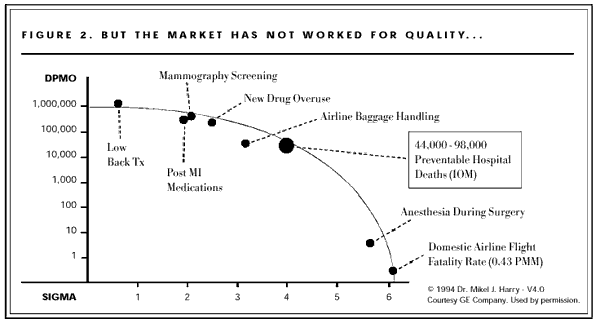
Although medical care is not the only determinant of health, it is a critical one that represents substantial expenditures. Thus, harnessing the efforts of purchasers who are looking beyond their bottom lines to improve health care quality as well as efficiency is quite appealing, and according to the 1998 and 1999 Institute of Medicine reports, it is essential for conquering today's epidemic of quality failure.
The efforts described in these case studies demonstrate enormous energy and dedication on the part of purchasers and providers in various segments of the U.S. health care system. Some of the preliminary successes are inspiring: the migration of some Minnesota enrollees into lower-cost and higher-performing health systems; GE's business approach to improving health plan quality; enrollment gains for Massachusetts Medicaid plans that have better performance ratings; in Orlando, community-wide recognition that better quality saves money; and HCFA's rewarding of performance in treating congestive heart failure. These developments are positive and give weight to the view that, with more time and experience, value purchasing could be a significant driver for better health care in the United States.
But perhaps these pace-setting examples are merely outliers that reflect idiosyncratic environments, histories, and individual efforts. If that is true, it could be argued that only limited concrete progress has been made by the value purchasing movement, with most of the focus on the cost side of the equation and very little on quality and outcomes. If this is the case with the industry's leaders, what then is happening in the rest of the system, where presumably less attention is being paid to this issue? Perhaps the measurement challenges are so great and the value attached to outcomes and quality so limited that efforts such as these will remain marginal.
There is a third possible interpretation of these experiences: that these initiatives are still in their very early development and need more time to mature. Could a decade of improvements in measurement and standardization, combined with new lessons from additional performance improvement experiments, change the picture of value purchasing? Could the current success of the Institute of Medicine and Leapfrog coalition at bringing significant public attention to patient safety and medical errors spill over into other quality and outcome areas as well? Could a "tipping point" be achieved in which paying for health care performance becomes the norm? Could creative use of the Internet and advances in consumer education and reporting foster a new generation of consumers equipped to be their own value purchasers?
It is unclear whether or when the initiatives we studied will deliver the big improvements that we are all looking for. In the meantime, they are moving ahead. The challenge of producing significantly better health outcomes for the money we spend remains substantial. Value purchasing is in the early phases of development. Private and public policymakers could be embarking upon a decade of intense investment in refining, expanding, and disseminating best measurement and incentive practices, such as those illustrated here. Particularly compelling are opportunities for public and private collaboration to reduce fragmentation and consolidate value purchasing power in health care markets. At the same time, however, it is necessary to recognize and fully understand the barriers to value purchasing. Vast resources are being spent on health care. The seven case studies in this report exemplify the challenges of enhancing accountability for that spending.
References
AHCPR (Agency for Helath Care Policy and Research). 1997. Theory and Reality of Value Based Purchasing: Lessons from the Pioneers. AHCPR 98–0004. Rockville, Md.: Department of Health and Human Services.
Bodenheimer, T. 1999. The Movement for Improved Quality in Health Care. New England Journal of Medicine 340(6):488–92.
Burton, W., and D. Conti. 1999 The Real Measure of Productivity. Business and Health (November):34–6.
Chassin, M. 1999. Is Health Care Ready for Six Sigma Quality? Milbank Quarterly 76(4):565–91.
Christensen, C., R. Bohmer, and J. Kenagy. 2000. Will Disruptive Innovations Cure Health Care? Harvard Business Review (September–October):102–12.
Fraser, I., P. McNamara, G. Lehman, et al. 1999. The Pursuit of Quality by Business Coalitions: A National Survey. Health Affairs 18(6):158–65.
Galvin, R. 1999. An Employer's View of the U.S. Health Care Market. Health Affairs 18(6):166–70.
Kaye, N., and M. Bailit. 1999. Innovations in Payment Strategies to Improve Plan Performance. Portland, Me: National Academy for State Health Policy.
Landon, B., and A. Epstein. 1999. Quality Management Practices in Medicaid Managed Care. Journal of the American Medical Association 282(18):1769–75.
Marshall, M., P. Shekelle, S. Leatherman, and R. Brook. 2000. The Public Release of Performance Data. Journal of the American Medical Association 283(14):1866–74.
Milbank Memorial Fund. 2000. Better Information, Better Outcomes? The Use of Health Technology Assessment and Clinical Effectiveness Data in Health Care Purchasing Decisions in the United Kingdom and the United States. New York.
Mortimer, J. 2001. Personal communication.
Nelson, D., S. Alday, and M. Follick. 2000. Teaching Small Employers to Buy Value. Business and Health (July/August):30–5.
Wicks, E., J. Meyer, L. Ryboyski, et al. 1999. Report on Report Cards: Initiatives of Health Coalitions and State Government Employers to Report on Health Plan Performance and Use Financial Incentives. Washington, D.C.: Economic and Social Research Institute.
The Central Florida Health Care Coalition:
Using Data to Empower PurchasersIntroduction
Created in 1984, the Central Florida Health Care Coalition (CFHCC) is one of the oldest and largest health care coalitions in the country. With hard data as its primary agent for driving change to improve health care quality and cost-effectiveness for its employer members, CFHCC has made significant differences in how health care in the Orlando market is delivered. According to its leaders, CFHCC has succeeded in garnering more than $300 million in savings at the hospital level as a result of its quality improvement initiatives. Examples they cite include:
- A substantial reduction in the rate of cesarean sections performed in the community, from 36 percent in 1989 to 18 percent by 1998, well below the national average of 22 percent.
- A dramatic improvement in the rate of kidney failure at area trauma centers to just 1 percent—again, far below the national average of 20 percent.
- A simple procedural change in how instruments for hospital surgical trays are selected, resulting in dramatic savings.
- Educational campaigns designed to show physicians more cost-effective methods for treating common illnesses like upper-respiratory infection.
Improving quality has always been at the core of CFHCC's goals. The organization's philosophy is simple: improving the health care delivery system is the only way to improve quality and contain costs. The Coalition operates on the premise that information drives change. And information, coupled with healthy professional competition among peers, can affect how health care is delivered. These changes, in turn, lead to cost savings.
"We are just information brokers," said Becky Cherney, president, CEO, and founder of CFHCC. "We get good information, we check it out, we give it to the physicians, and they make it [quality improvements] happen." According to Cherney, those who focus solely on curtailing health care costs are likely to always be fighting the same battle. Securing discounts and increasing co-pays merely shift costs without any real effect on the health care delivery system.
This case study reviews how and why the coalition was created, describes in detail how the coalition functions, offers insight into the impact it is having within the Orlando health care community, and details the Coalition's plans. The case study is based on several interviews with public and private employers, coalition members, and health system representatives involved with the Coalition, as well as interviews with Cherney and John B. Hanson, chairman of CFHCC and director of benefits for the Orange County Public Schools.
How the Coalition Started
Despite the Coalition's current focus on changing health care delivery practices, escalating costs supplied much of the initial impetus for creating CFHCC in 1984. At the time, the annual rate of increase for health care costs was in the double digits, and benefits managers found it difficult to determine what kind of value they were getting for their money. A group of benefits managers from 52 major employers in the region met to discuss their quality and cost concerns, and from there the Coalition was born.
The Coalition started with ten charter members. Today it comprises more than 124 major employers representing more than 1 million covered lives, about one-third of the employees in Orlando's commercial market. The Coalition is unique in that its members include both public and private entities with business interests that range from space technology to the world's most famous theme park to community schools and administration. Members of the Coalition include Orange County Public Schools, Walt Disney World, Universal Orlando, the City of Orlando, Lockheed Martin, and SPRINT—to name just a few.
The Coalition works with two large health care systems that have 14 hospitals in the Orlando area to improve health care delivery: Orlando Regional Healthcare and Florida Hospital Healthcare System. It also works with two smaller independent hospitals. In addition, ten health plans were assessed in a 1998 consumer survey initiated by the Coalition.
Although self-insurance is not a requirement for participation, nearly all CFHCC members are self-insured. Membership is not limited to employers: anyone who works in health care is welcome to join, but the major employers are the only ones with voting rights.
The Coalition started simply by looking systematically at hospital records. In the late 1980s, it moved to encouraging provider use of more sophisticated data-collection systems and has continued to expand its quality measurement programs ever since. According to Cherney, once the Coalition started obtaining data on certain medical procedures, members were shocked to see the disparity in care services provided. For the first time, physicians were able to see how they compared to their peers in providing care.
For example, physicians could compare themselves with their peers in terms of the number and type of lab tests they ordered for pneumonia and the effect it had on care. In another instance, members discovered there was a huge difference in the use of anticoagulants and the ordering of arterial blood gas studies and x-rays among physicians doing coronary artery bypass grafts.
Data provide the Coalition with leverage in the local health care market. "We all have the same objective: to control costs and provide quality care. That's what all of us want," said Sue Steck, director of benefits, payroll, and records for Universal Orlando. "By throwing our efforts together, we've been able to do that. You get the attention of the hospitals, in particular. None of us could do that isolated by ourselves. Being a Coalition member gives us that clout. They know they have to respond to us. They understand the power that sits around that table."
According to Beth Rudloff, director of case management with Orlando Regional Healthcare, the fact that the hospital system presents outcomes data to prominent employers is a strong motivator to continually improve outcomes. "We present information to the Coalition every six months. There are some indicators that need additional focus or show an opportunity to improve," said Rudloff. "When you are presenting this information to Disney or the government, you can't ignore it. We meet with medical staff and spend a lot of time trying to figure out what we need to focus on to improve patient care."
Companies have various reasons for joining the Coalition. In 1987, Hubbard Construction joined because it wanted better quality and administration from its health plan. At the time, the company's employees' biggest complaints centered on their group health insurance plan. Hubbard Construction turned to the Coalition for help in choosing a new plan. "We spend a lot of money on insurance," said Margaret H. Collins, personnel director for Hubbard, a heavy construction firm with 1,500 employees. "We joined the Coalition so that we would know what other people are doing, where they are, and how they are handling all these major problems we're having."
Collins also noted that the company was impressed to see procedural changes being implemented by both Florida Hospital and Orlando Regional Healthcare and their providers in response to data presented to the Coalition. She credited the Coalition with providing incentives for hospitals to focus on areas in which they could cut costs and improve quality.
Universal Orlando joined the Coalition to help raise the overall health care standard in the community. "I look at the Coalition from Universal's perspective—not as much what it can do for us as a company, but what we can help do for the community," said Steck. She believes that improving hospital procedures will help everyone in the community, and that is important in a tight labor market where everyone is vying for the same employees. In addition, like many large employers in central Florida, Universal Orlando feels a certain commitment to the surrounding community.
Although the reasons for joining are varied, Coalition members share the common goal of controlling health care costs while also providing quality health care. Members agree that the Coalition is helping to raise the level of quality health care offered in the central Florida region—not just the care provided to Coalition members' employees. If physicians improve the way they practice at area hospitals, then all patients benefit, not just those whose employers participate in the Coalition.
The Orlando Market
Orlando, with its amusement parks and ubiquitous entertainment billboards, is widely considered to be "anywhere" USA. Virtually every advertiser has a billboard in town. The area is home to an extremely sophisticated and competitive hospitality industry—including, but not limited to, Walt Disney World, Universal Orlando, and SeaWorld—that caters to tourists and locals alike. These organizations are major employers in an area that boasts an unemployment rate of just 2.6 percent. As a result, in addition to competing for tourist dollars, local businesses are also competing for employees. And strong health benefits packages have become key bargaining chips.
According to area business leaders, those bargaining chips are expected to become more valuable as tight labor market conditions continue. The Economic Development Commission of Mid-Florida estimates that Orlando, with a population of 1.5 million people, will be one of the nation's faster-growing areas through 2008. Starting in 2003, a Watson-Wyatt study predicts there will be approximately 30 percent fewer entrants into the workforce. "If you're paying about $50 to get into Disney, and there is no one there to run the teacups, then that's a problem," said Cherney. At least one employer, Universal Orlando, is considering offering health benefits to part-time employees as a way to draw new employees from its competitors' ranks.
Orlando also boosts a mature managed care market, with 65 percent managed care penetration. It is home to the two significant hospital systems noted earlier: Orlando Regional Healthcare and Florida Hospital Healthcare System. And virtually all of the major insurance carriers have a presence there.
The fact that CFHCC has been in successful operation for 17 years demonstrates that health care is a focus for the Orlando business community. Employers care about quality health care for several reasons:
- As a way to draw new workers
- To ensure that current workers remain viable and productive
- As a way to offer a benefit back to the overall community
"Health benefits are important in hiring," said Collins, adding that current worker productivity is just as important. "If you can't hire more people, then worker productivity becomes a very important issue. We need to keep these people healthy." Investing in long-term wellness programs, however, is not always practical in a market where the workforce is extremely young, with a median age of 35.4, and transient.
How the Coalition Operates
Unlike many health care coalitions throughout the country, CFHCC does not attempt to negotiate price discounts on behalf of its members, although the Coalition plans to take that step in the near future. Instead, CFHCC has focused on improving health care by encouraging its providers to review data comparing physician, hospital, and plan performance in relation to specific conditions and procedures, such as cesarean-sections, open-heart surgery, and pediatric asthma. In this way, employers can see what they are getting for their money.
In addition, the Coalition measures consumer satisfaction with the Consumer Assessment of Health Plans Survey (CAHPS) and is attempting to measure outcomes in outpatient settings.
The Coalition uses three major data-collection and analysis tools—the outcomes measurement modules developed by CAHPS, and the MediQual/Atlas and MEDecision data-collection systems—to measure quality at the health plan, hospital, and group practice and physician levels. The Coalition uses all three systems in an attempt to balance clinical outcomes, satisfaction data, and cost information.
MediQual/Atlas, a data-collection system available for hospitals to use in trying to improve quality of care, is based on clinical findings and is severity-adjusted. Fifteen of CFHCC's hospitals use the system, allowing CFHCC to "compare apples to apples," and to unify standards among all its members. The system allows the Coalition to compare participating hospitals to others across the country, to determine how individual physicians measure up against their peers, and to provide information on charges per patient case. These data are then used to determine where improvements should be made and to track the effect of improvements being implemented.
Using these and other data systems, hospitals have developed a four-quadrant chart to show doctors how they compare to their peers in terms of length of stay and costs in relation to specific diagnostic-related groups (DRGs). The purpose is to help everyone improve on performance.
In addition, the data can call attention to specific practices that can improve quality. For instance, in 1997 providers noticed that the overall number of trauma center deaths from renal failure was at the norm, but that it varied among physicians. The data showed that the renal failure rate depended upon the amount of hydration given to trauma patients upon admission to the ICU. When all trauma patients were routinely hydrated, the renal failure rate dropped well below the national norm.
Orlando Regional Healthcare and its physicians take the Coalition and its goals seriously. As director of case management, Rudloff works directly with the business systems team leader to determine how they can use data systems to work with their physicians to improve outcomes and costs. "We are a very data-oriented organization that has been working on this for ten years altogether," said Rudloff. "What the Coalition has done for us is provide an incentive to continue down the same path. For example, Orlando Regional Healthcare focused on bypass surgery five years ago and improved cost and quality. They are looking at the data again today to see if additional improvements can be made."
Rudloff said the organization's data-collection efforts are part of a physician-driven process: physicians want to know how they are performing against their peers. The presentation of physician performance and profiling data is extremely important in gaining their attention and buy-in. "They want as many details as possible. They don't like to hear only that their costs are higher or lower. They want to know why," said Rudloff.
Orlando Regional uses the MediQual/Atlas system. But while the system is a good tool for global comparisons, it is not as useful for comparing local data, according to Rudloff. For example, Atlas can show a global charge per case but cannot break it down into individual lab tests or other charges that would tell the hospital system where reductions need to be made. If the hospital's charge per case for pneumonia were $1,000 more expensive than the norm, Atlas would not be able to show whether the drugs used were more expensive or if the hospital was ordering more tests than normal. As a result, Orlando Regional relies on three separate data-collection systems: Atlas, Fathom, and Explore. Orlando Regional provides information to its physicians on how they compare overall and gives them detailed data on variance from the norm. The physicians then meet to determine what actions to take to improve care.
Outpatient Survey
In addition to collecting inpatient data, the Coalition piloted a project to study outpatient data. The project was spurred by the documented fact that huge variations in medical care exist across different geographical sites. The Coalition developed a system to measure care in the office setting, providing data never available before, and a way to improve outcomes in outpatient settings.
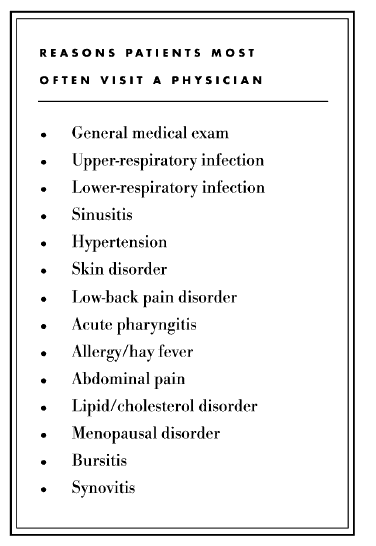
The 18-month pilot project compared claims data provided by two large area employers: Orange County Public Schools and Universal Orlando. As part of the study, the Coalition identified the top reasons people went to visit a physician and collected data on charges per episode (see box).
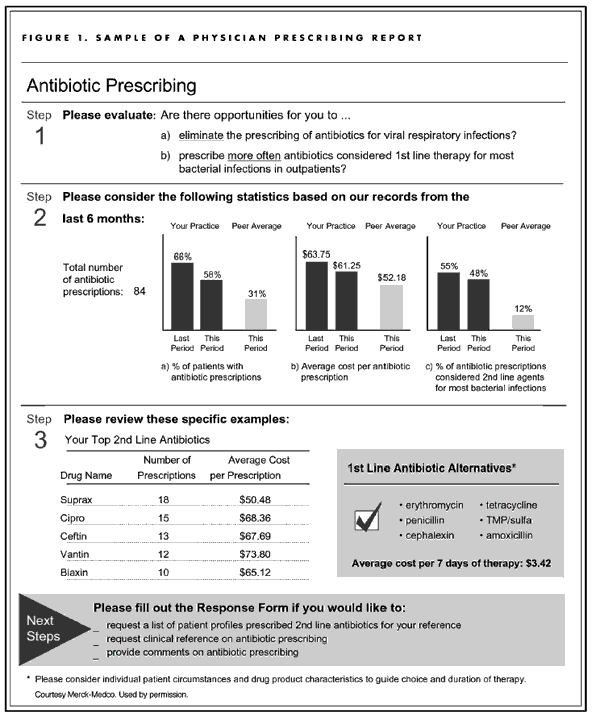
The Coalition is using this information to show physicians the most cost-effective treatments for specific conditions. Cherney offered the example of treating for upper-respiratory infection. In one three-physician practice, surveyers found that when upper-respiratory infection was diagnosed, more than half of the time two of the three physicians would prescribe an antibiotic, even though the condition does not require such treatment; many times the patient insisted on getting an antibiotic even though it was not clinically necessary. The third physician had a much lower rate of prescribing antibiotics for the same condition. She would give her patients prescription antibiotics only by postdating the prescription by three days. If the symptoms persisted that long, it meant the patient had likely developed a secondary infection, which is treatable by antibiotics. She found most patients never needed the prescription and did not use it. Based on this information, the Coalition launched an education campaign—targeted at physicians and members—regarding treatment for colds.
CAHPS
The CFHCC also uses the CAHPS survey to measure patient satisfaction. CAHPS is the survey instrument used by the National Committee for Quality Assurance (NCQA) and the Medicare+Choice program. In 1998, 11 of the Coalition's members participated in the survey, along with ten health plans.
Although the purpose of the survey is to measure patient satisfaction, the Coalition has added questions aimed at monitoring the overall health status of the community and gathering information on specific diseases. According to Cherney, employees' satisfaction levels with their health plans are a major concern. "If you're spending hundreds and millions of dollars [on health benefits] and your employees are still mad at you, you've got a real problem," said Cherney.
Incentives
Monetary incentives have not been part of the Coalition's arsenal in terms of getting providers, hospitals, and health plans to focus on improving quality of health care—although this is about to change with a "pay-for-performance" system the Coalition plans to implement. Instead, the Coalition has relied on a variety of incentives tailored for each group. These indirect incentives include: peer pressure, competition, delivery changes that yield cost savings, a reliance on an employer's commitment to the community, and the use of data and information together with guidelines as a tool for sparking change.
Incentives for Physicians to Improve Their Practice
Most of those interviewed for this case study agreed that physicians have driven the majority of outcomes improvements. According to Coalition members, physicians have responded keenly to peer pressure and the need to excel in their field. At the beginning of the data-collection process, physicians were not eager to participate, but once they started receiving information on how they practiced comparing them against their peers locally and nationally, they wanted to continue receiving this information—and they wanted additional details.
"Physicians are driven to be good," said Cherney. "They've come to believe that they are the best, and if the data show for some reason that they aren't, then they want to know why."
Physicians use these comparisons to demonstrate to managed care companies why they should be on their panels and also to affect their medical malpractice premium rates. If they can provide data demonstrating how well they practice, they may be able to lower their premiums.
If a particular physician demonstrates persistent and serious quality problems, the situation is handled at the hospital level. For example, if a physician places in the bottom quadrant of the chart in relation to outcomes, the hospital medical staff will analyze the data and work with that physician to improve performance. If the physician's performance does not improve, he may be asked to leave the hospital staff.
The proposed pay-for-performance model would strengthen this incentive for physicians to improve their practice, said Cherney. For example, physicians willing to treat employees with chronic illness could receive higher reimbursements. "It makes sense to get our sickest employees to our best-performing physicians," she added.
Incentives for Employers
Employers offer a variety of reasons why it is beneficial for them to belong to the Coalition:
- The Coalition provides a wide range of claims data that employers would not be able to obtain on their own.
- Belonging to the Coalition gives employers the clout to continue seeking quality and cost improvements. The area's two largest hospital systems cannot ignore Orlando's largest employers.
- By working to improve quality and the overall health of their employees, employers hope to ensure that their workers will be able to continue working and lose less time on the job. These issues are extremely important to employers struggling to retain and recruit employees in what is projected to be one of the country's tightest labor markets.
- Through the empirical data provided by the Coalition, employers are able to compare outcomes and health plans, providing them with concrete information on what they are getting for their money when they purchase health benefits packages on behalf of their employees.
- Coalition members are convinced that quality improvements, and working to change health care delivery practices, will naturally lead to lowered health care costs. In the words of one member: "If you don't have the quality, then it's going to cost you more."
- The Coalition offers members an opportunity to share and understand what their colleagues are doing in terms of trying to improve quality and control costs. It is a networking opportunity.
- The Coalition offers large employers committed to the Orlando area a way to help improve overall health in the community, and to continue their tradition of finding ways to improve overall community life.
- Participation in the Coalition can demonstrate to employees that their employer is actively working in their best interest.
Coalition members believe that CFHCC is helping them achieve cost savings, but only because quality is the primary focus. It is a belief that does not appear to be widely held by businesses in general, but it is one that Coalition members swear by. Unless quality concerns are addressed first, then true cost savings will never be achieved. "If you can get quality down right and make it efficient, then price will follow," said Collins.
She also noted that simple procedural changes made by hospitals—changes that don't necessarily have to do with patient outcomes—can result in enormous savings. For example, providers found that every time a physician asked for an instrument to be included on a surgical tray, that instrument would most likely become a standard piece of equipment for future trays, regardless of whether it was necessary for the surgery being performed. After encouraging hospitals to address their surgical costs, physicians limited the number of instruments for a tray to those used routinely for 90 percent of operations. Tray costs were cut significantly, freeing those dollars for other uses. Standard surgical tray costs decreased, and the trays became easier to work from.
In addition, the Coalition has established several programs aimed at helping to improve the health of the overall community. They include programs targeted to new mothers as well as an asthma awareness program. In the "Amanda the Panda" program, the Coalition distributes a free series of 13 pamphlets to all new mothers, providing information on caring for the baby. The "Open Airways for Schools" program has been implemented at 42 schools in six counties and in 2000 alone identified more than 800 students with asthma and taught them and their parents, about the disease. The program is credited with helping to raise attendance in 1998 by 19 percent and helping students with asthma improve their grades by 8 percent. There are currently 40 schools on the waiting list to participate in the program.
Obstacles to Creating a Successful Coalition
Like other employer health coalitions, CFHCC has experienced its share of growing pains and dealt with difficult issues such as leadership, financing, and member recruitment.
For example, during the period 1990–1992, when Cherney stepped aside, the organization experienced a loss in membership. Furthermore, funding for data-collection activities was not always adequate, and there was a period when some members felt they were not getting much value for the dues they were paying and left the Coalition.
Cherney argues that small, struggling coalitions will never get off the ground without strong leadership. "The number one reason why coalitions fold up is that the leader leaves," said Cherney. "The national movement needs to have a training program. And we need to work with smaller coalitions and the shining stars." For example, she said, if a community such as San Jose wants to create a coalition, then an organization such as the highly successful Pacific Business Group on Health should be brought in to mentor.
Loss of leadership or the withdrawal of a key coalition member can lead to a coalition's demise. High CEO turnover is not unusual at large companies, and for a business coalition that depends on continued participation and support of its members, that can mean instability.
Coalitions also need to have size if they are to have clout in their markets. Cherney argues that regional purchasing coalitions like CFHCC can have a much greater impact on their markets than smaller coalitions that wield less influence.
Other obstacles to creating and maintaining a successful coalition include inadequate financing and member recruitment. The Orlando Coalition found that dues alone could not support all of its activities. So the organization now operates on a budget that consists of dues, grants, and other money-generating events. In fact, dues represent the smallest part of the Coalition's operating budget. Instead the Coalition survives through contributions and funds generated through conferences, grants, and partnerships with pharmaceutical companies.
Cherney pointed out that recruitment is an important activity for a coalition that's just starting out, but that it should not be the focus of a more mature organization. "We're not in the business of constantly reaching out. My focus is on keeping all the projects that we have going," Cherney said. "In the last four or five years, we've gained a status where people come to us. Besides, the ones that you try hard to recruit are the ones who may balk if they do not see a return on their investment immediately."
Looking Ahead
CFHCC has plans to make two significant changes to its operations within the next two years: a move to direct purchasing on behalf of its members, and the creation of a three-tier reimbursement system for physicians based on their overall outcomes.
Cherney expects that the move to direct purchasing will not take place before 2002. At that time, the Coalition would likely begin by covering an estimated 10,000 to 15,000 lives, offering perhaps four or five product choices. The Coalition will also establish a payment structure under which charter members will receive some type of cost break for their role in creating the new system.
In addition, in an effort to secure even greater quality improvements, the Coalition plans to establish a multi-tier performance rating system that would pay physicians according to patient outcomes. As part of the new pay-for-performance system, physicians would be profiled on their treatment of ten conditions Coalition members say are currently the most costly and debilitating for their employees: lower-respiratory infection; sinusitis; hypertension; lipid/cholesterol disorder; abdominal pain; chest pain; low-back pain; diabetes; depression; and ischemic heart disease/angina.
Do Employers Truly Value Quality? Or Are Cost Savings the Bottom Line?
What became evident through interviews with members of the Coalition is that they truly believe that the provision of high-quality health care is the only way to control health care costs. Some key questions remain, however. Do employers really care about the overall health of their employees and those living in the surrounding community? If improving quality did not translate to lower health care costs, would employers still be interested in value-based purchasing?
Coalition members differ in their answers. At Hubbard Construction, where some employees have devoted all of their working years to the company, health is a high-priority issue. In addition to participating in the Coalition, the company tracks the conditions that are most likely to affect members of their workforce and offers either information regarding these conditions, screening tests, or preventive equipment. Through data collection, Hubbard knows that its employees are most susceptible to conditions such as high blood pressure, back problems, hernias, and diabetes. Each employee must undergo a physical. If the employee's diastolic pressure exceeds 90, he or she is not allowed to start work until the condition has been taken care of. To help prevent back pain, the company issues information on back care, proper ways to lift, and how to wear a back brace correctly; it even provides equipment. The company sometimes also goes as far as tracking whether an employee with back problems receives good treatment. Hubbard put a drug treatment program into place with the Coalition's help.
"We really are interested in their [our employees'] health," said Collins. "We're not in the business of health care, but we're in the business of making sure our health care is okay." The company's interest continues after the employee retires, because the employee may opt to continue with the company's group health insurance. The company will also help employees and retirees sift through the complicated paperwork associated with their claims.
But Collins is also aware that costs are a very real part of the equation. While the company picks up half the bill for all group health insurance costs, many employees opt not to carry the insurance because it costs too much. Accordingly, the company views quality improvement as a way to lower costs and, in the process, make insurance available for more of its employees. Hence its participation in the Coalition.
Universal Orlando has a different perspective, due largely to the high turnover rate among its mostly young and relatively healthy workforce. As a result, Universal does not offer wellness programs or track the conditions that are most likely to cause absenteeism among employees. "The tenure can be very short. I don't really have an opportunity to make them healthy and reap back from that," said Steck. "We don't have that kind of luxury, so it's not an investment we make."
Conclusion
CFHCC represents 35 percent of the employees in the local commercial market, and it appears to be making a difference in how health care is delivered in two of the area's major hospital systems. Since its inception, the Coalition has remained focused on making changes at the health care delivery level, effecting savings along the way. But how much of an impact is the Coalition really having? Are those changes affecting just a small percentage of people in the Orlando health care market?
In conducting this case study, we found evidence that the Coalition is having an impact on the way health care is delivered in the Orlando health care market. As noted, the Coalition has been able to document health care delivery changes that have led to cost savings in some cases and outcome improvements in others.
Using several data collection and analysis systems, the Coalition has also garnered the attention of the provider community. The area's two major hospital systems participate in the Coalition's data-collection efforts, along with no fewer than ten insurance carriers. At the provider level, physicians are working to improve their overall performance, especially in relation to the specific measured DRGs, as a result of the implementation of a physician profiling system.
According to Rudloff, the changes that physicians make in their practice patterns extend to all their patients, not just those who are members of the Coalition or who are patients in one of the participating health care systems. For the community at large, this has had the "rising tide raises all boats" effect. "If we work intensively with physicians in our system, they are going to take what they learn and apply it wherever they practice, so it's going to influence the culture at a competing hospital as well," said Rudloff. "Clearly, this raises the level of quality for the entire community."
Coalition members also argue that small businesses within the local community benefit from their efforts as well, although this impact is difficult to document. The belief is that once the Coalition can wring savings and practice changes out of a system, small businesses, which do not have the same clout as a coalition, also benefit. Whether cost savings achieved through practice changes at local hospitals are passed on to small businesses through their insurance premiums has yet to be determined.
In addition to working to improve delivery practices, the Coalition has launched public education programs to benefit the entire community. These include an education program about newborn care for new mothers and an asthma program. In Collins' words: "A whole community can ride the coattails of a coalition's efforts."
As with most quality improvement programs, the value of a specific improvement can be difficult to measure in trying to gauge the Coalition's success. To Rudloff, the Coalition is about "changing the process of care, trying to create the demand for the information, and showing how those changes have cut costs and improved quality." There is no question that the Coalition has taken many of these steps. The question is how much of an impact it has had in the greater market.
Direct Contracting in the Twin Cities: A Viable Health Care Purchasing Strategy for the 21st Century?
Introduction
When the Buyers Health Care Action Group (BHCAG), a coalition of Minnesota's largest employers, decided several years ago to take the middleman out of health care, it made headlines and raised hackles. Under a unique health care purchasing program called Choice Plus, BHCAG contracted directly with participating health care delivery systems—or "care systems"—for the care of its members' employees, eliminating the role of health plans as brokers for health care services. But although the groundbreaking program, involving 28 health care delivery systems, has made significant progress and attracted widespread attention in its four years of operation, serious questions remain about its overall impact on health care delivery in the Minneapolis–St. Paul market and even about its long-term viability.
Despite the unanswered questions, BHCAG is set to make headlines again as it takes steps to expand beyond the boundaries of the Twin Cities and launches a new nonprofit entity that will focus on advancing improvements in clinical care, patient safety, quality measurement and reporting, and health care reform.
BHCAG launched Choice Plus in 1997 with the goal of stimulating market competition and helping employers and consumers obtain the best health care services for their money. Like other purchasing groups around the country, BHCAG is in pursuit of the Holy Grail: value-based purchasing that improves population health. Some observers say that BHCAG's direct contracting method may be the wave of the future, eliminating managed care and health plans as we know them today. Others say it is short-lived and won't survive in the long run. Still others say that Choice Plus is just another form of managed care that simply shifts rather than eliminates administrative costs.
However, the program can point to several substantial accomplishments in its short history. It has, in fact, fostered competition in the Twin Cities health care market, and several carriers have moved to offer products similar to BHCAG's. It has also engaged the participation of 28 competing care systems. BHCAG appears to be a significant agent for change in the Minneapolis–St. Paul market, spurring health care providers, employers, public purchasers, insurers, and consumers to think about and purchase health care services differently.
In addition, BHCAG is probably one of the best-known health care purchasing coalitions in the country, and it has attracted intense interest from business coalitions and policymakers throughout the United States. Coalitions in California, Iowa, Denver, South Dakota, and in the cities of Miami, St. Louis, and Portland, Oregon, are considering modeling their purchasing strategies on Choice Plus. Within Minnesota, the state Department of Employee Relations, with 150,000 employees, has joined BHCAG as an affiliate member. The state Medicaid program—by far the largest purchaser in the state, with responsibility for 500,000 lives—is considering a care system approach, viewing it as one that will benefit both recipients and taxpayers.
That said, BHCAG is not yet a powerhouse in the local health care market, and it's unclear whether it ever will be. For one thing, it doesn't have the numbers. The employers in BHCAG represent just 5 percent of the Twin Cities commercial health care market. Enrollment of their 140,000 or so employees (10 percent of employees in the commercial market) is spread across 28 care systems, meaning that BHCAG has relatively little purchasing clout with any given system. Steve Wetzell, former executive director of BHCAG, said candidly that enrollment in the care system model will need to improve dramatically—accounting for at least 20 percent of the market—to ensure a future for the coalition. The need for growth is a primary driver behind BHCAG's latest move to expand Choice Plus beyond the Twin Cities area and at the same time, open it to non-BHCAG-insured and self-insured employers.
Like many other purchasing coalitions around the country, BHCAG asserts that its interests lie in improving health care. But many of the group's efforts remain focused on creating a situation in which care systems compete on price and satisfaction measures, and not as much on quality. "BHCAG is still very much focused on costs," said Carolyn Pare, then director of benefits at Dayton Hudson Corporation (now BHCAG chair). "As impressed as we are with what BHCAG has done—and everybody in the country is impressed, because they are cutting-edge—they're not doing very much at the [quality] level." It is a perception that BHCAG is acutely aware of and is struggling to change.
The following case study reviews how and why BHCAG was created, and the philosophy that drives it; describes in detail how the group functions; offers insight into BHCAG's impact on the Twin Cities health care community; and discusses its future plans. The case study is based on interviews with BHCAG leaders and members, public and private employers, care system and health plan representatives, and state officials. The purpose is to better understand the implications of BHCAG's strategy for value-based purchasing.
How BHCAG Started
Considered one of the most sophisticated business coalitions in operation today, BHCAG got its start about ten years ago, when several key business leaders met informally to discuss health care prices, which were on the rise nationally, and how to get them under control. The organization began with fewer than nine employers and 45,000 people enrolled but has since mushroomed. BHCAG now represents 35 employers and 140,000 covered lives, all enrolled in Choice Plus.
While BHCAG employers make up just 5 percent of the overall Minneapolis–St. Paul market, the organization's member companies are all large, self-insured companies, such as Dayton Hudson Corporation, 3M Company, and General Mills—the kinds of clients that most health plans and insurers covet. In addition, BHCAG's contracting network of 28 care systems includes virtually all of the Twin Cities' practicing physicians—a big selling point with employers and employees.
BHCAG member employers began buying health benefits together in 1993 through a preferred provider organization (PPO) option, in an effort to use their combined market power to secure better prices. But in 1997, the group decided that its PPO program was not enough and made its daring move to direct contracting with 20 care provider systems. In effect, BHCAG wanted to change health care delivery, not only to secure better prices but also to raise awareness about quality.
According to Wetzell, the move to direct contracting was precipitated by several factors. Most important was lack of competition in the commercial health insurance market, where three major carriers—HealthPartners, Medica, and Blue Cross Blue Shield—controlled approximately 82 percent of the market share. "There's a question as to whether purchasers, and ultimately consumers, can protect their economic interests when there are just three carriers dominating the market," said Wetzell.
In response to consumer demands for provider choice, these plans all offered products with broad, overlapping provider networks so that they were, in effect, virtually identical. This lack of differentiation not only exacerbated the lack of competition among insurers, but it also made it extremely difficult to measure and compare quality, Wetzell noted.
Measuring quality is an integral part of BHCAG's mission. Furthermore, BHCAG believes that consumer empowerment is essential to driving quality improvement. This philosophy is a critical element of BHCAG's direct contracting system. Consumers select their care systems after receiving information from BHCAG on cost, provider choice, and overall customer satisfaction scores. Essentially they decide what is important to them in a care system. If consumers have problems with the price of their care or the way it is provided, they can complain directly to their physicians.
The Twin Cities Market
Minneapolis–St. Paul is home to the Mall of America, the third most popular tourist destination in the United States. Considered one of the largest commercial centers between the East and West Coasts, the Twin Cities serve as the headquarters for no fewer than 12 of the Fortune 500's largest U.S. corporations. In addition to medical product makers, food processing businesses, and major graphic art firms, more than 1,300 technology-intensive companies have located in Minneapolis–St. Paul, giving it one of the largest concentrations of high-technology businesses in the country.
Because of the area's low unemployment rate—which was 2 percent in 2000, compared to 4.1 percent nationally—major employers are concerned about the quality of care their workers and potential workers receive. According to several business leaders, they want to ensure that the employee pool remains productive and viable.
The state of Minnesota has long been viewed as a leader in health care, working to reduce the number of uninsured and implementing progressive health care programs. The Twin Cities area is considered a mature managed care market with numerous health care systems. In the late 1990s, three major insurance carriers had 82 percent of the commercial insurance market share. This market domination spurred BHCAG to implement its direct contracting program as an alternative and as a way to slow escalating market consolidation.
According to Wetzell, BHCAG has been successful because the large, self-insured employers care about the quality of care provided to their employees and are committed to the area. It also helps that many of them are headquartered in the Twin Cities area. "We have the actual decision makers here, whereas a lot of other communities have divisions, but the decision making is done somewhere else," Wetzell said. "Here, there is a critical mass of employers who have a stake in the community."
Wetzell and others also view members of the closely knit medical community as key players working in concert with employers to help improve health care outcomes. Even area insurers have a focus on health care quality. HealthPartners, for example, offers extensive quality- and satisfaction-related data on its Web site and helped form the Institute for Clinical Systems Integration (ICSI) along with the Mayo Clinic, the Park-Nicollet Medical Center, and several other smaller medical groups. The ICSI engages in continuous quality improvement, has developed and disseminated practice guidelines, and has assessed emerging technologies (Christianson, Feldman, Weiner, et al. 1999).
How BHCAG Operates
BHCAG's philosophy is clear: There must be more competition in the marketplace to effectively control price and improve quality. Simply working with health plans to streamline costs will not produce dramatic changes in how health care is delivered or major improvements in the quality of care that is provided. In order for the new system to make an impact, consumers need to be directly involved in their own care.
According to Patricia Drury, a senior consultant to BHCAG, the direct link between physicians and consumers is "working to motivate the troops within the care systems to make system changes to bring down costs and improve quality, and they're doing things like they have never done them before." Direct contracting prompted one care system to fully automate all of its systems with a preventive care reminder for every patient visit. For example, if a patient is admitted for treatment of a sprained ankle, the program may determine that it's also time for the patient's tetanus shot. Or a diabetic might get a prompt for a retinal test. BHCAG's direct contracting model has become extremely useful in helping physicians manage patients with chronic conditions, said Drury.
The consumer-oriented focus of the new purchasing system also establishes an important new relationship in the health care marketplace: a direct link between the delivery system and its patients. "Employers come and go, plans come and go, but that relationship between the integrated delivery system and patient is what is critical to population health and efficiency," said Wetzell. "So we have to measure that and have consumers staying where they think they're going to get the best care, regardless of who they work for or which plan is sponsoring that program."
The value of a direct relationship with consumers is not lost on participating health care systems. David Wessner, president and CEO of HealthSystem Minnesota, says it is up to consumers to take an active role in determining what they want from a health care system. "Our philosophy is that you inform your consumer as much as possible and let them then buy according to their value system," said Wessner. "So in terms of quality, in areas such as outcomes, preventive service measures, or satisfaction levels, if somebody wants to buy based on how fast you answer the phone, let them buy on how fast you answer the phone. If somebody else wants to buy based on your hemoglobin scores, let them buy on that."
In the small world of purchasing cooperatives, BHCAG's direct contracting approach to value-based purchasing is highly experimental. The principals who run BHCAG have made it clear that they view the Choice Plus program as a change agent, a program that ultimately will alter the way health care is delivered in the Twin Cities market and eventually in the rest of the country. And, as expected, much of the traditional market in the Twin Cities area appears to be threatened by the new approach, which challenges the roles and vested interests of virtually every stakeholder in the market. In the words of Wessner, BHCAG is creating "a marketplace that basically eliminates the health plan as a player."
BHCAG describes its care system model as one that is centered on primary care, with affiliated specialty, hospital, and allied professional relationships. According to BHCAG, the care system is also "organized to provide or contract for the full continuum of medically necessary services for an enrolled population."
The Choice Plus program uses a three-tier pricing structure, with care systems placed into one of three cost groups. BHCAG does not dictate or suggest specific pricing levels. Instead the care systems present their own bids in January for the following year's business. Based on those bids, the care systems are then grouped into three cost groups, ranging from the lowest-cost group to the highest.
BHCAG then issues materials in the fall of that year, noting which cost group the care system falls into, as well as overall satisfaction scores for each system (see Table 1). Consumers choose the care system they want to affiliate with, based on providers' locations, prices, and quality scores. In the program's first year, the average monthly premium differential between the high- and low-cost groups was $37 per family plan (Christianson et al. 1999, p. 103). According to BHCAG, the amount of subsidy each employer provides employees for health care costs varies greatly. Generally, however, most employers require employees to pick up a greater percentage of the cost if they choose a care system from a higher-cost group. In essence, by implementing premium differentials, employers reward employees for choosing care systems from the lower-cost groups. "That creates a consistent market across employers but maintains their discretion to decide how much of their cost they want to subsidize as an employer," said Wetzell.
Under this system, BHCAG does not negotiate price. The care systems are accountable to the consumers, not to employers negotiating for a specific price break. BHCAG does build in a risk-adjustment system to ensure that care systems that attract sicker patients or deal with more complicated clinical conditions are compensated appropriately.
The system is also designed so that family members can choose to belong to different care systems. For example, a college student attending school away from home can choose a provider near school and not be locked into his parents' care system. Some care systems try to build provider networks that are as geographically comprehensive as possible to avoid such coverage problems. But BHCAG's new system "allows care systems as small as two clinics to compete against giants like Allina and HealthPartners that have 70 or 80 clinics," said Drury. "It allows smaller groups to stay in the market and compete on a level playing field with the bigger networks." It also allows care systems to specialize in caring for specific populations, such as children.
But BHCAG's system is not only about price and making consumers aware of how their care systems compete financially. BHCAG is determined to make clinical quality and satisfaction scores a major part of the equation. For example, in an effort to differentiate care systems and allow for some comparisons on clinical quality, BHCAG prohibits primary care providers from participating in more than one care system. Furthermore, BHCAG requires each care system to meet minimum quality improvement requirements—if they don't, they face expulsion from the program. The group also sponsors a yearly Quality Awards program in which care systems compete for substantial cash awards. The award winners must demonstrate that they have substantially improved clinical quality in a given area.
Quality Measurement/Survey Tools
While BHCAG strives to improve health care quality in the Twin Cities area, it is limited in how directly it can pursue this goal. Two main obstacles exist: strict state privacy laws that prohibit BHCAG from looking at and comparing medical records, even among their own enrollees; and the dispersion of BHCAG's participants over nearly 30 care systems. In most instances, the small numbers prevent the group from coming away with any valid quality comparisons.
BHCAG's employers, however, are not deterred. In fact, they have established a committee whose sole purpose is to determine how to better measure and improve health care quality. Employers participating in BHCAG believe that quality is the ultimate key to fostering and nurturing worker productivity far into the future. In the meantime, however, BHCAG has built substantial quality and satisfaction measures into its operating system. These measures include the following:
Quality Improvement Requirements. To participate in Choice Plus, care systems must demonstrate that they meet certain quality improvement requirements. Each care system must: establish a quality improvement oversight group that involves medical staff, set concrete goals for measurement, and develop a plan to institute any gains in quality improvement. Failure to establish a quality improvement program will be publicized by BHCAG to consumers, although the group will continue to offer the care system for one year. If improvements are not made within that period, BHCAG will either terminate its contract with the system or strongly encourage consumers not to select it.
Quality Awards Program. Although state laws generally prohibit BHCAG from collecting medical record data without individual patient approval, individual care systems can do this within the context of their own quality improvement programs when they compete for BHCAG's annual Quality Awards. The top award carries with it a $100,000 cash prize and substantial positive publicity.
There are two components to the award. The care system is judged on the completeness of its preventive efforts in 19 specific preventive services—such as blood pressure, cholesterol levels, cancer screening, tobacco counseling, and adult and childhood immunization—as well as its ability to document that it improved a specific health outcome.
"I think the Quality Awards process in particular has motivated a number of those systems to do some things they might not have otherwise," said Kathleen Burek, former assistant commissioner of the Minnesota Department of Employee Relations. "They've gotten the attention of the care systems."
FACCT Pilot Program. As part of a limited pilot study conducted in 2000 in conjunction with the Minnesota Department of Employee Relations and the Foundation for Accountability (FACCT), based in Portland, Oregon, BHCAG surveyed three care systems on how their processes of care compared to quality standards for three chronic conditions: diabetes, coronary disease, and asthma. The group found that the three care systems varied greatly in how they managed these conditions. BHCAG is now trying to secure funding to explore how the care systems are using the results and to expand the pilot into a full-scale survey.
Consumer Satisfaction Surveys. BHCAG uses Medicare's Consumer Assessment of Health Plans Survey (CAHPS) to compare consumer satisfaction with the care systems in each of the three cost groups. The survey covers such topics as how people rate their clinic or personal care physician; how well doctors communicate; getting referrals and care; getting care without long waits; and the courtesy, respect, and helpfulness of office staff.
For many BHCAG participants, the satisfaction scores are just as important as information on clinical quality indicators. "Those scores push our change agenda and our management agenda here very directly," said Wessner. "So we try to design work that's based around trying to move those scores. They're very powerful, and they drive resource expenditures inside our system very directly."
According to many of those interviewed, consumers are primarily interested in obtaining satisfaction data. But under the new direct-purchasing system, consumers are showing a heightened interest in quality data, especially in relation to how much health coverage costs them under a particular care system. "Patients do pay attention to quality data, and they really pay attention when price is on the table," said Drury, noting that some consumers have voted with their feet when the care system they were enrolled in changed cost groups or experienced poor rating scores.
According to Drury, BHCAG's members are committed to finding ways to improve clinical quality or to at least measure it. She says that BHCAG would like to conduct more surveys and is considering establishing direct economic incentives involving quality.
But that does not mean that BHCAG wants to assume complete responsibility for providing consumers with clinical quality data for measurement purposes. "I would like to see us get to a point where some clinical indicators are available, but I'm not sure that the BHCAG organization is the place where that is best generated," said Terry Koves, director of compensation and benefits for Land O' Lakes. "I think it's got to come through a different organization. We're just not equipped as a group of employers. I think some organization that is able to get at the data well—massaging it and presenting it in a way that is understandable by participants, by people, by the population—would be important."
According to BHCAG, this was one of the original purposes in creating the Data Institute, formed four years ago as a private interest by BHCAG, the Minnesota Department of Employee Relations, the Minnesota Chamber of Commerce, and the Employers Association.
BHCAG sees the Data Institute as having the potential to become a neutral, single source that all Minnesotans can rely on to provide reliable clinical quality indicators, do clinical chart reviews, and fund meaningful clinical outcomes measures. The Data Institute currently contracts with BHCAG, the state Department of Employee Relations, and the Minnesota Department of Human Services to conduct an annual BHCAG patient survey.
Incentives for Care Systems
Nearly 30 care systems in the Twin Cities area have chosen to participate in BHCAG's program. According to employers and care system representatives, there are several reasons why care systems are interested in direct contracting:
- The program offers a direct relationship with the consumer/patient.
- Care systems are better able to use price to shape demand.
- The Quality Awards, in and of themselves, are strong motivators to improve clinical quality and customer service.
- The initiative offers physicians an incentive to improve the way they practice.
According to Koves, the care systems appreciate BHCAG's emphasis on quality and the fact that the group is willing to devote dollars and time (directly via the Quality Awards) to ensuring that quality is a priority. "We're not simply saying just do quality and you will get rewarded by patients choosing you," said Koves. "We are out there saying that if you can demonstrate some really interesting quality measures—both consumer satisfaction and some real numbers—we're prepared to pull together some money from these 30 employers and provide you with some interesting incentives and some publicity and some opportunity to display how well you have done your work."
The top award carries a $100,000 prize, but according to care system representatives, the more valuable components of the awards are the attendant publicity and the motivation they provide clinicians to improve clinical outcomes and quality.
Park-Nicollet, part of the HealthSystem Minnesota care system, won the top award in 1999 for creating a program to reduce strokes and hemorrhages through better management of patients taking anticoagulants. Another system, the Children's Physician Hospital Organization, took home the second place award of $50,000 for creating a telephone triage system that targets children whose parents are not inclined to bring them in for a checkup or in response to a specific condition. The new system enables Children's to monitor outcomes and help prevent adverse events, including death.
The push for quality is not limited to efforts designed to win Quality Awards. The bigger picture is quality improvement at a systemic level, which is why, according to Wessner, BHCAG permits primary care physicians to participate in only one care system. When care systems include the same providers, there is no way to differentiate them. The ability to differentiate and measure performance motivates physicians and staff to improve. "That is stimulating to our clinicians, to have the opportunity to differentiate themselves, as opposed to getting averaged in with everyone else," said Wessner.
The direct contracting relationship offered through BHCAG also gives care systems a great deal more control over pricing. As a result, care systems can differentiate themselves to consumers on price. When consumers receive health care through a health plan, they generally are unaware of differences in prices among health care providers—they only see price differences at the health plan level, Wessner noted.
But under direct contracting, the consumer knows whether the care system is in a low-, middle-, or high-cost group. Some consumers will choose based on cost alone, while others are willing to pay more for quality, value, and reputation, said Wessner. "The great thing about the Buyers Health Care Action Group is it creates more than one price going to the marketplace," said Wessner.
Incentives for Employers
Employers cite a variety of incentives for participating in BHCAG, including the following:
- A network of virtually all the practicing physicians in the Twin Cities area
- A way to involve consumers directly in choosing their own health care options
- Strength in numbers—that is, clout with health care providers as a result of belonging to a coalition of 30 large, influential employers
- Lower administrative costs (BHCAG's administrative costs run about $12 per member per month, compared with $14 to $22 for health plans)
- The opportunity to abandon the health plan as the middleman
There is also the potential to ensure and even improve worker productivity by purchasing better, more effective health care services. "We have to stand for more than price," said Pare of Dayton Hudson. "Health care needs to be talked about in terms of more than just how much it costs. It needs to be talked about in terms of what it does for you and why do you need it, and why you need it can't be just about needing acute care. It has to be about how each of our employees is functioning as a whole person."
According to Pare, cost savings do not necessarily translate into better health outcomes, so the focus needs to be on quality. "We need to have everybody fully functional in the workforce," she said. She added that employers who are serious about maximizing health care value know that they need to pay attention to quality, productivity, and functionality—not just the bottom line.
For some employers, the benefits of participating in BHCAG are a little more indirect. As Koves put it, BHCAG offers "an opportunity to sit at a table as an equal with some very influential and bright people."
Obstacles to Success
As BHCAG continues its efforts to make the Twin Cities a more competitive health care market, it faces several challenges. Some of these, such as membership recruitment, are fairly typical of the problems faced by other business coalitions. But others are more specific to the environment in which BHCAG operates.
Many health plans in the state view BHCAG as a direct competitor. In particular, HealthPartners, which worked extensively with BHCAG as an administrator, has publicly decried BHCAG as "cannibalizing their business," according to an observer. Some health plans dismiss BHCAG's operation as a nuisance with no serious competitive implications for their own business. Despite its complaints, HealthPartners' total self-insured business is twice the size of BHCAG's alone. Yet several health plans in the area, including HealthPartners and Allina, offer products they claim are similar to BHCAG's, and they have created care systems for bidding purposes within BHCAG's Choice Plus program.
If health plans begin to see BHCAG as a real threat, they could use their market power to recruit a crucial employer from the group and, in the process, destroy BHCAG, said Wessner. The group is extremely cognizant that its large membership base is spread thinly among 28 different care systems. Expanding its membership base is the only way to increase BHCAG's influence with care systems and ensure a future for direct contracting, said Wessner. In addition, BHCAG needs a larger membership base in order to conduct valid quality comparison studies across care systems.
According to BHCAG leaders, the most significant obstacle to pursuing quality is posed by the state's laws on health data and patient privacy, which they describe as the most restrictive in the United States. Under these laws, patient charts cannot be accessed for any reason other than patient care without the signed permission of each patient. As a result, BHCAG cannot commission chart audits that could provide the level of clinical data needed to measure, compare, and improve clinical quality. Meanwhile, health plans have access to these data by virtue of the fact they are used to process payment for patient care. Health plans can provide a whole host of quality comparisons to consumers that BHCAG cannot.
Looking Ahead
According to Wetzell, BHCAG never wanted to be viewed as a competitor by area health plans. Instead, BHCAG was hopeful that insurance carriers would adopt the BHCAG model. "That hasn't happened, so that leaves the employers on their own, through BHCAG, to build and grow this model to make it sustainable," said Wetzell.
In order to ensure that the BHCAG model is viable and continues to grow, BHCAG will turn over the Choice Plus administrative reins to a new organization, Patient Choice Healthcare, Inc. (PCHI), later this year. PCHI has proposed to expand Choice Plus, using BHCAG's network and intellectual property, to include non-BHCAG-insured and self-insured employers. This will make Choice Plus available to small employers for the first time. It will also provide capital to more aggressively market the program. In addition, PCHI plans to expand the health plan to markets outside of Minnesota, working with other business coalitions.
In a related development, BHCAG has launched a new nonprofit entity that will focus on advancing improvements in clinical care, patient safety, quality measurement and reporting, and health care reform. This new entity will be jointly governed by employer representatives of BHCAG, provider representatives from the Healthcare Provider Systems Council, and consumers. The Healthcare Provider Systems Council was formed by many of the care systems with which BHCAG has a direct contracting relationship to represent the interests of care systems and to advance direct contracting and a more direct patient/provider relationship.
The decision to seek an outside administrative contractor reflected the coalition members' desire to return their focus to value-based purchasing and health reform, said Wetzell. "The employers never got into this to run a health plan," he said. "They got into this for purchasing and reform reasons." The coalition took over the administrative operation because the group could not find any HMOs or insurers that were willing to do it, he added. "Patient Choice stepping forward with their proposal allows us to outsource the operation of the product and allows employers to focus on purchasing strategy and market reform."
Do Employers Truly Value Quality? Or Are Cost Savings the Bottom Line?
While several BHCAG members admit that lowering costs and stimulating competition in the health care marketplace are important to BHCAG, they make it clear that implementing quality measures is also a high priority. They say this despite the fact that there is little evidence to demonstrate that BHCAG is actually having much of an impact on quality.
BHCAG members believe that they could accomplish more on the quality front if not for the difficulties involved in collecting the data required to implement quality improvement initiatives, and if enrollment levels were higher. Because BHCAG's enrollment is so dispersed, it is virtually impossible to measure and compare clinical outcomes at the care system level in a statistically meaningful way. Through the creation of the new nonprofit entity, BHCAG plans to aggressively address the need to better measure its impact on quality.
Still, the question remains: Are employers truly interested in improving the overall health of the population in the Twin Cities area? Do employers care whether their employees' health outcomes actually improve, or is employee satisfaction with health care benefits more important to employers? If BHCAG does not find a way to satisfactorily measure outcomes, will simply changing to direct contracting lead to improvements in health care delivery?
As noted by Pare, several employers view health care quality as the key to ensuring worker productivity in a tight labor market. They extend that view beyond their own employees to their employees' family members and to the Twin Cities population in general. But that is not necessarily the majority viewpoint. During a recent BHCAG board meeting, according to Wessner, more than an hour was devoted to making the business case for quality—for a group that supposedly is already convinced of the value of quality.
Furthermore, while some employers say they believe that better quality is essential to ensuring worker productivity, they are not certain of how to focus on this area. "The productivity of our employees is important, no question about that. If they are not well, they're not going to be here to work," said Koves. But he went on to say that, as a fairly small employer, Land O' Lakes does not have a medical director or staff to collect or assess clinical data for employees, nor does it track disease prevalence in its workforce. "Right now I'm very iffy in terms of understanding exactly what I might do with hard clinical data," he said.
Because BHCAG is unable to obtain clinical data that can be used to change and improve processes of care, it seems to be focusing instead on changing the nature of the financing system through which health care is delivered. By changing that system and bringing consumers into a direct relationship with their providers, consumers can demand changes—clinical, financial, and process-oriented—directly from their provider. Thus BHCAG's approach has to do with refocusing accountability. According to Pare, employers hope that this system will provide them with a way to truly interest and involve their workers in health care decisions and, in the process, increase their interest in quality.
Conclusion
BHCAG has enlisted more than 20 care systems to contract with the program, and other carriers have moved to offer products similar to BHCAG's. Nationally, the initiative has attracted widespread attention from policymakers, other business coalitions, and the news media. And it is poised to push its direct contracting system to employers beyond state lines. Clearly BHCAG's program is in the spotlight.
By moving to direct contracting, BHCAG has attempted to change the rules governing health care accountability and put patients into more direct contact with their providers. Patients now bear some responsibility for their health care decisions—at least in terms of selecting their care systems—and they can hold care systems accountable for their prices and the services they provide. Eventually this new locus of accountability could help improve quality, in BHCAG's view. Some patients may continue to be satisfied with service improvements, such as shorter waiting times and helpful appointment staff, but some consumers may demand evidence of superior quality of care as well. Otherwise they may take their business to another care system.
There is no question that BHCAG is having an impact in the marketplace and that its employers are committed to raising awareness regarding health care quality. The question is whether direct contracting will catch on or whether it will serve as an interesting experiment that eventually dies if it is unable to demonstrate solid improvements in clinical efficiency and quality, and truly involve consumers in health care decision-making.
"The mission of BHCAG has always been to create a market that competes on value and self-discipline based on the right kind of incentives, and then to put the coalition out of business," said Wetzell. "That is the end game: to use [Choice Plus] as a change agent."
Reference
Christianson, J., R. Feldman, J. Weiner, and P. Drury. 1999. Early Experience with a New Model of Employer Group Purchasing in Minnesota. Health Affairs 18(6):100–14.
Bringing Good Things to Life: GE's approach to Improving Health Care Quality
Introduction
Like most large companies that spend a lot on health care services, General Electric (GE) has been trying to leverage its formidable purchasing power to get its suppliers to provide the best value for the health benefits it buys its employees. Since the early 1990s, the technology and manufacturing conglomerate has been pursuing value-based purchasing through a variety of initiatives designed to make suppliers accountable to their customers.
One of the world's most admired corporations, GE is one of a handful of employers in the United States—including GTE Corporation, General Motors, and Pacific Bell—that are using their purchasing abilities to improve health care quality and improve accountability. The company's goal is simple, said Corporate Health Care Director Robert Galvin, a physician and devotee of value-based buying, "What we want is value, defined as the highest-quality care delivered at the most competitive price."
Galvin, who from the company's Fairfield, Connecticut, headquarters oversees more than $1.5 billion in annual health benefits worldwide, said GE's desire to better serve its customers is not that unusual. "In sectors outside of health care, companies are maniacally focused on customers. They want to know who they are and how they segment, how they think, and what it is they want from services or products." GE is attempting to do the same in health care.
This case study examines GE's value-based strategy overall, why the company has been successful, and what the future holds. This examination also showcases the efforts of one of GE's 12 businesses—GE Aircraft Engines, a $10 billion business headquartered in Cincinnati. Aircraft Engines is profiled because it best represents value-based purchasing at the grass roots, demonstrating how a company's strategies play out in real communities and the importance of recognizing local health care idiosyncrasies when making purchasing decisions. GE's division in Cincinnati was chosen also because it has devised some of the most innovative strategies for addressing purchasing challenges, is one of the more aggressive buyers, and is committed to a community-wide approach. It is among the best, decentralized examples of what GE is trying to do throughout the corporation.
Background
With operations in more than 100 countries, GE provides health coverage to 700,000 people in the United States. This figure includes disability plus employee contributions and out-of-pocket costs.
For nearly 15 years the company has exercised its purchasing power to motivate suppliers to provide the best value for the health care dollar. It remains one of a group of private companies and coalitions around the country that has embraced the idea of value-based purchasing, attempting to integrate quality, cost, and value into their health care purchasing decisions.
When it comes to buying health care benefits, GE is trying to develop the structure that best delivers what its employees want. Over the years, the company has been defining and redefining value in its health care purchasing decisions, seeking to ensure that its employees are satisfied with the treatment they receive from their health plans and providers; that the quality of care is high, based on industry-wide standards; and that the health plan is responsive and accountable to GE management concerns. Through this process, GE hopes to prompt measurable improvements in everything from treating depression to prescribing antibiotics to performing cesarean sections.
Pursuing Quality at the Local Level
One way GE tries to improve quality and get more value for its dollar is by working directly with physicians. The company's efforts in Cincinnati illuminate that strategy. As a physician who trained and practices in town, John Zerbe is a welcome visitor to the medical group with which he is meeting. But today Zerbe is not here to talk about the latest medical breakthrough or to commiserate about managed care. He's wearing a different hat. As medical director of GE's Aircraft Engines plant in Cincinnati, Zerbe is eager to show his professional peers how their prescribing decisions compare with other practitioners in the local community.
The meeting's goal is to capture the attention of the physicians who treat GE employees by showing them their costs and practice trends, and how they rank against their peers on such matters as antibiotic prescribing, anti-inflammatory prescribing, and antihypertensive prescribing (see Figure 1). These physicians are a receptive audience. Fed up with managed care, they are eager to contract directly with GE so they can bypass the insurance middleman, and the attendant presumptive hassles. Thus they are a captive group, willing to hear their "customer's" concerns.
By showing an individual doctor an analysis (conducted for GE by Merck-Medco Managed Care) that his total prescription costs are $20,000 per month above his peers, Zerbe says he can make the case about the implications for costs and quality, and can push the doctor to improve his performance. Antibiotic prescribing is one concern Zerbe wants to raise with this physician. "This is a huge quality issue for us at GE," he said. "Our customers—the employees and their dependents—are starting to hear more about overutilization of antibiotics" and the effect on antibiotic resistance and public health.
Because he is a colleague, Zerbe's message resonates with the physician. Zerbe suggests that, instead of writing an antibiotic prescription for a patient with no sign of fever and no major clinical problem, the physician consider prescribing Tylenol and fluids, because the data show that these are just as effective and will cut costs. The Merck-Medco analysis is designed to make this physician consider whether there are opportunities to eliminate prescribing of antibiotics for viral respiratory infections, or whether he can prescribe front-line alternatives such as erythromycin that are as effective as second-line products such as Zithromax, which can cost ten times more than erythromycin.
Zerbe believes physicians are more inclined to change their behavior if they see how they're doing compared to their peers. "It makes you look and listen if you know that somebody is looking over your shoulder," he said. By providing physicians with solid data that reflect current standards of care and cost-effective clinical protocols based on best practices, the company is more likely to get their buy-in. "I hang my hat on the quality stuff. I don't want to be known in the community as just beating these guys up on costs since that's already happening from about 14 other angles."
Seeking Value for the Health Care Dollar: The Six Sigma Solution
In the mid-1990s, GE shifted its purchasing strategy for health care benefits from a heavy focus on costs to one that integrates value-based principles into the buying equation. After realizing that the managed care plans they did business with were essentially vendors, the company began to work with them as it does with most other vendors, expecting high-quality performance at low cost. GE decided to focus more on quality because it didn't think it was putting enough of an emphasis on it, having in the past assumed that the health plans it contracted with would do it for them.
The structure it has adopted for improving health care quality is a disciplined process the company calls Six Sigma. GE defines Six Sigma as "a disciplined method of defining, measuring, analyzing, improving and controlling quality in every one of the company's products and processes." This is a process that GE follows for the design of every new product and service it offers. It is an approach to quality that sets as its target 3.4 defects per 1 million opportunities; in other words, there is little, if any, room for error since the goal is to "virtually eliminate all defects." Company documents say Six Sigma, in fact, "has changed the DNA of GE."
A chart Galvin often uses in his presentations shows how under the Six Sigma approach, the bulk of measurable practices—from mammography screening to antibiotic overuse to inpatient medication accuracy—are of lesser quality than that of airline baggage handling (see Figure 2).
The company decided to formally apply Six Sigma to health care in 1996, making that area no different than an activity in any other parts of their business. Under Six Sigma, the goal is to push health plans and, when possible, providers it does business with to make systemic changes to achieve quality improvement in access, customer service, and care. Galvin said, "My job is to create the right set of incentives and money flow so that those who really provide value get rewarded." He describes Six Sigma as "nothing more than a way of measuring and driving quality. It didn't so much transform the culture here as give it a language." When a plan contracts with GE, the plan understands that GE is a Six Sigma company and that it will be using Six Sigma language for rewards and penalties.
The Six Sigma formula provides five decision points or "tollgates" that help GE design a system that delivers high-quality care. What the customer thinks is critical to quality (CTQ) is part of the first tollgate (see Figure 3). To reach that objective, GE surveys its "customers" (employees) and through this process is able to identify what they think is an important quality measure. GE converts these measures to benchmarks that the health plans it contracts with must meet.
GE believes that the way to satisfy customers is to translate what they say and develop ways to accomplish their goals. Asking purchasers what they mean by high-quality care is a way to reach those objectives. The company's health quality team then designs a system based on various processes that will deliver what the patient as well as GE values as high quality.
The company starts to define value by asking employees what is important to them when it comes to health care service. GE spends a lot of time assessing what the customer wants via consumer surveys, and the focus on customers is relentless. GE surveys them every six months to recertify their values and translates them into requirements for plans. The company then creates incentives for health plans by making payment for services dependent on meeting these specifications.
Galvin said that seeking the employee view is a critical step. "From the patient's or employee's point of view, high-quality care is care that makes them feel listened to, provides continuity between physician or hospital episodes, and which is customer-focused." Employers, in contrast, will say high-quality care is evidence-based or reflects best practices, he added.
"Our role as a buyer is to send a clear signal to suppliers about what we want for ourselves and our employees and then to back up those signals with a financing structure that rewards its delivery," said Galvin. Under GE's approach, the better a plan does, the more payment its gets from the company. Plans have a certain amount of their administrative fee, anywhere from 10 to 25 percent, at risk based on their performance. Failure to perform could cost a plan millions of dollars. In 1999, for example, the company recouped $7 million in penalty payments because a plan was not delivering the quality and value the company sought, according to Galvin.
The impact of that effort is unclear, however. Some health plans argue that use of administrative fee penalties is such a negative incentive that they have walked away from doing business with GE. According to one health plan medical director, "GE is a tough negotiating unit. Our final fee from GE, before any penalties, left no profit margin."
How the Company Works with Local Vendors
One of the central tenets of the Six Sigma process is making health care buying parochial; the company buys, or "sources," its health care services locally instead of offering a national health plan to all of its employees. In Cincinnati, for example, the company works with Anthem Blue Cross and Blue Shield. In Boston, it works with the Tufts Associated Health Plan. Each of GE's 12 businesses assigns a health care team leader and a medical director who oversee the local community. (Sometimes the team leader and medical director wear the same hat.) The health plan that does business with the GE plant in that community is responsible to someone at GE. Through Six Sigma, the plan's representatives know what the company expects from it at the very beginning since those expectations are part of the initial request for proposal and ultimately the contract.
The company signs contracts for three years and then puts the contract out for bid again. This can make it hard to develop long-term partnerships. Still, said Joyce Huber, manager of health care for GE Aircraft Engines, the company goes into its relationships with a health plan with every intention of making it a long-term commitment.
But GE's data-heavy process is challenging even for suppliers who meet the test, admitted Beth Wilbur, health care manager in the GE Cincinnati office. "We're not easy to work with. We measure everything, and we're very data-driven." Wilbur said she is amazed sometimes when a plan wins GE's business and the plan's staff members are relieved that the data-driven process is over. "I always have to tell them that they're just at the beginning."
Added Galvin: "I assume most plans we do business with think we are a pain in the neck. But most of them have said we make them better."
Measuring and Following Performance
The company measures and follows performance via a supplier scorecard that assesses how a plan is doing in specific areas covering member or employee issues, cost and quality issues, GE issues, and account service issues. Health plans that do business with GE know that they communicate via the Sigma Scorecard, which explains what GE expects for its purchase of their service (see Figure 4). A plan's score can affect how much it receives from the company via its contract. "The value of this is that we're telling them what's important, what we're going to be looking at, and what we're measuring," said Huber.
Health plan managers point out, however, that constant revision of the scorecards without adequate time to recoup the investment in the old measures discourages vendors from working on the issues important to GE.
In addition to attaching dollars to a plan's performance on the scorecard, the company sets annual goals for each plan it does business with (typically a 10 percent increase in their score), and plans work on achieving that goal during the year. The company tries to find "common cause" with the plan to work with them on what's good for the plan's business, which will ultimately benefit GE.
The plan is scored on such things as employee satisfaction, the ability to respond to calls about GE benefits and their service delivery, and member quality indicators. The cost section of the scorecard reflects how the plan is doing on per-member, per-month costs and enrollment rates. The GE section reflects issues such as eligibility, financial data collections, and quality assurance standards, including whether the plan has undergone National Committee for Quality Assurance (NCQA) accreditation or uses Health Plan Employer Data Information Set (HEDIS) measures. The account service section of the scorecard measures communication and responsiveness, accountability, innovation, and resources. Plans are scored in these four sections every quarter.
They also are scored on their member quality indicators, which cover access, customer service, delivery, claims, care, and financial controllership. The latter is a big issue for the company since executing GE's benefit plan and paying for things they shouldn't be covering is a big cost item. Before the Six Sigma program helped GE fix the problem, the company was losing up to 2 percent of its claims payments annually.
GE benchmarks other areas within the four main sections, such as the number of physicians and hospitals a plan offers, ease of choosing a primary care physician, wait time for appointments, and ease of getting care. In the customer service area, the plan gets scored on how fast it resolves a problem, the call response rate, the accuracy of the information given, the courtesy of the person answering the call, responsiveness, and accountability. In delivery, GE is measuring how much time a patient spends with a physician and staff, thoroughness of treatment, outcome of care, confusion about plan coverage, confusion in seeking treatment, bills that have false charges, not being able to get a referral to a specialist, administrative delays, and difficulty in receiving necessary care. Other indicators are the speed of processing claims, accuracy of processing claims, quality of data collected and reported, timeliness of data tape submissions, and enrollment rate.
GE also will ask a health plan, as part of its contract, to assess GE's population data and demonstrate how it will address variations or quality problems. If a health plan has 12 medical groups and three of them have cesarean section rates at 40 percent instead of the 20 percent national average, GE wants to know how the plan will address the variation. If only 60 percent of female workers who need mammograms are getting them, GE wants a health plan to demonstrate to the company the steps it will take to increase that rate to 80 percent and then holds the plan to an outcome.
GE's process for measuring performance is very thorough. The company even uses anonymous callers to test a plan's knowledge of GE's benefits and their delivery of service. The plan gets ranked on this "coach calling" exercise quarterly. A plan's score is based on how it ranks against other plans GE does business with around the country, after adjustments for severity and regional differences.
Helping Vendors Improve
GE does not just sit back, however, and let the supplier fail. The company wants to help health plans it contracts with to continually improve because it is to GE's benefit to have a long-term relationship with a vendor. So GE assists vendors with benchmarking and best-practice sharing across health plans. It also makes sure plans in one region work together if they can help each other. Wilbur oversees Anthem in Kentucky and Anthem in Cincinnati. "For some reason, they don't talk to each other, and they don't score the same in some of the same categories. I'm constantly telling them, 'You might want to talk to your partners to see how they do this.'"
Once the scorecard is out, Wilbur puts together an action plan that she reviews with the supplier, showing them how the plan fared, where there is opportunity for improvement, and the dollars on the table if they do not improve or meet the goal. The plan and GE look at the actions and decide together to meet the goals, who is responsible for meeting the goals, and the time frame for adhering to the action plan.
Wilbur said it hasn't always been easy to get plans to follow through on actions. A lot of plans see this risk/reward situation "as a cost of doing business with GE, not as an incentive," she said. In addition, there are reasons why plans cannot meet all the requirements. A company that is not scoring well on controllership may have to spend millions of dollars on a new computer system to comply with GE's in-depth process of data collection and measurement. For a three-year contract that may not be renewed, that's a large investment up front.
But the scorecard also helps GE measure what its employees really care about. In one case, a CIGNA plan got a zero in the member section because its employees didn't pick up the phone within one minute; in fact, patient wait time averaged four minutes. Nevertheless, the plan's patient satisfaction scores were high. Thus, although the plan didn't score well on the responsiveness scale, they did well on the loyalty scale.
"Suddenly we questioned whether we were measuring the right things," said Wilbur. GE's employees didn't care that it took four minutes to answer the phone. They were concerned about getting their problem solved, something the plan scored high on.
This is why the company is constantly revamping its scorecards. "We have measured response time forever," said Galvin. "Our employees say that's important, but they want more [benchmarks]. They didn't want the phone answered quickly; they wanted their problem solved quickly."
Another example: GE pushed higher recognition of depression and usage of antidepressants for years before they decided that antidepressants are overutilized.
The company also is a constant presence. Wilbur meets with Anthem officials monthly and talks with them regularly, and she meets with her account manager every two weeks to discuss the action plan. The scorecard helps the plan and GE stay focused on the quality goals. Wilbur also has a dedicated team at Anthem, which she has trained about GE benefits and expectations for the servicing of its employees. Wilbur's analysis also has shown that the dedicated team has made a difference.
The ability to compare notes with other large employers in Cincinnati enables Wilbur to work with her vendor to meet broader needs than GE's. The goal is to show the plan opportunities for improvement that will boost its reputation and service delivery record at a community-wide level.
Collaborating with Other Stakeholders
In addition to pushing the quality envelope for its own employees, GE also uses its purchasing leverage to encourage overall clinical improvements in markets where it operates. In Cincinnati, GE is a full participant in a collaboration with other stakeholders trying to improve the quality of care delivered to nearly 2 million residents in a 14-county region. The Health Improvement Collaborative of Greater Cincinnati includes representatives from social services, every CEO of every hospital, all of the large employers, the Employer Health Care Alliance, provider organizations such as the Academy of Medicine, and all of the locally operating health plans. "Cincinnati is unique because other markets don't have stakeholders sitting together at the table," said Wilbur.
The Collaborative is pushing to improve the health status of the greater Cincinnati market and enhance the value of health services in the area by working to develop, implement, and evaluate best practices. In 1998, the Collaborative began a health information network that, among other things, will allow hospitals to track their performance over time to help them be more effective and efficient: The Health Bridge project is a Web-based tool that gives hospitals on-line access to eligibility information and physicians on-line access to hospital's clinical systems. The Collaborative also has focused on improving community health, sponsoring initiatives to prevent infant low birth weight and encourage more flu shots. For example, instead of having all of the health plans send out reminders to the public about the importance of a flu shot, the reminders go out in the name of all physicians in the community.
"The Collaborative provides GE a way to leverage opportunities by driving some efficiencies and getting some value out of what we've purchased in this market," said Wilbur. GE also is working with the Collaborative on a project intended to improve early diagnosis and treatment of depression, which significantly affects worker productivity and is a major health concern for area residents. One of the main objectives is to ensure that doctors are not overprescribing medications. The aggregate data collected by GE (which has layers of safeguards to protect the identity of individuals) are showing that patients are walking into primary care doctors' offices with depressive symptoms and are being put on antidepressants immediately. The project encourages providers in the community not to overutilize medications.
The Collaborative also has been working on a project to streamline clinical guidelines so that physicians aren't trying to comply with different guideline sets for different payers. This kind of effort helps with community buy-in, said Huber, who notes that "doctors are much more likely to receive it" if it's an effort pushed by a broad-based group trying to respond to physician concerns.
Working with Other Employers
As a member of the Employer Health Care Alliance, GE Aircraft also sponsors the Cincinnati Health Care Plan Value Project, an assessment of managed care network performance that is designed to monitor progress on quality improvement and cost-effectiveness in managed care plans in the market. GE and three other major employers use this project to measure the value of managed care plans in Cincinnati against each other and against national standards; obtain performance data from plans and provide them with targets for improvement; and stimulate competition and continuous quality improvement. The project has published several report cards that listed health plans that were willing to participate, how they compared to one another, whether they met or exceeded best practices in such areas as diabetic treatment and chemical dependency services, and their overall network performance. The report also ranks plans on how they manage a variety of key health indicators, such as immunization rates and breast cancer screening rates.
Sharon DiMario, executive director of the 70-member Alliance, said the report card effort has been somewhat successful in moving the market. If a health plan does not participate in the Health Care Plan Value Project, the Alliance imposes a harsh stick. Nonparticipating plans don't receive requests for proposals from any of these companies, which are the largest employers in Cincinnati, when they're looking for more vendors.
In addition, as a result of the Value Project, GE and other larger sponsors have seen improvements in the quality of data and information provided by plans. The report card program also has opened up lines of communication between employers and health plans, and prompted more working partnerships.
But DiMario said that the effort has not catalyzed other of her member employers, which include smaller companies, to become more involved. She had hoped a more diverse group of companies would participate in this project, but so far, she said, "it hasn't gotten down to the average-size employer."
Still, the report cards have accomplished a goal of getting the information to as many companies as possible so they can use it as a tool in their decision-making when they purchase health care. And while the jury is still out on how much it has improved the quality of care in the Cincinnati market, this kind of release of comparative data on plans has raised the bar in terms of which plans are performing better. DiMario notes that some of the health plans that participated in the initial report card were not the best-performing plans and they have since chosen not to participate. This means, she said, "that the quality/performance bar has been raised higher each year."
Future Directions
Having accomplished what it thinks it can at the health plan level, GE is now looking at how to apply a Six Sigma process more directly with providers. "We're at the point where we know we need to be at the provider level, and we're just trying to feel our way through, asking ourselves what can we do, what are the risks associated with it, and what can we get out of that relationship," said Huber.
Like other large employers that have been behind the so-called purchasing revolution, GE increasingly views health plans as doing more to slow change than lead it. Galvin addressed this issue directly in a 1999 article in the journal Health Affairs, noting that for health care quality to improve, physicians and patients must be more engaged in the discussion (Galvin 1999).
Galvin said that while HMOs have served as intermediaries for employers, executing their desire to increase the value of their health care purchase, their strategy has delivered only half of what employers wanted. "HMOs have exploited the overcapacity of the system but haven't fully developed their networks into organized systems of high-quality care," he wrote. Meanwhile, HMOs have alienated patients and failed to respond to customers' basic needs, he added.
The shift to the provider level is linked to the company's overall philosophy of "picking the lowest-hanging fruit first"—addressing the easiest problems initially and then moving to the tougher ones. Once that is accomplished, the philosophy goes, the company can move on to the next level. "We're not going to get that fruit by working at the plan level," said Huber. In addition, Huber and her colleagues say, they may have reached a limit in their efforts with health plans. Health plans today have other issues they're struggling with, such as liability legislation and other patient rights issues. Meanwhile, providers are becoming more emboldened, increasingly resisting health plan demands for greater quality. "If we can find a way to influence provider behaviors to increase quality, that's a worthwhile goal," said Huber. "Even it increases costs, if it increases the health of our employees, reduces hospitalizations, and increases productivity, I don't mind paying more for that behavior."
The Six Sigma process, added Wilbur, is a valuable tool that GE takes to the table when it works directly with providers. "This is a way to help our suppliers develop the critical-to-quality measures and look for the 'sweet spot' for improvement," she said. Another way that Wilbur has worked with medical groups is sitting down with them and talking to them as one employer to another. "It was an incredible opportunity for us to help them learn from us and our ability to measure things," she said.
Engaging Consumers
Getting consumers more engaged is also a priority. Galvin argues that until employers can show workers that they have a stake in making decisions about value in health care, the value-based purchasing movement will flounder.
Like other companies, GE in fact has been slowly shifting its focus to consumers, trying to get them to be more involved in health care purchasing. GE came to this approach after seeing the futility of attempting to directly contract with health care plans, similar to what a business group in Minneapolis-St. Paul, the Buyers Health Care Action Group, has done. Galvin says GE found that in most communities, providers were not organized and had insufficient capital to work with. The company is now turning its purchasing energies to its employees, hoping to leverage their knowledge and power as health care buyers.
"Our power as a purchaser is going to be in our 700,000 covered lives. We're looking for the mythical 'active consumer,'" said Galvin. Rather than attempting to engage consumers in assessing quality, the company is emphasizing patient safety issues—a more tangible measure and one that consumers can more easily embrace.
To date, GE has been conducting focus groups around the country and now believes the Internet is a critical component of any strategy to make consumers more involved. It now has about 2,000 employees signed up to receive information on issues they need to know about via e-mail—for example, information about medication choices and safety indications. The company sees a lot of benefits in this kind of effort and it has a large pool of potential recipients. Galvin estimates that about 100,000 GE employees have access to e-mail at work, and about 25,000 have computers at home.
Conclusion
For now, GE remains committed to seeking the best value for the health care dollar and to supporting the substantial administrative and staff resources required to meet this objective. Even health plans that do business with GE acknowledge that while some of its demands may be difficult to meet, the company is probably trying harder than any other employer to truly impact care. But Galvin admits that he sometimes is a lone wolf among his employer counterparts.
A growing number of companies, frustrated by the glacial pace of results in the quality movement, are becoming disillusioned and are thinking of leaving the value-buying revolution. According to some experts, a lot of employers are even saying they want out of the health care buying business altogether, content to simply give their employees vouchers and let them fend for themselves in the open market. "I think you're hearing a vein of frustration," said Galvin.
Galvin said that getting out of the health care buying business is not realistic, at least in the near future, and that most employees seem happy with their employers buying health benefits. A recent Commonwealth Fund survey showed that nearly three-quarters of employees like the jobs their employers are doing and want them to continue being responsible for health benefit decisions. In addition, it's not clear whether under a defined contribution strategy employers would ultimately "bail out" their employees if an unprecedented inflation spiral should occur, and much of the infrastructure needed to operate an individual consumer market is simply not there.
GE staff members admit that the road ahead poses challenges for the value-purchasing movement. These include:
- Consolidation. As more health plans merge and their total enrollment broadens, the company's purchasing power declines, forcing it to redefine its value-purchasing role. At one point, for example, GE employees represented 15 percent of Tufts Associated Health Plan enrollees. Today they are less than 3 percent.
- Politics. State and federal legislative attempts to enact patient rights legislation could deter GE and other companies from being too innovative. The possibility of a national law that would let patients sue their HMOs or even employers who contract with those HMOs could affect how far a company is willing to go to influence health plan behavior. Galvin says if such a law is enacted, his company would immediately withdraw all reward and penalty clauses from its contracts and seriously rexamine its proactive supplier management.
- Data collection. The ability to collect useful data that can be used to identify quality problems and improve delivery performance is essential. So far, the company has not had too many problems but says that have tough privacy laws could stymie those efforts.
Despite the challenges, GE isn't ready to turn its back on its purchasing programs. Having invested so much in the Six Sigma process, its scorecards, and building relationships with health plans and other stakeholders, it would have a hard time shelving the effort. In addition, external benchmarking has convinced GE that value purchasing provides a competitive advantage, resulting in less health care spending than its competitors. But the next five years will be the test as to its long-term survival.
GE chairman and CEO John Welch will be retiring in late 2001. Welch has been a major source of support and encouragement for the company's value-based purchasing movement, and it is assumed that his eventual successor, Jeffrey Immelt, who formerly ran GE Medical Systems, will be as receptive to this effort.
GE's Wilbur agreed that it will take an earthquake to get the company to relinquish its support of a value-based strategy because it is an ingrained management philosophy. "You will not survive in a meeting at GE if you don't know what's driving something. It's how we operate at every level. The culture here is very much 'we want to know what's going on and understand it and see if we can impact it.'"
Reference
Galvin, R. 1999. An Employer's View of Providers and Health Plans. Health Affairs 18(6):166—70.
Health Care Purchasing for Small Employers in Colorado:
Defining Value as Affordable Choice
Introduction
In Denver, Colorado, the experience of an employer health care coalition called The Alliance underscores the difficulties that small businesses face as value purchasers. Through its Cooperative for Health Insurance Purchasing (CHIP), The Alliance has tried to bring cohesiveness to the highly fragmented small-group market and give small employers some purchasing muscle with insurers. The Alliance created the CHIP with the express goal of providing an affordable choice of health plans for fully insured and mostly small employers seeking managed care. The CHIP has achieved that primary, albeit fairly narrow, objective. But despite its good intentions and best efforts, The Alliance has been unable to influence quality of care or rising health insurance premiums through the CHIP.
Yet having an affordable choice of health plans is important to small group purchasers in Colorado, as well as to their employees. Currently no one else offers it to them. "Every market is driven by an underlying premise," Alliance CEO Tom Rockers observed. "And the underlying premise in this community, being the West, is freedom of choice." Since the CHIP's launch six years ago, more than 1,800 employers have signed up for it, and total enrollment has grown to about 27,000, representing $50 million in annual premiums. Clearly, the CHIP provides a unique value to this market.
This case study examines the CHIP as a vehicle for value purchasing in Colorado, primarily Denver, and is based on a series of interviews with Alliance leaders, area consultants, a state insurance regulator, a small employer, and a health plan representative. It includes the following:
- A history of The Alliance and its activities, plus a detailed description of the CHIP, its operation, and evolution.
- An overview of the Denver marketplace and underlying forces.
- A discussion of health care quality and how The Alliance has tried to promote it.
- An assessment of how the CHIP has affected the local health care marketplace.
- An analysis of the challenges that await The Alliance as it continues its efforts to advance the CHIP.
- A conclusion summarizing the CHIP's contributions and limitations.
Providing Choice for Small Employers
William Coors, the chairman and president of Coors Brewing Company, along with a handful of other employers, large and small, established The Alliance in 1988 as a way for businesses to pool their purchasing power with health insurers. At that time, health care costs were on the rise, and large businesses like Coors were concerned about possible cost-shifting by smaller employers who could not afford to offer their workers health insurance. The idea was that by combining its purchasing power to help small employers find more cost-effective ways to purchase fully insured products, the business community as a whole would benefit.
Initially The Alliance served only self-insured employers. Its first product was a preferred provider organization (PPO) that features comprehensive and varied network options, including a national wraparound network for out-of-state access. According to Cathy Van Doren, director of clinical programs for The Alliance, more than 130 Colorado employers with upward of 70,000 covered lives purchase health insurance through this product. The Alliance also offers dental coverage, a prescription drug card program, and a utilization management service for small and large employers.
Setting the Rules for Purchasing Cooperatives
The CHIP came about as a result of HB 1210 and HB 1193, the small-group health insurance reform acts that passed the Colorado legislature in 1994. This legislation was designed to make health insurance more attainable for employers of 50 or fewer people. More than 90 percent of businesses in Colorado are small employers, and only 40 percent of those businesses offer health insurance to their employees. State officials also were concerned that underwriting practices such as rate banding, which allows individual health status to affect premium rates, were creating insurance gridlock, because small companies with an unfavorable claims history could not switch insurers.
The reform legislation provided for the guaranteed issue of basic or standard plans to all small employers and required insurers to radically alter their underwriting practices by replacing rate banding with modified community rating, which, for the most part, takes individual health status out of the equation for calculating premium rates. Rate quotes for all small groups are formula-driven and must be consistent.
To introduce choice of health plans to the small-group market, the new law for the first time allowed insured employers to form purchasing cooperatives. Heath maintenance organizations (HMOs) were becoming popular in Colorado, and it was thought that the new cooperatives would help employers manage their health care costs and offer their employees a choice of plans at the same time. "The purpose of the cooperatives is to give small employers in the state the same advantages that large employers have in getting health insurance coverage for their employees so that they can better attract and retain employees to do their business," said Tom Kowal, project and contract manager for the state Department of Health Care Policy and Financing, which regulates the CHIP.
Although membership in the cooperatives is not restricted under the law, in reality the cooperatives appeal mainly to smaller employers, because large employers generally desire more flexible benefit-design options than are available to them through the cooperatives. To date, the CHIP is the only purchasing cooperative in the state. (The Colorado Bar Association discussed plans to field a cooperative, but it never got off the ground.)
In 1995, The Alliance issued a request for proposals to health plans operating in the state. Eight plans responded; after reviewing their proposals, The Alliance decided to negotiate contracts with four HMOs:
- Kaiser Permanente
- FHP of Colorado, which was subsequently acquired by PacifiCare
- Frontier Community Health Plans, which was later bought by Aetna US Healthcare
- HMO Colorado, the Blue Cross and Blue Shield plan, now known as Anthem Blue Cross.
These were deemed to be the top HMOs in the state at the time, although Frontier was a newcomer. By contracting with well-known and respected health plans, The Alliance hoped to provide employers with some assurance of quality, service, and stability.
For the first three years of operation, the CHIP gave employees the option of selecting a straight HMO or a point-of-service (POS) option for each of the four plans. But when it was time to renew their contracts with The Alliance, the health plans protested this arrangement, saying it created administrative problems for them. Under the current model, the employer decides whether it will purchase the HMO or the POS option, and the employee chooses from among the four plans.
Tackling Start-up Obstacles
In launching the CHIP, The Alliance realized that it had to win over insurance brokers and agents in order to succeed. "In the small-group market, the brokers have always been king," noted Susan J. Alt, who with her husband, Donald E.L. Johnson, runs The Business Word, a publishing company that employees 48 people. (Alt also chairs The Alliance's board of directors.) Bill Lindsey, a Denver-based health care consultant and insurance broker, said he interviewed more than 150 small businesses in the state about how they made their health care purchasing decisions. More than 90 percent of them replied that they got all their information from their brokers. "They are the ones who drive the decision," he said.
Not surprisingly, the CHIP encountered strong resistance from many brokers, who viewed the new cooperatives as a competitive threat. "We really went out of our way to make sure that the brokers were as well taken care of as possible," Van Doren said. According to Rockers, that means "service, service, service"—ensuring that brokers' calls are answered swiftly, resolving any administrative problems that arise, offering competitive commissions, and paying those commissions in a timely fashion. The Alliance also launched a Web site with an automated rate-quoting feature that has become very popular with brokers. Brokers can also download enrollment forms from the Web site and send them electronically to employees at different work sites.
The Alliance engaged in a major public relations campaign for the CHIP—including newspaper ads, interviews with reporters, and radio spots. "We were new and interesting, and the idea was that small employers would have a choice of health plans and an advocate with the health plans," Van Doren explained. In addition, the power that comes from the larger numbers offered by a cooperative would help purchasers hold costs down and improve health care quality, resulting in "better value overall," she said.
One thing the CHIP could not do realistically, however, was offer a premium lower than what the health plans marketing directly to employers were offering. That's because the enabling legislation specifically barred the new purchasing cooperatives from bargaining with health plans on the medical cost components of their premiums. Under the law, the only piece of the premium open to negotiation is the administrative cost component, which generally accounts for about 10 percent of the premium, although that percentage may vary. The intent, said Lindsey, who helped craft the legislation, was to maintain a level playing field for all insurers, including the CHIP. "The way that the legislation was drafted, the CHIP is not at a disadvantage in the market," he explained. But neither does it have a competitive advantage. If it did, it would have become the only game in town—which was not the desired goal, Lindsey said.
"The CHIP has to operate under the same rules and requirements as the insurance companies, which means that, in order to prove its value, the CHIP has to negotiate a deal with the insurance company so that the CHIP's margin can be built into the insurance company's rate and not become uncompetitive," Lindsey continued. "That's the CHIP's real focus, then. Its hard work is to try to negotiate for itself a margin from the insurance companies so that it can operate."
This means that choice, the CHIP's biggest selling point, may have a price. It appears that some employers pay as much as 10 percent more in premiums to buy insurance through the CHIP. Anecdotally, however, some employers believe that they save money by participating in the CHIP. It is difficult to ascertain an average, because the small group market is so fragmented and because insurance premiums have fluctuated wildly during the past few years. The fact remains that some employers have made a conscious decision to pay more for choice.
Weathering Market Turmoil
Initial enrollment growth in the CHIP was rapid. From October 1995 to December 1996, the CHIP enrolled 735 employers covering 12,848 lives, about 9,000 of which were with small employers. By July 1997, small-group enrollment had grown to 15,000 (Hall 1998, p. 33).
In 1998, at about 17,000 enrollees, the CHIP hit a plateau while the market was thrown into turmoil. "It was a chaotic marketplace," said Chris Miller, director of underwriting for Anthem Blue Cross. "But from an employer perspective, it was a good time to get a cheap rate, and a lot of employers did, and those cheap rates were not necessarily through the CHIP because there were so many other carriers operating."
Eventually, though, the plans had no choice but to raise their rates. Many employers who thought they had gotten a good deal saw their rates soar by 20 percent or more. To complicate matters, not all plans reacted at the same time. In 1998, HMO Colorado was one of the first plans to raise its rates; Aetna waited until 1999, according to Miller. That meant that employers shopping solely on price were switching plans, and dealing with the attendant administrative hassles, every year.
Suddenly the CHIP—with its moderate rates, three-year lock-in, and choice of plans—began to look more attractive. Enrollment started climbing again in the fall of 1999 and has been growing briskly, at about 1,000 new members a month, since then.
Despite the encouraging enrollment trend, Rockers said the CHIP has its work cut out. As he sees it, the CHIP must grow significantly before it's a force to be reckoned with. Currently The Alliance estimates that the CHIP holds about 3 to 4 percent of the total small group market. "Realistically, we've got to get 10 to 15 percent," said Rockers.
Miller, for one, expressed optimism about the CHIP's future—and its growth potential. "I think the growth that the CHIP is experiencing now stems from the fact that there are not a lot of other low-cost alternatives out there for employers," Miller said. The CHIP, he noted, "weathered a time when, certainly from a price perspective, it wasn't that competitive." Now, with a strong economy and a market that has consolidated significantly, "there is no reason to believe that [the CHIP's] growth won't continue."
Changing Demographics Reshape the Denver Market
Although the CHIP technically serves all of Colorado, its primary market is Denver, the state capital. Like other areas of the state, Denver has experienced significant growth during the past decade. Data from the Colorado Department of Local Affairs show that the population of Denver County grew from 467,610 in 1990 to 521,644 in 1998, an 11.6 percent increase. The current estimated population for the county is 540,566; by 2010, it is expected to reach 575,805. The Denver area is home to several large employers, including Coors Brewing Company, US West, the Denver public schools, and the state government, but the overwhelming majority of Denver employers are small and medium-size businesses.
These trends have had an enormous impact on the area's health care market and underlying forces. Managed care has made significant inroads. Among small-group plans, HMOs have 53 percent of the market and PPOs have 42 percent, according to state government data. Just a few years ago, health insurers seemed to be in the driver's seat. Hospitals felt compelled to slash their per diem rates, physicians rushed blindly into risk-sharing agreements that health plans were pressuring them to accept, new insurance carriers and products appeared on the market, and plans kept their premiums artificially low in order to grab market share.
But the changing demographics shifted the balance of power among providers and insurers. As their patient population swelled, area hospitals no longer needed insurers to deliver volume. Hospital rates went up, as providers tried to recoup their losses from earlier years and start covering their costs again. Most of the physician-focused ventures failed miserably; several national physician practice-management companies that had entered the market quickly abandoned it or went out of business. Physicians retreated sharply from risk-sharing arrangements with managed care organizations, and many went back to independent practices.
Provider empowerment, population growth, and a labor shortage similar to that in other parts of the country all provided fuel for a consumer choice movement. Managed care organizations were forced to expand their networks in response to freedom-of-choice demands from consumers and provider pressure. At the same time, plans that resisted providers' demands for higher reimbursement rates frequently found themselves abandoned and their networks falling apart.
Health plans could no longer maintain artificially low premiums, which soared about 20 percent on average, according to Anthem's Miller. Many insurers also experienced customer service problems and difficulties maintaining their burgeoning networks, which contributed to employers' frustrations with them.
Consolidation swept both the provider and the insurer sectors. At least a half-dozen health plans went out of business, according to Miller. Others disappeared through acquisitions and mergers, both regional and national. The four major plans left standing were Aetna US Healthcare, which had acquired Prudential; California-based PacifiCare; Anthem Blue Cross; and Kaiser Permanente. These are also the four health plans that participate in the CHIP. Two large hospital systems, Centura and Columbia–Health One, dominate the Denver area, controlling about 60 percent of the market's private hospital beds, according to Rockers. A third, Exempla, was created in 1997 by the union of St. Joseph Hospital in downtown Denver and Lutheran Medical Center in nearby Wheat Ridge.
Observers say that the market has calmed down somewhat. Still, it is not uncommon to hear of provider groups dropping out of networks that fail to meet their demands. Nor have premiums stabilized completely.
How Important Is Health Care Quality?
Quality per se is not the focal point of the CHIP's activities. The CHIP was created with the specific purpose of bringing an affordable choice of health plans to the small group market. It should come as no surprise, then, that the CHIP has had no discernible impact on the quality of care received by Colorado consumers.
Not that The Alliance hasn't tried. Initially The Alliance attempted to use financial incentives to motivate its health plan partners to improve quality. Plans that did not meet benchmarks for specific indicators were required to pay the CHIP a financial penalty; at the end of the fiscal year, half of that money was allotted to the best overall plan performer as a bonus.
At first, the benchmarking program didn't cause much of a stir with the plans because relatively little money was involved—in 1996, the bonus for the best performer was about $10,000. But then the stakes got higher. One plan paid out nearly $80,000 in penalties, and another reaped a net gain of about $20,000. When it came time to renegotiate the next three-year CHIP contract, the plans demanded changes to the quality program.
"The plans hated the financial assessment," Van Doren said. "Most of all, they hated paying the best performer." At the same time, The Alliance realized that plan underwriters were projecting and building performance penalties into their premiums. "In the overall scope of things, we were actually increasing the cost of insurance to the employer, which was not our goal," Van Doren said.
At first, The Alliance sought a compromise, so that half of the contested funds went toward an agreed-upon quality or educational program to benefit the community or CHIP members. But the plan underwriters continued to build the costs of participating in the benchmarking program into their premiums. Ultimately The Alliance dropped the financial incentives altogether. In exchange, The Alliance now has sole decision-making authority over which indicators will be used, what the performance benchmarks will be, and how performance information will be displayed to consumers—issues that had all been bones of contention with the health plans.
The experience illustrates that, despite its growth and generally good business relations with the CHIP plans, The Alliance lacks sufficient clout with the plans to involve them in quality initiatives on its own terms.
Consumers and Purchasers Focus More on Cost Than on Quality
Meanwhile, Colorado employers and consumers do not seem particularly attuned to issues concerning health care quality. In addition, there appears to be little organized activity on behalf of health care quality in Colorado.
The small-group reform law that permitted the formation of purchasing cooperatives also established the Colorado Health Data Commission, which collected and analyzed mortality, morbidity, and cost information from hospitals. According to Van Doren, however, the commission was not very effective at disseminating its information to the public. When the commission sought to expand its data-collection activities to include health insurers, legislators pulled the plug on it.
There is another employer coalition operating in the state that issues quality "report cards" on health plans. The Colorado Business Group on Health, which represents large purchasers of health care services, disseminates comparative information on health plan performance, reporting on items such as customer satisfaction, preventive care, and utilization rates of certain procedures. It is unclear, though, what impact these efforts have had on plan selection.
But the bottom line, even for large employers, is cost—with quality far behind, according to Lindsey. Most employers, he said, tend to take quality of care for granted. "They don't have a sense that there really is a big difference from facility to facility in terms of health care quality and outcomes, and they're skeptical of the measurement tools that are out there," he said. Another difficulty, he added, is that many employers are hard pressed to understand the role of the health plan in providing care and assuring or improving quality.
Meanwhile, Alt and Johnson said that, as employers, they have seen little evidence to indicate that their workers are interested in health care quality. "We don't get any information on quality except that we don't get any complaints," Johnson remarked. In Alt's and Johnson's experience, workers are most interested in price, which is the key determinant for them in plan selection.
Network Composition Makes Plan Differentiation Difficult
As for the health plans, because of the changing market dynamics and consumers' demands for choice, most have taken an inclusive approach to provider contracting. (Kaiser Permanente, a staff-model HMO that employs most of its physicians and generally owns its medical centers, is an exception.) As a result, all the networks are virtually identical in terms of the providers that participate in them. In addition, doctors tend to have privileges at multiple hospitals. That makes plan differentiation on clinical quality indicators nearly impossible, leaving only service quality as a point of comparison.
All four CHIP plans receive quarterly performance information on several customer service indicators. As required under the enabling legislation, The Alliance produces comparative annual reports for CHIP members that show plan performance on three customer service indicators: identification card turnaround time, speed in answering the telephone, and abandonment/disconnect rates. The Alliance also provides members with plan-specific scores on overall patient satisfaction and access to primary care physicians, as well as pediatric immunization and mammography rates.
Van Doren said that The Alliance hopes to make more of an impact on health care quality through consumer education and empowerment. But, she acknowledged, it is a long and difficult process. Having participated in several report card projects, she said she's learned that although 30 to 40 percent of consumers might read comparative report card information, fewer than 1 percent actually use it to make a decision. Those people, she added, tend to be malcontents—that is, they were already dissatisfied with their health plan for one reason or another and were going to make a change anyway.
"If we don't continue to give them consistent information, they're never going to learn to use it," Van Doren said of The Alliance's efforts to provide consumers with information on health care quality. "In my fantasies, I would love to be the Consumer Reports of health plans, but I also have to recognize that this kind of change doesn't happen overnight, and that buying health care is not like buying a car."
Putting a Value on Choice
The CHIP has brought one significant change to the Denver-area health care marketplace: it has introduced choice of health plans to a large segment of the market that previously had none. The importance of that change depends on the value one attaches to consumer choice. The CHIP's prime targets are those small and medium-size employers who view their health benefits packages as strategic tools for attracting and retaining good workers. In their view, the ability to offer workers a choice of plans at an affordable price can help them achieve those goals.
"What the CHIP provides me, as an example," said Lindsey, "is the ability to say to my employees, 'I'm not going to try to force you into a particular managed care plan, but I do want managed care to control my costs, and the CHIP allows choice. So, depending on how you value your relationship with your doctor or your hospital, you determine economically what that value is to you, and then if you want to pay the difference between the lowest-cost plan and the plan that has your doctor, you can make that purchasing decision and pay the difference.'"
Up to a point, health care purchasing becomes a decision that is shared by the employer and the employee. While the employer selects the type of plan design—HMO or POS—that he will offer to his employees, each employee has a choice of four health plans. At enrollment, the CHIP provides employees with plan-specific information on how to access network physicians and hospitals, the number of physicians in each plan, the rate of primary care physician turnover, procedures for getting prescriptions filled, and other issues of interest to employees. Then it is up to the employee.
Alt and Johnson believe that this shared responsibility is critical to restoring order and accountability to the health care system. But they also admit that they were dismayed by some of their employees' choices as they attempted to increase workers' involvement in health purchasing decisions for the company and for themselves individually.
For example, to be in the CHIP, the company had to select either the HMO or the POS option. Alt and Johnson decided to put the matter to a vote by their employees. The overwhelming majority chose the standard HMO because it was cheaper. "We were quite surprised," Alt said. "Employees definitely will make decisions, at least at the outset, based on price alone, assuming that all other things are equal."
To accommodate the two sets of preferences, the company wound up creating two segregated employee pools, a management group that has the POS option and a nonmanagement group that is offered only the standard HMO plan. "It's kind of disappointing that we can't offer point-of-service to everybody," Johnson said.
Alt said that she was also taken aback to learn how willing employees were to drop their doctors for a cheaper health plan. "Don and I have a lot of loyalty toward our doctors, and we realize how important it is in terms of quality care to have a history and a relationship with a physician," Alt remarked. "But other people bought strictly on price. They would change HMOs in a blink of an eye if they were going to get a better premium deal."
Although Alt and Johnson, who are among the CHIP's staunchest supporters, were disappointed by their employees' decision, their experience underscores what the CHIP is about. As the cost of health insurance is shifted increasingly back to employees, either through higher premium contributions or co-pays for office visits and prescription drugs, they should have more freedom to purchase what they want, Rockers said. The next step, he believes, is greater product differentiation, so that those choices are not based solely or primarily on price. The Alliance has permitted some degree of product differentiation within the CHIP's offerings—a move with which Lindsey disagrees, saying it has complicated the decision-making process for employees. Still, that may be the point at which quality ultimately enters into the picture. But for now, as well as for the foreseeable future, says Van Doren, the driving factors are "price, access to care, and choice of doctors."
Looking Ahead
Rockers believes that the CHIP needs to increase its enrollment dramatically, from its current level of about 3 percent of market share to 10 or 15 percent, before it can pull any real weight with insurers. "If we could walk in to PacifiCare or Blue Cross with 200,000 lives, I think the reception would be a little bit different than it is today—with regard to service, with regard to price, with regard to anything—because then we'd become an important customer," Rockers said. "We're not there."
If anything, Rockers' assessment may be a bit conservative. A study of small-group cooperatives by the Economic and Social Research Institute and Wake Forest University Law School suggests that a market share of 15 to 20 percent is key to engaging large health plans, achieving cost savings, and attracting small businesses. "There is nothing wrong with [these cooperatives] that being large wouldn't cure," one researcher said (AHSRHP 2000).
Expanding enrollment from 25,000 to 200,000 will take a long time, if indeed it's possible, given the nature of the highly fragmented small group market and the underlying forces at work in the Denver area. In order for the CHIP to attain that level of enrollment, employers and employees alike must demonstrate a belief in the value of choice—even if it costs more. That does not appear to be the case now, although the CHIP does offer other advantages, primarily to employers, such as convenience, relative security in an unpredictable market, and some assurance of quality because it has contracted with reputable plans.
In Lindsey's view, The Alliance missed a rare strategic opportunity by failing to capitalize on the recent market turmoil. "If the CHIP had been more visible, it would have grown much faster," Lindsey said. "But they relied on agents and brokers to get the word out, and unfortunately they are oriented toward maintaining the status quo." In his opinion, the CHIP's renewed enrollment growth has been fueled not by brokers but by employers who are unhappy with their current health plans.
Alt agreed that broker inertia, even in the face of soaring premiums, is a huge obstacle. "The way the brokers explain this [to employers] is, 'Oh well, there's nothing you can do about this. Premiums are going up everywhere for everybody across the board. You can't fight this,'" she said.
Rockers acknowledged that the CHIP needs to be more aggressive in its marketing efforts. He has in fact dedicated two salespeople to marketing the CHIP. While many area health plans have cut back on their commissions to brokers, the CHIP raised its commissions so that they are actually higher than those offered by some plans. In addition, the CHIP is committed to providing superior service to brokers. The automated rate-quoting feature on the CHIP's Web site is good example of how The Alliance has tried to anticipate and meet brokers' needs.
Lindsey believes that although The Alliance has made substantial inroads in winning over brokers and allaying their suspicions, it still must do a better job of educating them on what the CHIP is and where its value lies. "Brokers generally are going to be driven by who has the hot product and the low price," he said. "And there are still a lot of brokers who don't understand that the CHIP was never, under the legislation, designed to be price-competitive. It was designed to offer choice."
At the same time, the CHIP faces a number of competitive threats. The most obvious threat is from the health insurance industry, including the plans that participate in the CHIP and market directly to small employers. Observers say that although most insurers "hate" the CHIP and several have tried to undermine it among brokers and in the state legislature, the CHIP overall has maintained a good working relationship with its four health plan partners. However, Rockers noted that several insurers are trying to build more choice-oriented options into their plan offerings, and that will mean more competition for the CHIP.
Anthem's Miller, who's been involved with the CHIP since its inception, said that The Alliance has been a responsive business partner, willing to listen to carriers' concerns about issues related to risk, benefit design, coordination among the plans, and underwriting regulations in the small group market. In addition, he said, Anthem benefited from its participation in the CHIP. "They had a good business plan," Miller said. "To us, it was an opportunity to get involved with some employer groups that we had never been involved with previously, so I didn't see them necessarily as competition to what we were trying to do directly. I saw it as an opportunity." Although that view could change, he conceded, he added that he doesn't see that happening anytime soon.
It's unlikely that the CHIP will face more direct competition from a new cooperative in the near future. Lindsey said that although there is room in the market for another cooperative, the enabling legislation specifically sought to keep out sham cooperatives, and it is not easy to launch a purchasing cooperative in the Denver area. Nor is it inexpensive; Lindsey estimated the start-up costs at $1.7 million to $3.5 million. To date, the state bar association is the only group that has come close to creating a second cooperative, and that effort ultimately fell apart.
However, a potential source of competition is emerging in the form of employee leasing firms, or professional employer organizations, as they prefer to be called. These entities, which are popular in Florida, Texas, and other states but are just starting to take hold in Colorado, provide outsourced services to employers, typically small businesses. Those services could include payroll, marketing, manufacturing, and benefit administration.
In 1999, the Colorado legislature loosened the rules governing these firms. "Three or four of the big ones instantly entered the market, and the services that they sell are fairly attractive to small groups," Miller said. "Their goal is to get thousands of employees in the state, and at that point, they'll be able to operate like a major employer." They could then offer multiple plans to employees without going through a purchasing cooperative, or they could self-insure.
In addition to the forces of broker resistance, inertia, consumer demand, and competition, The Alliance continues to keep a watchful eye on developments in the state legislature. According to Van Doren and others, many insurers and brokers in the state are unhappy with the effects of small group reform and would like to reverse some of those changes by bringing back rate banding and even doing away with the purchasing cooperatives. "We still have a lot of people in this state who don't think the small group reform should ever have passed in the first place," Van Doren said.
Despite these challenges, Rockers maintains an attitude of businesslike optimism. A former hospital system executive who joined The Alliance in 1998, Rockers has weathered stormy times. That, he said, is what survival in a competitive market is about. "This is a market-driven product," he said, "and you have to evolve with the marketplace. If we don't evolve, we die. I believe in being socially conscious, but if we don't operate this as a business, we go out of business. I think that's exactly the way it should be."
Conclusion
Given the relatively narrow parameters of its mission and the complex environment in which it operates, the CHIP appears to be on a steady course. But the goal that The Alliance has set for itself—capturing at least 10 percent of the small group market—is a difficult one. According to Miller, it's unlikely that any one health insurer in Colorado has much more than 10 percent of that market, which raises the question of whether it's reasonable to expect that the CHIP can do better.
Regardless of whether the CHIP ever achieves real clout in the market, it has provided empowerment for those small employers who want to offer their workers a choice of health plans and maintain some control over health care costs at the same time. It has not made an impact on health care quality in the Colorado market; nor has it had an effect on rising health care premiums. But those objectives were never part of its core mission.
Unlike most other purchasing cooperatives, the CHIP was designed primarily to serve the needs of small employers. It appears to be providing a valuable, if limited, service for that segment of the market; in addition, it is a service not currently offered by anyone else. Perhaps one day the CHIP will be able to do more. But for now it is meeting its mission: offering a choice of plans at an affordable price for employees of small businesses. And in the Colorado market, choice indeed appears to have value.
References
AHSRHP (Academy for Health Services Research and Health Policy). 2000. Health Purchasing Coalitions Struggle to Gain Bargaining Clout: Small Size and Lack of Support from Health Plans Are Factors. Health Care Financing & Organization Findings Brief 4(1).
Hall, M.A. 1998. An Evaluation of Colorado's Health Insurance Reform Laws. Unpublished manuscript, Wake Forest University School of Medicine, June 1998 draft.
How Massachusetts Medicaid Uses its Purchasing Power to Improve Health Care
Introduction
Public purchasers are rarely seen as innovators in the field of health care quality improvement, and in general, the large private purchasers have drawn much credit for aggressively seeking to get the best quality and value from their health care dollar. But in one state, the public sector has emerged as a leader. In Massachusetts, it is the Medicaid program that has helped set the pace for many health care purchasers.
Since 1992, the Massachusetts Division of Medical Assistance (DMA), which oversees Medicaid in the states, has been trying to improve both the performance and the health outcomes of the providers and health plans that it contracts with. Through its value-based purchasing efforts, the state has accomplished a number of improvements in health care for the Medicaid population. These include reducing the average number of complex births; increasing the average number of prenatal visits; improving birth outcomes for women with high-risk pregnancies; reducing hospital admissions for asthma attacks; expanding access to mental health and substance abuse services; and boosting the percentage of HMO members covered for at least one mental health visit. It has tried to push health plans to focus on quality improvement in areas that are unique to the Medicaid population.
The state also has tried to influence how health care is purchased in the commercial sector. The efforts of the DMA and the Group Insurance Commission (GIC), which provides state employees' health insurance, to build cost, quality, and value into Medicaid's purchasing equation has provided a road map for private-sector health care purchasers, spurring them to use performance criteria so they can better judge the value of the health services they buy for their workers. (The GIC has been pushing plans and providers to improve quality since 1988, well before the DMA began focusing on it, and it remains a formidable purchasing force in the state.)
This case study examines Massachusetts Medicaid's efforts to improve the quality of health care delivered to beneficiaries and to influence the way the private sector does business with health plans that operate in the state. The study includes a background description of the state Medicaid program, how and why it began pursuing value-based purchasing, and the effect of this approach to health care buying on health care spending, quality, and accountability. This study was based on interviews with representatives of both public and private purchasers in the state, as well as some of the health plans that do business with Medicaid.
Background
With a $4 billion annual health care budget, Massachusetts Medicaid is the largest purchaser of health care services based in the state. By setting specific performance goals and measurable quality benchmarks in its health vendor contracts, the DMA—like a growing number of private health care purchasers across the United States—has been attempting to enhance the value of health care services that it buys for its 900,000 beneficiaries. At the same time, Massachusetts Medicaid, by identifying ways to reward efforts that lead to higher quality care and ultimately better outcomes for consumers, has been focusing on motivating health plans and providers that want to do business with the state to deliver a better product.
"We set a very high bar for what any HMO that wants to do business with us should meet for our population," said Jeremiah Cole, DMA's director of strategic initiatives. Cole said the Medicaid program probably does more value-based purchasing than any other purchaser in the state because buying health care is their only business—not the sideline endeavor that it is for the majority of private companies. "By deciding specifics up front about the objectives we're trying to reach, we can screen out unqualified bidders and focus on quality improvement with the bidders we do contract with," he added.
"We go into this with the attitude that we're going to move the market to a better place and health plans will like it," added Mary Beth Fiske, former director of the HMO program for the DMA. "For us to have a Medicaid program that we can manage, predict, and work with, we need to hold our vendors accountable to the population we serve."
Although the private sector has chosen a less aggressive path than state purchasers have for dealing with health plans that don't "perform," it's clear that the public/private partnership is an important relationship that has helped shape the quality purchasing model in the state. Medicaid and GIC officials helped form the Massachusetts Healthcare Purchaser Group, a 55-member organization that was set up to help purchasers of all sizes collaborate in the quest for improving health care quality. "This collaboration has brought so much leverage to the market," said Paula Breslin, former executive director of the Purchaser Group. "Health plans have to listen when all the big purchasers, or most, want them to do something associated with improving quality," she added.
What Motivated the New Purchasing Strategy?
The seeds for Medicaid establishing a process to hold health plans and vendors accountable were planted in 1992, when the DMA—like many similar programs across the country—moved from a fee-for-service system to one built around managed care. The shift was seen as a way to stem soaring health costs that were draining state budgets and to steer beneficiaries to less expensive primary care practitioners who could coordinate enrollee care. The shift to managing patient care required a major conversion from being a regulator and passive payer of claims to a creative, savvy purchaser of health care services. With this transformation, the state moved beyond a role of just paying for the health services used by enrollees. It began to take steps to improve the quality of services it purchased by enhancing the accountability of vendors it did business with, and by ensuring that the performance in areas important to improving the health status of Medicaid beneficiaries—such as prenatal care, mental health and substance abuse, and childhood health screening—exceeded minimum requirements.
Michael Bailit, now a Boston-area private consultant who advises state Medicaid agencies on how to be effective purchasers, spearheaded this effort when he joined the Division in 1991. Prior to that, Bailit managed health benefits for employees at Digital Equipment Corporation, then one of the state's largest employers that embraced value-based purchasing. Bailit chose to work in state government when he left Digital, he says, because he believed ideas applied in the private sector could easily be applied in the public sector. Although public-sector purchasers may face various challenges as they become effective at buying "value," Bailit said the basic principles of good purchasing apply regardless of the product or the buyer. "At its core, purchasing is purchasing, no matter what you're buying," he said.
Still, changing the entrenched culture of Medicaid was not an easy task. There was great resistance within the DMA to both managed care and continuous quality improvement. Getting staff members to embrace the idea that the Medicaid division should view beneficiaries as the customer—rather than the hospitals, nursing homes, and other providers it paid to deliver services—required a major shift in attitude.
"I'd go to meetings, and everyone would look at me like I was speaking Swahili when I would say 'What do our customers want?'" said Bailit. That experience taught him that getting public purchasers to buy based on value requires a profound change in the organizational culture—a process that can take time since it conflicts with the government's historic way of doing business. "It is not just technically a different way to contract. It's how you breathe and it's how you look at the world around you," said Bailit. "It's a very tough change because it is so counter to how Medicaid has operated forever," he added.
"This was seen as a radical philosophy," agreed DMA's Cole. "This was a big bureaucracy that was used to fee-for-service payment and being a claims payer," he added.
Eventually Bailit and his staff developed an internal goals-setting measurement process that applied to how the agency managed vendors but also how it managed itself. Bailit said that the process and the related new culture were built from scratch.
Not surprisingly, leadership was a key ingredient to success. Many people in the state point to the collective efforts of Bailit, Bruce Bullen, and Charles Baker (characterized by insiders as "the three Bs"). Bailit was hired into state government by Bullen, now the chief operating officer at the financially troubled Harvard Pilgrim Health Plan, who was then the commissioner of DMA. Bullen, who worked under Democratic governor Michael Dukakis and GOP governor William Weld, has been consistently described as one of the most visionary and respected Medicaid directors in the country. He believed that if purchasers are serious about improving the quality of health care for consumers, they should manage and demand improvements from the health care system. Bullen's efforts were heartily backed by Baker, a former classmate of Bailit's, who at the time was a top official in state government and eventually became a member of Weld's and subsequent cabinets. Baker, now CEO of the Harvard Pilgrim Health Plan, supported managed care and the idea of a prudent value-purchasing approach for Medicaid. Having this kind of leadership from key levels of government made a difference when it came to implementing quality improvement strategies, said Bailit. "When I wanted to do something, there was support right up the line."
A Receptive Health Care Market
Pushing quality improvement through a value-based purchasing strategy also seems a natural pursuit for the Bay State, because it has one of the largest and most mature HMO markets in the country. Today more than 60 percent of the state's 6 million residents are enrolled in an HMO, and nearly all doctors participate in HMO networks. Unlike most parts of the United States, Massachusetts attracts many not-for-profit HMOs. These are mostly local plans, with historical roots in the social goals of the early HMO movement and strong links to respected academic centers such as Harvard University and Tufts University. These HMOs are also some of the country's highest-rated health plans in terms of quality, appearing regularly at the top of national comparative lists. Until recently, however, quality has taken a back seat in most plans' marketing strategies, with price and coverage being what most plans have competed on. For some plans, extensive provider networks have been more important than quality.
Quality is also an important focus because the Boston health care market has more hospital beds and physicians per capita than the national average, and its health costs are significantly higher than the national average. Analysts note that purchasers, health plans, and providers have viewed these realities as fair trade-offs to preserve the city's academic medical centers, which contribute heavily to the local economy. But finding ways to improve quality within the context of high costs and overcapacity is a continuous objective.
How the State Pushes Improvement
About 70 percent of the state's 900,000 Medicaid beneficiaries are enrolled in MassHealth, a managed care program launched in 1992. Under MassHealth, enrollees are in either a capitated HMO or a primary care case management (PCCM) plan, in which primary care providers agree to serve as gatekeepers. Under the PCCM arrangement, community health centers, individual physicians, or hospital outpatient departments agree to a separate provider agreement with Medicaid that includes specifics about provider panels and services such as pregnancy care.
The state's overall objective is to manage toward quality rather than to regulate it. State officials maintain that quality management and improvement take time and require a collaborative strategy involving vendors and purchasers. The way to assess whether the effort has succeeded, they point out, is through setting measurable goals that reflect the purchaser's definition of quality and by continuously remeasuring performance.
The state "manages" quality by including in its contracts standards that require vendors to continually improve; vendors are accountable for holding to these goals. Through this "vendor management" approach, Massachusetts Medicaid develops concrete contractual terms with its selected health plan contractors to promote improvements in care that can be measured. Through these contract terms, which generally are set at "best practice" levels, the agency conveys what it expects and requires in order to measure performance and assure the best value for its expenditure. These terms are periodically revised to encourage plans to improve care and to move toward the best practices available. The contract terms demand that plans collect and submit data to the DMA, participate in quality improvement work groups, and conduct ongoing quality studies. This applies to the four HMOs with which the DMA contracts, such as the Boston-based Neighborhood Health Plan, as well as individual providers that have agreed to be primary care gatekeepers for Medicaid beneficiaries under the PCCM program.
The purchasing specifications for HMOs—a combination of National Committee for Quality Assurance (NCQA) accreditation standards, commercial HMO standards, and industry best practices—are designed to meet the needs of Medicaid beneficiaries. These terms cover a range of areas, such as access and member service, quality of care, behavioral health and substance abuse treatment, and a plan's financial stability. HMOs have to meet at least two-thirds of the purchasing specifications in each of the categories to contract with the DMA. If a health plan has difficulty meeting purchasing specifications, the state and plan work to develop quality improvement (QI) goals. These QI goals focus on a variety of indicators of high quality, such as provider education to improve the percentage of children who receive well-child visits at appropriate time schedules, the extent to which the plan conducts outreach to women for cancer screening, reduction in hospital emergency room utilization, and measures to ensure that adult mental health patients are followed up with a medication appointment within two weeks of discharge from a hospital (for examples, see box). The QI goals, which are negotiated annually, are derived by looking at Health Plan Employer Data and Information Set (HEDIS) data, version 3.0, and such indicators as member satisfaction results from consumer surveys.
The DMA will decline to accept a bid from a health plan that cannot meet the QI goals. For example, the DMA excluded the reputable Tufts Associated Health Plan from the bidding process because it could not comply with the DMA's reporting requirements and time lines for improving mental health care services to Medicaid beneficiaries due to year 2000 computer concerns.
The DMA works with vendors semiannually to evaluate interim performance goals and to help them achieve objectives upon which they have agreed. It also works with vendors throughout the contract period to ensure that they stay focused on QI goals and the schedule for implementing them. The DMA insists that it doesn't micromanage its vendors, giving them freedom to develop strategies for providing services as long as these approaches further the goals to which they have already agreed. The state's specifications and QI goals are constantly evolving to ensure that the process is continuous. "Our general philosophy has been, 'Measure as best you can, define quality as best you can, and compare performance' and then up the bar and say, 'We're going for better,'" said Cole.
For example, the DMA has focused heavily on the quality of mental and behavioral health care delivered to Medicaid beneficiaries to ensure that beneficiaries get comparable levels of service regardless of whether they're in a PCCM program or an HMO. They have hired a vendor who ensures that health plans meet specific standards to contract with the program, including benchmarks for provider credentialing levels, the scope of the benefit packages, and coordination of medical care with behavioral care.
The DMA also requires HMOs and PCCM vendors to collect and submit data and participate in QI work groups to improve performance in specific areas. The state sets up standard work groups that meet every four to eight weeks to share best practices and challenges around specific improvement goals. For example, the state will bring in guest speakers to talk about caring for challenging populations or about contract management issues.
Fiske said the QI work groups have been very effective in facilitating discussions that can lead to better health outcomes. "The DMA trying to act as a broker produces a sense of working together as a team for quality," said Fiske. "You get HMOs around the table who are much more willing to talk about best practices, and you get more sharing of information that wouldn't normally occur in the marketplace."
While these requirements can consume staff and financial resources, health plans acknowledge that the state is pushing relevant objectives. The DMA "is asking for the right things" to bolster performance, said James Hooley, president and CEO of the Neighborhood Health Plan (NHP), a Medicaid HMO formed by the state's community health centers. NHP, an affiliate of Harvard Pilgrim Health Care, holds the largest Medicaid HMO contract in the state. Hooley said having the state compel health plans it contracts with to provide enrollees good access to such things as behavioral health services and adequate prenatal services forces the plans to focus on important quality-related goals. "If we, as managed care plans, are not focusing on these kinds of quality improvements for our members, our role diminishes," he said. "If we're not making a difference in terms of the way our enrollees get care, we're not doing our job."
According to Fiske, health plan operators also say the effort has helped on the commercial side, enabling them to identify areas in which they have problems in their non-Medicaid populations. "Every medical director I've worked with says the QI process is helpful to them as an organization beyond Medicaid," said Fiske. "These standards aren't viewed as 'just more hoops we have to jump through for the state' but as 'something that helps us do business.'" Bailit agreed that most medical leaders of health plans embrace the idea of a purchaser coming in and setting QI goals because often it's hard to get organizational leaders to support them. "They are thrilled when a large purchaser says, 'We want you to work with us to improve the quality of care in an area,'" said Bailit, "because they don't get that kind of support out of [health] plan managers."
Blue Cross and Blue Shield of Massachusetts officials say the state's QI efforts were helpful when they did hold a contract. Paula Griswold, who directs the Blues' hospital quality program, said, as an example, that the state pulled plans together to talk about how the Blues were responding to the needs of disabled enrollees and how to better serve this population of patients. "They got us together to look at the major health needs for that population. . . . Since everyone was working on the same thing, it generated some synergies for collaboration and cooperation," she said.
"They have made us focus on all the things we should be doing as a plan," agreed NHP's Hooley. "Now staff people sit down and talk about how best practices and QI goals can improve the quality of services for our members."
Not all providers are happy with the state's approach. Some complain that Medicaid has at times gone too far, setting hard-to-meet goals within unrealistic time frames. Katherine Flaherty, director of Medicaid programs at Partners Healthcare, said that Medicaid is an important line of business. But she says the state needs to be more flexible and sensitive to the burdens on academic institutions when it comes to Medicaid patients. The hospital is struggling to just set up the infrastructure for tracking this population, and the state's payment rates are not always sufficient to cover the costs of care. "It's appropriate to be looking at some of these basic indicators," said Flaherty. "But I think you have to develop your methodology to be a little more sophisticated to adjust for higher-risk populations." In addition, she said, it would be helpful if Medicaid's quality indicators were coordinated with all of the "similar yet a little bit different indicators that other insurers look at."
The Punishment for Nonperformance
Among the HMOs it contracts with, Massachusetts tries to compel better performance. Although Massachusetts Medicaid does not have a lot of flexibility to tie better performance for medical care to higher payment because of a federally imposed ceiling on how much it can spend, it does have the ability to control the volume of enrollees in a health plan that it contracts with. Thus the state pushes health plans to perform better by threatening to freeze enrollment if a plan fails to significantly meet its quality improvement goals.
It also can freeze assignment of enrollees to health plans. Medicaid beneficiaries who fail to pick either an HMO or a PCCM provider within a certain period are automatically assigned to a PCCM or one of the HMOs the state contracts with. Freezing assignment enables Medicaid to use its purchasing power to steer beneficiaries away from a plan that fails to meet performance goals because the DMA can assign enrollees to better-performing plans.
The state has frozen enrollment in HMOs when they have not performed well and have failed to meet their QI goals. By scoring its performance, the state assesses whether the plan has met the goal, failed to meet the goal, or partially met the goal. The state once had a health plan that scored 2.5 points across all goals, when the average was 3. Because the plan was in the middle of a merger, Massachusetts Medicaid officials felt it was not paying attention to its QI goals for maternal and child health care and for member outreach and that it was ignoring some operational issues. So the state decided to freeze enrollment, informing beneficiaries that the plan was not open for choice and explaining why. The state then worked with the plan to decide which specific areas it needed to improve and the time frame for meeting specific goals. In this case, the plan agreed to a deadline. When the state revisited to see whether the goals were being met, officials decided that the plan was taking the goals seriously and agreed to lift the freeze.
Fiske said these are actions that can pinch a health plan, particularly those that are trying to build market share: "For the smaller and newer plans, [patient] volume is a big issue" because it helps them spread their administrative costs. NHP's Hooley said a freeze is an effective reason to work on quality improvement. "We've taken their goals very seriously. . . . We've tried to do well because the way they assign membership relates to how well you score on your improvement goals. If you get high scores, you get more members. We want to grow our membership so we have a built-in incentive to do well."
The enrollment freeze is a powerful tool that all purchasers should apply to improve performance, said Bailit. "Unless, as a purchaser, you are willing to take away business from those who aren't performing, you won't have any impact," he said. "You can make a lot of noise and get a response, but ultimately your contractors will realize that all you're doing is making a lot of noise. They don't have to change the way they compete because you're not making them do it."
The Purchaser Group's Strategies and Struggles
But getting other purchasers to adopt that stringent an approach has been a challenge. Bailit, who was one of the founders of the Massachusetts Healthcare Purchaser Group, says he is frustrated by the reluctance of private purchasers to be as aggressive as Medicaid has been when it comes to pushing for better performance from health plans. The Purchaser Group has compelled health plans in Massachusetts to constrain premium growth without hurting quality (instituting a cost/quality challenge that held plans to a 2 percent average premium increase in 1998, while the overall increase was about 5 percent) and has forced plans to collect data and report on such indicators as emergency room admissions, asthma control efforts, and childhood vaccination levels. But members have been reluctant to drop plans or curtail enrollment if performance suffers. Still, the group does set purchasing specifications and reports to its members and the community at large about how health plans are doing.
Paula Breslin, who recently stepped down as executive director of the group, said that private-sector employers have a harder time than Medicaid with punishing plans. The reason: "The market works against us right now. People are basically happy with their health benefits," she said.
Dolores Mitchell, who oversees benefits for 250,000 state employees, retirees, and dependents and is president of the Massachusetts Healthcare Purchaser Group, said private employers cannot easily follow Medicaid's lead. Early on, Mitchell and her purchaser colleagues debated ways to press health plans on quality and prices. "The question came up about what to do if the plan doesn't come through, and I said, 'You've got to be prepared to walk.' But one of the larger employers said, 'We can't do that; our employees wouldn't like it.' That made me realize that they are more afraid of their employees than we are of ours." In truth, Medicaid beneficiaries, because they may not have any alternative to Medicaid, are more of a captive audience than workers in the private sector.
Bailit acknowledges that Medicaid, as a public payer, is forced to be more openly accountable for the quality and value of health services than private purchasers are. Public-sector agencies have to answer to advocacy groups, provider organizations, and the legislature, he notes. "These are pressures in accountability that you don't have in the private sector," said Bailit.
In the private sector, the goal is to keep employees, particularly in today's environment, with the U.S. unemployment rate at a record low. Preserving health care choices as one benefit of employment is an important objective. "If you talk to corporate benefit managers, their number-one priority is to keep the phone from ringing with complaints from workers," he added. "How do you keep the phone from ringing? You offer rich benefits with every provider to keep your employees happy."
The relationship with the Massachusetts Blues provides another glimpse of the challenges private purchasers face. The Blues won't even participate in the Massachusetts Healthcare Purchaser Group's annual cost/quality challenges because they did not like the way the group ranked them one year. Each year, the Purchaser Group publishes a "Guide to Health Plan Performance," a report card that contains information about the quality of and member satisfaction with health plans that do business with private and public purchasers in the state, including Medicaid. The guide reflects such performance indicators as screening rates for cervical cancer and breast cancer, the percentage of a plan's patients who were hospitalized for a heart attack and received a beta blocker after release to improve survival, the percentage of people in the plan with diabetes who had a retinal exam in the previous year, and the percentage of enrollees who were hospitalized for a mental illness and saw a mental health provider in an outpatient setting within a month after discharge. The guide also reflects what members say about the plan in terms of obtaining care or communicating with physicians.
The member satisfaction surveys reflect the views of both healthy and unhealthy patients. The quality-of-care data are drawn from the most recent HEDIS data, which health plans voluntarily submit to the NCQA and which are then audited by the New England HEDIS Coalition. The Blues HEDIS information is printed, but the plan will not provide the Purchaser Group with anything more than what it can retrieve publicly.
But while the Blues plan refused to participate in quality improvement efforts and has balked over the way quality data have been publicly reported, the Purchaser Group has not made it suffer too much. DMA's Cole, who sits on the group's board, said not a single purchaser dropped the Blues plan from their benefit offerings. Still, the group did once consider making a "don't buy Blue Cross" recommendation in their "Guide to Health Plan Performance" in response to the plan's unwillingness to participate in the group's quality initiatives. They had to reject the idea due to legal concerns. The guide did, however, note the lack of cooperation on the part of Blue Cross.
The Benefits of Public/Private Collaboration
Breslin and others said that the Purchaser Group and the private/public collaboration have moved the market in other ways. Health plans that have worked most closely with the Purchaser Group and participated in their challenges are those that are doing best on HEDIS measures, she said. The out-of-state behemoths like Aetna U.S. Healthcare, CIGNA, and United Healthcare do not have a huge foothold in Massachusetts and have had a hard time gaining ground in part because of the Purchaser Group's efforts to monitor their performance. "They have been unable to crack this market," said Mitchell.
"The reasons that Aetna U.S. Healthcare doesn't do well in Massachusetts is that everyone in the employer community knows in general that its quality is suspect," added Cole. As a purchasing group, "we've made it perfectly clear that the quality was the worst of any plan we measured," he said, adding that "the likelihood that they will ever have a substantial number of members is zero."
Mitchell said that despite the limitations, participating in the Purchaser Group has been helpful to her. "First of all, misery loves company, and the idea of information sharing is very helpful. The public policy and legislative issues that we work on together are made much more useful and powerful by virtue of speaking with one voice," she said.
Breslin hopes that consumers use the information the Purchaser Group distributes, but it is not clear that they do. Mitchell acknowledged that there is less than a 2 percent turnover of health plans among her state employees each year. "I wish my employees would read [the materials], but I'm not their mother. I think we have an obligation to choose the best health plans that we can, and it's my obligation to provide the information. If employees use it, fine; if they don't, that's their business."
The Purchaser Group also is shifting its focus to helping health plans and physician networks collaborate to identify best practices and evidence-based opportunities to improve care where they exist. Areas that they are working on now include low-back pain and management of asthma and diabetes. The other requirement they have imposed is making new health plans get NCQA accreditation, which formerly was a voluntary process. They also are forcing health plans to report on how they are doing in five areas that have an important effect on quality: physician and hospital network management; mental and behavioral health; disease management; pharmaceutical benefits; and member services. Instead of providing information to purchasers at the aggregate level, the group will make actual responses available, a move that Breslin says provides better detail about a plan's philosophy and corporate culture.
Future Directions
Although Massachusetts has made great strides in improving performance and integrating value into its purchasing approaches, Massachusetts Medicaid, like its private-sector purchaser counterparts, faces many challenges for the future.
- Like other states, Massachusetts is a health care market in great turmoil. Several well-established health plans in the state are facing serious financial difficulties—in part because of years of suppressing premiums to gain new customers. Harvard Pilgrim recently was in state receivership, having acknowledged it is as much as $177 million in debt. Tufts Associated Health Plan has pulled out of certain markets in New England and is laying off hundreds of staff members, and Kaiser has left the New England market altogether.
- In addition, while the number of Medicaid-eligible beneficiaries has grown, the number of HMOs serving the Medicaid market has declined. Those plans complain of low payment rates. Thus competition on cost, let alone quality, is increasingly limited. Two commercial HMOs—Tufts and Blue Cross/Blue Shield of Massachusetts—don't do business with Medicaid anymore. The troubled Harvard Pilgrim is the only remaining commercial plan serving the Medicaid market, via the Neighborhood Health Plan, which has taken over its Medicaid practice.
- There has also been significant consolidation in the market. Experts say that continuous quality improvement efforts and the ability to measure success from one year to the next tend to suffer when health plans merge or drop out of the program, because it becomes difficult to track patients and health plan performance when there is so much turnover, a problem that already exists in the Medicaid market.
- A growing number of hospital networks also are forming in the state, limiting competition and strengthening the bargaining position of providers without necessarily delivering more cost-efficient, higher-quality care.
- The anti-managed care environment has led to a broadening rather than a narrowing of health plan networks. Thus the differentiation in cost or quality among health plans is becoming less obvious since they all have pretty much the same providers.
- These events are occurring amid renewed concerns about the cost of health insurance. After several years of low rates of increases, health insurance premiums are starting to rise significantly again. Health providers are trying to survive while payments from all payers, including Medicaid and Medicare, are being ratcheted down.
Conclusion
Despite the challenges ahead, Massachusetts has no intention of giving up on its quest for better quality and value in its health care purchases. After eight years, Massachusetts Medicaid has shown that it can try to influence how health care is delivered to the beneficiaries it serves. Since its quality improvement program has been in place, the state has bolstered health outcomes in targeted areas, including childhood health, prenatal care, and behavioral health care. It also has gotten health plans to focus on important quality indicators and played a role in shaping the purchasing approaches of the state's private-sector employers. Although it is unclear whether the situation in Massachusetts can be replicated in other states, state leaders offer several lessons:
- Having leadership that is committed to quality improvement is important.
- Setting clear quality objectives or goals and collaborating with vendors on how to meet those objectives are necessary steps to success.
- Transforming the culture—from passive payer to sophisticated purchaser—requires time and an understanding that this is a profound change from the traditional way that government operates.
- Purchasers need to apply an effective punishment/reward tool that affects behavior and works toward the quality goals they set
- Purchasers need to understand that quality measures are insufficiently developed generally, and especially for the special population of Medicaid beneficiaries.
- Purchasers must accept that contracting with Medicaid can be a hard sell, especially when payments do not necessarily cover requirements. The special needs of the Medicaid population means that contracting health plans must have more sophisticated management tools, unique networks of providers, and special performance measures.
- The high profile of Medicaid and the public scrutiny it receives means that making changes is more difficult and time-consuming than it would be for other purchasers. Medicaid's "stockholders" include taxpayers as well as the providers and consumers who benefit in different ways from the program. The program also has to answer to legislators, trying to balance the need to finance and provide adequate care with efficient and effective purchasing.
But as health plans are forced to focus more on their bottom lines, the desire of purchasers to pursue improvements in quality could be neglected. In an environment where payments get squeezed, providers tend to retreat on what they are willing to do in the quality performance area.
The degree of resistance to quality tends to rest on a variety of variables, said Bailit. One variable that is consistently raised: Is the health plan making money or not? If it is losing money, it is hard for the plan to focus on much else, he said. That is what is happening in Massachusetts right now. After several years of nominal increases in health care costs, Medicaid is currently projecting an 8 percent increase for 2001, exclusive of provider rate increases. Utilization in some areas also is increasing, and prescription drug costs have now surpassed the cost of hospital care. All of these pressures distract from the energy available to conduct quality and value-oriented activities, said DMA's Cole. "A lot of pain and organizational energy goes into just trying to survive short-term," he added. "These are the kinds of things that get in the way of quality improvement."
The Military Health System: Implementing a Vision for Value
Introduction
The Department of Defense (DoD) has an ambitious vision for its Military Health System (MHS): high-quality health care at a reasonable cost, with easy access to health care providers and generous benefits. In short, DoD wants to be the ultimate value-based provider—and purchaser—of health care services for TRICARE, its health benefits entitlement program.
To that end, DoD is reengineering its health care delivery system through a long-term population health improvement strategy based on routine and comprehensive health assessment, preventive and primary care, and disease management. It is also taking steps to enhance strategies and build new mechanisms for assessing and ensuring the quality of care that it purchases from network and fee-for-service providers.
Quality is of paramount importance to MHS leaders. At the same time, however, they are under very real pressure from Congress to "contain" health care costs while maintaining beneficiary satisfaction and expanding benefits. In April 2001, for example, DoD created new health care benefits, including a prescription drug benefit, for its over-65 population. MHS leaders believe that the best way to avoid costs is to prevent illness, and that the best strategy for preventing illness is population health assessment and improvement. "We're all convinced that this is clearly the most powerful money-saver we have," said H. James T. Sears, M.D., executive director of TRICARE Management Activity (TMA), which administers TRICARE. (The term TRICARE refers to medical care for the three military services—Army, Air Force, and Navy.)
This case study explores DoD's efforts to bring value—high quality, reasonable cost, and easy access—to its health care system. To date, those efforts have been concentrated on DoD's own health care delivery system of military hospitals, medical centers, and clinics. Thus most of the improvement activities discussed in this paper reflect DoD's efforts as a health care provider rather than as a health care purchaser. The paper includes a background description of the MHS, an overview of the MHS Optimization Plan, a discussion of population health improvement within the MHS, and highlights of the Air Force Medical Service's activities in the population health arena. It also reports on DoD's challenges in the purchased care sector, current efforts to assess the quality of care purchased for DoD beneficiaries, and possibilities for the future.
Background
The MHS is a $17-billion-a-year operation that has both a wartime role of medically supporting military deployments—its readiness mission—and a peacetime role of caring for active-duty service members, dependents, survivors, and retirees. Approximately 8.2 million active-duty personnel, family members, survivors, and retirees and their family members are eligible for MHS care. Of retiree eligibles, 1.3 million are over age 65. The lion's share of this care—accounting for about $12 billion of annual MHS costs—is provided through a direct care system of some 580 DoD medical centers, hospitals, and clinics worldwide. A purchased care system of regional provider networks operated by civilian support contractors supplies the remaining care (USGAO 1999, pp. 5–6). (Contracted care is commonly referred to as "downtown care." A significant portion of contracted care is for specialty services that may not be readily available locally within the direct care system.)
The structure of the MHS organization is complex. MHS policy is set by the assistant secretary of defense for health affairs, whose office also develops the health care operations and maintenance budgets. Each of the three services—the Army, Navy, and Air Force—has its own medical department, headed by a surgeon general, that operates that service's military treatment facilities (MTFs). Health Affairs directs the distribution of DoD medical funds to the services, which in turn allocate the funds to their facilities (USGAO 1999, p. 6).
Since the end of the cold war and the fall of the Berlin Wall, the military has undergone substantial downsizing; its active-duty force has been reduced by approximately one-third. As the armed forces have scaled back, so too has the MHS. Its medical workforce has declined by 15 percent, and the number of military hospitals has been cut by one-third (Backhus 2000, p. 3). Further reductions may lie ahead, as the MHS continues its efforts to "right-size."
At the same time, the MHS beneficiary population has changed dramatically. Today the MHS serves more retirees, dependents, and survivors than it does active-duty service members, which account for only 19 percent of its eligible beneficiaries. Active-duty dependents represent 27 percent of the eligible population, while retirees, their dependents, and survivors make up 53 percent of the beneficiary population (USGAO 1999, p. 5). Older retirees are the fastest-growing segment of the MHS beneficiary population.
The net effect is that, even though the number of active-duty beneficiaries has fallen by 27 percent, the total beneficiary population has decreased by only 9 percent. Costs have not decreased accordingly. In fact, during the 1980s, DoD health care costs soared by nearly 225 percent, compared to a 166 percent increase in national health expenditures.
These challenges prompted DoD during the mid-1990s to enter the managed care arena. In 1994, DoD established its own managed care program, TRICARE, which is operated by a subordinate agency known as TRICARE Management Activity (TMA). (Today TRICARE covers the entire rubric of DoD health care services, including not only managed care supplied through the purchased care system, but also direct care provided by DoD's own treatment facilities and medical personnel.) TRICARE beneficiaries have three health care options:
- TRICARE Prime is the health maintenance option. Most care under TRICARE Prime is provided by the MHS's direct care system; the remainder is provided in a civilian network maintained by regional managed care support contractors. Only the Prime option requires beneficiaries to enroll; active-duty members are automatically enrolled in TRICARE Prime, while family members and retirees under age 65 may choose enrollment in Prime. The 2001 defense authorization act will open Prime enrollment to eligible beneficiaries over age 65 beginning October 2001. The enrollment requirement is an important distinction, because, as enrolled beneficiaries, TRICARE Prime members are the only MHS beneficiaries whose health is managed through the MHS population health improvement programs. Care is accessed as in a health maintenance organization (HMO): Enrollees have a primary care physician or manager who helps them develop appropriate health care strategies and provides referrals to specialty care as needed. TRICARE Prime enrollees have first priority for care in the direct care system, which, for many beneficiaries, is their first choice.
- TRICARE Extra is the preferred provider option. A beneficiary who accesses care through a preferred network provider by definition is using the TRICARE Extra option. These providers have agreed to accept a slightly discounted rate of fee-for-service payment from DoD. The network is managed by a regional managed care support contractor.
- TRICARE Standard is the traditional full-rate fee-for-service option. Providers are certified to administer services to TRICARE beneficiaries, but they are not in managed care support contractor networks. These providers may charge up to the TRICARE maximum allowable charge (TMAC).
TRICARE Prime is free (except for pharmacy co-payments) to active-duty personnel and family members. Retirees under age 65 pay a $230 enrollment fee for individuals and $460 for families, plus co-payments. The other two TRICARE options have an annual deductible of $150 per person and $300 per family. There is also a $1,000 catastrophic cap per year on out-of-pocket expenses for active-duty personnel and a $3,000 catastrophic cap for retirees. Provider choice is greatest under TRICARE Standard and most restricted under TRICARE Prime. However, TRICARE Prime is the least costly option and offers the best access to the MHS direct care system.
Introducing managed care to the MHS was only the beginning of what has become a complete reengineering of the DoD health care delivery system. In 1998, the three surgeons general, deputy surgeons general, and Health Affairs/TMA executive staff chartered a tri-service team of senior officers to review the entire MHS and develop a plan for "creating a benchmark health services delivery system and an executable funding program." That effort resulted in the identification of 29 separate initiatives within an overarching strategy for improving the performance of the MHS. Initiative No. 4, the MHS Optimization Plan, quickly became the focus of MHS reengineering. This essentially is DoD's blueprint for improving its direct care system.
MHS Optimization
The MHS is a large and complex organization; plans for its "optimization" are multi-faceted and are rolling out in a somewhat piecemeal fashion. "There is a coherent system that is coming," said Captain John R. Aguilar, M.D., TMA's director of optimization and integration. The challenge, he said, is to do what needs to be done without disenfranchising patients in the process. "It's like driving down the road at about 60 miles an hour and changing your flat tire," he quipped. "We can't just stop our worldwide health care mission while we massively reengineer our delivery system."
A key priority of the MHS Optimization Plan is the "recapture," where possible and appropriate, of beneficiary care from the purchased care system, which DoD analysts have found to be significantly more costly than care provided by the direct care system. "We need to optimize the care within our walls," Aguilar explained. "In order to shift our populations back to the MTF, we must optimize our efficiency and the way we do business within the MTF." By making use of best clinical practices, practice guidelines, outcomes management techniques, and other strategies for improving care, MHS leaders hope to lure beneficiaries back from downtown hospitals and clinics and into their own MTFs. Savings can then be plowed back into the direct care system and into initiatives for improving population health. TMA leaders also expect to see long-term savings as a result of improved population health.
The plan is ambitious. "We will be the benchmark health service delivery system in peace and war and the health services delivery option of choice for our beneficiaries," it states. "We will be a best-buy for both our beneficiaries and the Nation. Most importantly, our focus will shift from providing primarily interventional services to better serving our beneficiaries by preventing injuries and illness, improving the health of the entire population while reducing the demand for the much more costly and less effective tertiary services. We anticipate significant cost avoidance as the need for interventional services diminishes" (MHS Reengineering Coordination Team 1999, p. 1).
MHS leaders have identified a variety of activities that they believe will help them optimize resource use, improve the health of DoD beneficiaries, expand access to care, and increase customer and staff satisfaction. The plan's component tasks combine resource planning and appropriate allocation to support the MHS dual wartime and peacetime missions, business improvement techniques, and efforts to maximize the quality and efficiency of health care services.
Region 11, in the Pacific Northwest, is serving as the test model for the Optimization Plan. Currently teams of both civilian consultants and military health care professionals are working with Region 11 health services providers to conduct pilot tests in implementing models on primary care management, clinic management for population health, appointment process, and referral management. Lessons gleaned from these and other key components of MHS optimization will be applied to the rest of the MHS as these strategies are promulgated throughout the system to other regions. The Region 11 programs will continue to be conducted over the next two years.
Improving the Health of the MHS Beneficiary Population
MHS leaders view population health improvement as key to meeting their challenges in both quality and cost control. In this respect, they have stepped ahead of many their counterparts in the private sector and other government agencies, by drawing a firm connection between health status, clinical quality, and health care costs. This leap of faith may stem in part from a paternalistic view that the MHS as an organization takes toward its beneficiaries. But it is also partly due to the military force-readiness mission and the need to maintain active-duty service members and weapon systems in peak condition.
"Of course there is a business case for quality," said Colonel Daniel Blum, director of health budgets and financing policy in the Office of the Assistant Secretary of Defense, Health Affairs. "The problem in most of these programs is that even though there's a business case for quality, the savings—in terms of days of duty—are not direct resource benefits to the MHS. If our service members are able to stay on duty and there's an improvement in their work performance and their availability to do their duty, that's not necessarily a savings for us in the short term—at least, not very often."
Nevertheless, maintaining force-readiness is part of the MHS mission. In addition, MHS leaders say they are trying to take a long-term view. "We are committed to taking proven measures to decrease costs, not only in the immediate future, which is next year, but also, by investing in population health, we can look for savings further out," Aguilar noted.
It helps, too, that the MHS is a natural environment for a population health approach, in that large numbers of its beneficiaries are in for the long haul. "We have almost a closed health care system," Blum said. "Many of our active-duty service members come in at age 18 and stay on until retirement. . . . Because we're going to either make or buy their health care, we can invest in preventive services and actually . . . see a payoff."
The MHS has developed a detailed Population Health Improvement Plan (PHIP) designed to assist MTFs and managed care support contractors develop a comprehensive and systematic continuum of care. Because the MHS Optimization Plan called for changing the focus from disease-centered interventional health care to a greater emphasis on prevention, with improvement in population health, a team of military population and preventive health experts from the three services worked together to create the PHIP. Key elements of the plan include:
- Enrollment processing. This involves the accurate identification and health assessment of the enrolled population in a timely manner. Because TRICARE Prime is the only option that requires beneficiary enrollment, Prime enrollees are specifically targeted for population health assessment and improvement efforts. Each beneficiary is assigned to a primary care manager (PCM); in DoD's view, this is the cornerstone of its program for population health. The PCM is responsible for managing the health of assigned beneficiaries. Enrollment processing also involves completion of a health risk and needs assessment survey.
- Demand forecasting. This is the process of estimating the volume of care required by a given population. In the PHIP, it is a critical step for calculating system costs and requires data on disease prevalence within a given population; such data are frequently obtained from health status surveys filled out at enrollment. Demand is also determined by clinical practices used to treat a given disease and by a standard defining required care.
- Capacity management. This involves monitoring the number of patients that a facility actually or potentially has the ability to receive and treat. For the MHS, the challenge is to link capacity at the MTF level with population demand and best clinical and business practices.
- Demand management. This covers a range of activities—including primary care triage systems, self-care programs, appropriate specialty referral, and shared decision-making guidelines—to promote appropriate beneficiary use of health care resources.
- Condition management. This is a coordinated, systematic approach to managing patients with a given set of medical conditions, such as diabetes or asthma, across the care continuum.
- Community outreach. This promotes healthy communities by interfacing with and involving key community stakeholders—parents, schools, social workers, and public safety officials—outside the medical system in efforts to solve problems related to public health.
- Outcomes analysis. This is the evaluation, usually on a continuous basis, of the results of health care activities, based on standardized measures. These measures help assess the performance of the health care delivery system, the health of the population, and the quality of clinical services provided to beneficiaries. The measures may include but are not limited to evaluation of morbidity, functional status, quality of life, service utilization, and satisfaction.
Like the MHS Optimization Plan, implementation of the PHIP is unfolding in bits and pieces. "There are many, many agencies in the various services that are doing parts of the population health effort," Aguilar remarked. For example, the U.S. Army Center for Health Promotion and Preventive Medicine, the Navy Environmental Health Center, and the Air Force Population Health Support Office all provide support to their respective services in the area of population health and disease prevention. However, "we need to coordinate and align their individual efforts to create a synergy so that all of the services can benefit from the best that each has to offer," Aguilar said.
The Air Force Medical Service: Breaking Ground in Population Health Improvement
Within the MHS, the Air Force Medical Service (AFMS) is paving the way in actually putting population health improvement strategies into practice. There are two reasons for this. First, the Air Force, perhaps even more than the Army and Navy, places particular emphasis on health status because of the need for pilots to be in top condition for flight missions. Second, during the mid-1990s, the AFMS had a visionary leader, General Charles Roadman, M.D., who believed that population health improvement was critical to reengineering the AFMS. "He really wanted to take us from being a system of reactive, fitness-oriented health care delivery to being a proactive, mission-oriented health care delivery system," said Colonel James D. Fraser, chief of the AFMS Population Health Support Division.
At the time, the Air Force was trying to weather the same pressures from post-cold war force reductions that the rest of the armed services faced. The way Roadman saw it, the decrease in the number of active-duty service members meant that each one was that much more important. "Basically our charge was to do more with less people," said Colonel Russell Eggert, executive manager of the AFMS Population Health Support Division. "Every active-duty person had to be optimized, physically and spiritually, to be as effective as possible." Roadman developed an apt analogy, comparing the health and well-being of an active-duty member to the conditioning of a weapon system.
Of course, downsizing the active-duty force had a direct impact on AFMS resource allocations. Facilities were closed, and infrastructure, support capabilities, and personnel were all cut back. Costs continued to be a serious concern. The AFMS was trying to implement managed care under TRICARE, but, said Eggert, "we didn't understand managed care principles very well, and we weren't implementing them very well."
Roadman believed that prevention and maintenance were the keys to cost control, and he was willing to take a long-term view. He created a goal structure for the AFMS, with customer satisfaction as the capstone, supported by four strategic pillars: readiness, deployment of TRICARE, force tailoring, and building healthy communities. When General P.K. Carlton took over the Air Force Medical Operation Agency command, he essentially kept that goal structure intact.
In 1994, at Roadman's request, the Office for Prevention and Health Services Assessment (OPHSA) was established within the AFMS as a health services research think tank, with the mission of developing innovative prevention and population health management practices. During the period 1994–1997, OPHSA was charged with conducting an audit in the civilian sector and among other federal agencies to identify best practices in health status assessment, population health improvement, case management, outcomes analysis, and other areas of interest.
What came out of that search was a new, powerful tool—called the Health Enrollment Assessment Review (HEAR) survey—designed to capture the health status of individuals at the time of health plan enrollment. "We realized that if we wanted to implement population health, we had to have the capability to understand what our population looked like as we were bringing them into the health plan," Fraser explained. HEAR is the foundation of the emerging information infrastructure within the AFMS for population health management and improvement. It provides information on demographics, such as age and gender; previous utilization of health services; chronic disease; when the beneficiary last received recommended clinical preventive services such as Pap smears, mammograms, and colorectal cancer screening tests; and modifiable risk factors like stress, obesity, alcohol use, and smoking.
With this tool, Fraser said, primary care managers have a way to assess the health risks and needs of their enrolled patients at the time of enrollment "and then collaboratively develop a plan of care to address [those] needs with prevention and management." A "Smart HEAR" —a streamlined, automated version of the original designed for periodic assessment of specific health risks and behaviors—is currently under development.
HEAR was first implemented by the AFMS in Region 6, the Southwest, and then was expanded across the AFMS. Under the Optimization Plan, HEAR will be deployed throughout the TRICARE system for all TRICARE Prime enrollees. However, enrollees cannot be required to fill out the survey. Currently only 17 percent of new enrollees mail back their HEAR surveys MHS-wide.
OPHSA continued its efforts to identify and mine innovative practices in preventive health, primary care management, disease management, and other areas of population health. In 1998, Roadman, who was then Air Force surgeon general, directed OPHSA to bring all those tools and innovations together under one umbrella. Thus was born the AFMS Population-Based Health Improvement Plan, a direct precursor to the plan ultimately adopted by DoD as a whole.
That plan has five basic components: defining the enrollee population; systematic delivery of preventive care services; disease and condition management; continuous measurement of health improvement status; and community health. While the first four components of this plan fit into a medical model of population health, the fifth takes a much broader view and reflects recognition by the AFMS that many of the factors that affect population health have nothing to do with medical care. "There's a community level of intervention and involvement that needs to be brought in," Fraser, said, to solve problems like teen pregnancy, domestic abuse, food safety, and substance abuse.
In a civilian community, stakeholders in family services, family advocacy, mental health services, education, and the police force might be brought in to address these types of issues. "What makes the MHS unique is that we're all part of the same organization. We own the agencies, so we all work for the same organization," Fraser explained. "That makes it much easier for us to design community interventions."
An early example is the AFMS initiative to reduce rising suicide rates in its active-duty population. An "integrated product team," with members representing the fields of mental health, family advocacy, and medical care, as well as the chaplaincy and the Air Force line (those assigned the direct war-fighting tasks, e.g., pilots and flight crews), was established to develop a community-wide population health program to reverse this trend. Through the use of a coordinated, nonmedical approach involving medical personnel, security officers, and counselors, suicide rates were substantially reduced over a three-year period.
Today the AFMS is getting into the nitty-gritty work of managing and improving population health. Data provide the key. Pulling together information from the HEAR enrollment file, the Air Force Personnel Center, which maintains data on where all active-duty members are stationed, and data stored in the computer information system of each MTF, OPHSA has developed a CD-ROM product that is sent quarterly to the managers of all AFMS medical facilities. From this CD-ROM, any given primary care manager can extract a list of all the enrolled beneficiaries for whom he is responsible, with information on age and gender breakdowns, health risks and behaviors, and receipt of clinical preventive services. For example, a doctor could view data on female beneficiaries ages 18 to 64 who are enrolled with him and determine which of those beneficiaries have no record of having had a Pap smear for three years.
"Once we've gotten to that level, we've really made the quantum leap, because that's information that's actionable," Fraser enthused. "The doctor knows who has to get in to get better."
OPHSA is developing similar CD-ROMs for mammography, immunizations for two-year-olds, prenatal care visits, and individual medical readiness for active duty. Other potential targets include asthma and diabetes. The idea, Fraser explained, is to "address those things that we can from a preventive services point of view—what screening tests can we do for the population based on age and population, who's had them, and who needs them—and address modifiable risk factors like smoking and drinking when we can." Disease management kicks in when chronic conditions are diagnosed.
In the end, said Fraser, best value is about providing "the right intervention at the right time for the right patient." That ultimately will make or break the MHS efforts. "To me, the issue in terms of why people should come to the MHS for their health care is one of quality," Fraser said. "Why should you come to us? Because we'll keep you healthier, and we can prove it. If you have a chronic condition—diabetes, asthma, low-back pain, neurological conditions, you name it—you come to us because we'll have a disease management program and we'll help you maintain your health much better, we'll make sure you get all the appropriate screening—all those things. I think that if you can say that, in truth, there would be no argument against why they should come to us. And I think we can do that at a reasonable cost."
Fraser is the first to admit that neither the MHS as a whole nor the AFMS is at that point yet. But, he added, "We're moving in the right direction."
Assessing the Quality of Purchased Care
DoD purchases care for its beneficiaries through five managed care support contractors that are responsible for developing, maintaining, and overseeing networks of doctors, hospitals, laboratories, and other health care providers for the 12 TRICARE regions. These networks are used to deliver services under TRICARE Prime for those Prime patients receiving care in the civilian sector. Network providers have also agreed to accept a reimbursement rate at or below the TRICARE maximum allowable charge (TMAC) for eligible non-Prime patients. Beneficiaries who access care through these providers are exercising TRICARE Extra, the preferred provider option.
TMA oversees contractor-related functions. Across the country, oversight of regional managed care support contractor functions is provided by the offices of the regional lead agencies, each of which has its own military medical direction and associated quality and utilization staff functions.
But in areas of the country where managed care penetration and provider competition are low, physicians may refuse to participate in a DoD network, just as they would for any other managed care network. If a health care provider (individual or institutional) agrees to keep its charges within TMAC and submits documented proof of being either a licensed physician or licensed institution, that provider can be authorized to provide services to TRICARE beneficiaries under TRICARE Standard, the traditional fee-for-service option. This is the most expensive option for TRICARE beneficiaries, but it affords them the greatest choice of providers.
Colonel Daniel L. Cohen, TMA's chief medical officer and director for clinical operations, notes that in some remote areas where TMA and managed care companies in general have virtually no purchasing leverage, physicians may even refuse to be TRICARE participating providers. "They won't take the TMAC, essentially telling the DoD that its reimbursement rates are too low and that they won't see DoD patients unless they pay more," Cohen said. "It's hard to see how, in those remote areas where we and the rest of the health care industry are under these constraints, we can implement the concept of value purchasing, because it's really a matter of supply and demand."
In more urban areas, contractors generally have been able to develop solid networks of providers that have agreed to negotiated discounts. But that raises another concern, Cohen said: how to monitor and ensure quality in a network of independent providers that have negotiated to provide care at a discount. Cohen expressed confidence that TMA is getting good value for its beneficiaries but, like any other judicious health care purchaser, wants to find ways to enhance its assessment of quality and utilization.
TRICARE has some requirements in place to help ensure provider quality. For example, all network hospitals must be accredited by the Joint Commission on Accreditation of Healthcare Organizations (JCAHO). Laboratories must be accredited as well, and doctors generally must be board-certified if they belong to contracted networks. Review of provider credentials is a prerequisite for acceptance into the PPO networks. These requirements are intended to assure that, at a minimum, contracting providers are qualified to render the services for which they are being paid.
But securing even that level of assurance for network quality is a different issue. JCAHO and the National Committee for Quality Assurance (NCQA) have developed network accreditation programs, but they are both relatively new and not yet established as industry standards. TRICARE does not require its networks to be either accredited by JCAHO or NCQA.
Cohen notes that TRICARE's preferred provider networks are still only a few years old. In addition, DoD beneficiaries transfer frequently throughout the country and even throughout the world, changing health care providers in the process. Finally, a significant portion of care is provided out of network. All of these factors confound efforts to assess quality in both the network (TRICARE Extra) and out-of-network (TRICARE Standard) components of purchased care.
Instead TRICARE focuses on provider quality, using an approach similar to what the federal Health Care Financing Administration (HCFA, renamed the Centers for Medicare & Medicaid Services in June 2001) uses to monitor and improve the quality of Medicare fee-for-service care. In fact, a Medicare quality review organization called Key PRO also contracts with TRICARE to identify and monitor utilization and quality among TRICARE providers. Under TRICARE's National Quality Monitoring Contract program, Key PRO conducts medical necessity reviews of about 1,500 inpatient records randomly pulled every month from providers across the country. When a problem is identified, Key PRO officials use the data as a basis to launch a discussion with the appropriate managed care support contractor on how to solve it. Together they develop a quality improvement plan.
In addition, a "sentinel" system flags about 65 indicators of potential quality problems, such as nosocomial infection (infection contracted in a hospital) or readmission within 30 days of discharge for the same or a related diagnosis. Managed care support contractors are required to review these potential quality incidents (PQIs) and determine whether they do indeed reflect a quality problem.
Cohen said that although the vast majority of health care services provided appear to be both appropriate and of high quality, problems related to inappropriate utilization and quality of care are somewhat more common in the inpatient mental health arena than in the inpatient medical-surgical arena. For example, in one TRICARE region, 50 percent of mental health PQIs were traced to a single mental health hospital. The managed care support contractor working with the lead agent staff brought pressure on this hospital to face up to its shortcomings and to improve, with substantial success. This effort improved care not only for DoD beneficiaries but for the entire community served by this institution.
On the outpatient side, which accounts for the vast majority of care, quality assessment is less advanced, except for outpatient mental health, where Cohen feels that TRICARE does a good job of monitoring quality because of how the benefit is structured. For outpatient mental health care, a utilization review process is in place that requires periodic review of treatment plans for medical necessity and appropriateness in order for services to continue. Less medical necessity review is done for outpatient medical care. At present, TRICARE requires medical necessity reviews for all elective surgical procedures performed in outpatient settings, but some contractors have requested permission to cut back on these reviews if they have been demonstrated to add little or no value. For high-risk, high-cost procedures, medical necessity review remains an effective tool.
But evaluating the quality of most medical outpatient medical care is a significant challenge. It may be essential and desirable to actually visit doctors' offices, conduct site reviews, and pull and inspect samples of medical records, Cohen said.
This is a labor-intensive process, but Cohen believes that it can be done. In fact, the managed care support contractor in TRICARE Region 2 (the Mid-Atlantic) has actually done this by piloting a methodology developed jointly by the contractor and lead agency staff. Several hundred doctors' offices were visited. At each office, site reviewers pulled a sample of medical records, focusing their reviews on selected conditions for which quality indicators had been developed. For example, for a child diagnosed with otitis media (middle ear infection), were appropriate first-line antibiotics prescribed? Were recurrent cases referred to an ear-nose-and-throat specialist? For a patient with diabetes, were the eyes and feet checked for diabetes-related complications? Was a hemoglobin A1C count taken, and did patients with high scores receive adequate follow-up? Initial results from these reviews were "great," Cohen said, adding that he believes a similar process can be developed on a larger scale for the TRICARE system.
With the creation of a new position at TRICARE for deputy director of network quality assessment and improvement, such an effort may not be far away. Cohen said that several DoD managed care support contractors have expressed interest in sitting down with TRICARE officials and developing a process for evaluating the quality of network outpatient care. The new deputy director will play a major role in designing such a process.
In Cohen's view, it is essential that TRICARE do a better job of evaluating utilization and quality in its purchased care sector. He cites two reasons for this mandate—one moral, one practical. "First of all, we're providing care for absolutely the most deserving beneficiaries in the world," he said. "The people we provide care for either go to war or watch their spouses go to war." Second, he continued, "we are the shepherds of the taxpayers' money. We have an obligation to control costs." With the launch of a brand-new benefit for the over-65 population that includes prescription drugs, cost control through the assessment of quality and utilization monitoring is not only an obligation but an absolute necessity.
Conclusion
If vision and commitment added up to reality, the DoD health system would be without equal. Impressive indeed are the levels of faith and enthusiasm that MHS leaders express in discussions about population health improvement, best practices, evidence-based medicine, and other issues related to clinical quality and health care value.
But MHS leaders have done more than simply talk about quality and value. They have developed detailed plans for key initiatives, several of which are sweeping in scope. And they have aligned significant resources to achieve their objectives. For example, a five-year plan and budget have been developed to create and field a new MHS information infrastructure to better support the goals and requirements of the Optimization Plan.
The MHS is also taking a hard look at its direct care organizational structure, which, with its multiple chains of command spread throughout three autonomous health services (Army, Air Force, and Navy), may be an obstacle to implementing many of its new initiatives. A pilot test was launched in October 2000 in Region 11 (the Pacific Northwest) to evaluate the benefits of creating a more centralized oversight management structure for all MTFs and contractor functions in that region. This regional management emphasis, which is designed to allow the MTFs to function as an integrated delivery system, is expected to leverage resources more effectively, better coordinate optimization efforts, and help improve efficiency.
But no matter what the MHS does or how well it does it, concerns about costs are likely to continue. As a result of recent legislation, DoD is extending and expanding benefits for retirees over age 65, starting with a prescription drug benefit in April 2001, followed by full Prime benefits in October 2001. In addition, the new legislative changes have eliminated co-payments for active-duty family members in TRICARE Prime who receive care from civilian providers.
At the same time, the MHS is under pressure to increase and improve access to ever-expanding services for all beneficiaries. Many DoD beneficiaries, especially those whose careers are in the armed forces, view military health care as an entitlement—that is, at recruitment they were promised "free health care for life." The recent legislation is widely viewed as delivering on that promise—in effect, ensuring that beneficiaries have "TRICARE for life."
The new benefits, combined with the rapid growth of the over-65 population, are creating tremendous cost-control challenges for the MHS, which essentially is being asked to provide more services with fewer resources. "We're constantly battling within the Department to explain why health care needs more funds than nonhealth programs," said Paul Kearns of TRICARE's Resource Management office. "The problem is that the whole Department of Defense budget is considered a discretionary budget within the federal government. It's not an entitlement, like Medicare or Social Security. But [the MHS] is an entitlement program within a discretionary budget."
These pressures create more urgency for the MHS to implement those measures that can save money, in both the short and long terms. But beyond that bottom line, the principles of quality improvement and value appear to be part of the MHS culture, at least at the leadership level. Said Aguilar: "I have a fundamental belief in the correctness, the ethical and moral obligation, not just for military medicine, but for the entire health care system, to do better in terms of population health."
Time will tell whether the MHS achieves its goals. It seems to be on the right track, but the road ahead is probably a long one.
References
Backhus, S.P. 2000. Defense Health Care: Observations on Proposed Benefit Expansion and Overcoming TRICARE Obstacles. Testimony before the Subcommittee on Military Personnel, Committee on Armed Services, House of Representatives, March 15. Washington, D.C.: U.S. General Accounting Office.
MHS Reengineering Coordination Team. 1999 (February). MHS Optimization Plan, Interim Report. Internal document of U.S. Department of Defense.
USGAO (U.S. General Accounting Office). 1999 (November). Defense Health Care: Tri-Service Strategy Needed to Justify Medical Resources for Readiness and Peacetime Care. Washington, D.C.
Medicare's Attempt at Value-Based Purchasing: Challenges and Opportunities
Introduction
Like most other health care purchasers, Medicare—the federal health insurance program for the elderly and disabled—is looking for ways to get the best value for its health care dollar. Studies have shown that the program often pays more for services and medical care than other insurers, yet the patients it serves don't necessarily get better quality for those extra dollars.
Thus, for the past several years, Medicare officials have looked beyond their traditional purchasing role, attempting to make the program a more prudent buyer of health care services. Medicare officials at the Health Care Financing Administration (HCFA, renamed the Centers for Medicare & Medicaid Services in June 2001), which oversees the program, have been gleaning ideas from the private sector on ways to integrate quality, cost, and value into health care purchasing for beneficiaries covered by the program. To accomplish this goal, HCFA is using whatever tools are at its disposal.
Through a variety of approaches and projects, Medicare has taken some small but relatively significant steps in its quest to make providers and managed care organizations (MCOs) more accountable for the dollars they receive from the program. HCFA believes that by forcing providers and MCOs to meet specific quality benchmarks it can improve the quality of care delivered to beneficiaries, boost provider performance, and instill a value component into the way it buys health care. Some of the efforts underway include demonstrating the merits of "centers of excellence," promoting competitive bidding among vendors it does business with, pursuing value-based purchasing for diabetes strategies, enabling beneficiaries to compare information about MCOs via their Web site, and linking risk-adjusted managed care payment for treatment of congestive heart failure to performance.
Despite these and other strides, Medicare has yet to truly embrace value-based purchasing in the way many private-sector purchasers have. A public entitlement program that both insures and buys health care for people, Medicare isn't like other purchasers. Although the program has sizable purchasing muscle, it faces many political, structural, and regulatory pressures that don't burden the private sector.
Medicare officials acknowledge that the program has not moved as far as a handful of leading-edge private-sector employers have in the value-based purchasing field. Still, these leaders and observers see the steps the program has taken thus far as important milestones for improving care for the beneficiaries it serves, as well as moving the program into the 21st century.
This case study explores Medicare's attempts to bring value—high quality, reasonable cost, and improved performance—to the public sector, examining the various tools HCFA has employed to become a more prudent purchaser and raise the quality bar for the services it covers. The case study includes a background description of Medicare, delineates some of the challenges it faces in becoming a value-based purchaser, and highlights some of the projects it is pursuing to improve quality of care and to boost accountability for services delivered.
Background
Medicare is the largest insurer of health services in the United States. It spends $220 billion a year on care for 38 million elderly and disabled people. A public entitlement program that both insures and buys health care for people, as well as setting rules for providers with which it does business, Medicare is accountable to many masters. These include Congress, beneficiaries and their advocates, and about 1 million providers and suppliers that participate in the program.
Getting Medicare to become a more demanding and discerning purchaser is viewed by some experts as one of the keys to accelerating the value purchasing movement, which up until now has been spearheaded by mostly large private employers such as General Electric (GE) or by business coalitions in specific markets such as the Minnesota-based Buyers Health Care Action Group. "For years, we've been cajoling Medicare's managers to act like purchasers because the private sector is not big enough to move the market," said Robert Galvin, M.D., corporate health director at GE, based in Fairfield, Connecticut. "You have a purchaser that controls 38 million lives. We can't change the world of health care buying unless we have a purchaser block like Medicare involved," he said.
What Restrictions Does Medicare Face?
Galvin's sentiment notwithstanding, getting Medicare to become a prudent purchaser is a challenge. Unlike GE and other private-based purchasers, Medicare is severely hamstrung. Besides being accountable to many different sectors, the program has other limitations.
- First, Medicare cannot negotiate prices with its vendors. Consequently most of the purchasing tools that the private sector uses to promote its quality goals are not available to the public purchasing behemoth. Because of its size it cannot limit purchasing to the best providers and it cannot pay providers differentially. Payments are set by law, and the program is limited in its ability to use alternate payment methods to encourage providers to give it more value for the dollar. Selective contracting or the ability to reject a vendor that may not be giving the program good value is a fundamental ingredient for most value-based purchasing approaches.
This is a severe limitation, acknowledges those that have run the program. "We are moving into purchasing, but it's a limited kind of purchasing that doesn't permit us to do much negotiating," said Robert Berenson, M.D., former director of HCFA's Center for Health Plans and Providers. "When we can actually treat health plans or providers differently because of demonstrated outcomes that we reward with carrots or penalize with sticks, then we'll become true value purchasers."
- The politics, process, and rules of Medicare also prevent it from setting up differing policies for different providers. Law requires the program to have a set of national rules that all providers and MCOs follow to keep benefits universal. Anytime the program tries to show discretion in its purchasing strategies, a roadblock is erected, usually by Congress. HCFA would face legal challenges if it deviated from regulatory policies and procedures.
Although politicians and policy analysts have argued for years that the program must become more competitive to restrain spending growth, improve buying power, and put it on equal footing with other health care buyers, that idea seems more theoretical than real. Many health care experts and economists question whether Congress really wants Medicare to use its potential buying power to become an efficient purchaser. While there is much policy discussion about making Medicare more like a private purchaser, most of it is just talk. When reform proposals near implementation, local opponents of competition are often able to stop reform experiments.
The most blatant example is HCFA's star-crossed competitive pricing demonstrations. Several times throughout the 1990s, HCFA tried to test the efficacy of setting payments for its managed care organizations more competitively. In two cases, in Denver and Baltimore, local lawmakers successfully intervened and quashed the demonstration. The third effort, this time under the direction of a Congress-mandated private-sector advisory committee, set to occur in Kansas City, Kansas, and Phoenix, Arizona, also was delayed for several years, due to opposition from MCOs and providers in those communities and their representative's willingness to intercede on their behalf.
Legislators' ambivalence about making Medicare a more efficient purchaser is frustrating. "The rhetoric from the policymakers is that HCFA should have the same tools that the private sector does," said HCFA's Berenson. But when it gets below the clouds, he adds, policymakers demur. "Purchasing means you have some discretion to treat different entities differently and the opportunity to say 'no' and be selective," he said. "There is a complete mismatch between the lofty rhetoric and the reality of what we have the authority to do," Berenson concluded.
- Unlike most private-sector employers and purchasers, Medicare officials (because they represent a public program) also have to be concerned with how selective contracting would affect access to care. Hospitals in particular rely heavily on Medicare payments to survive. Any attempt to differentiate hospitals could affect a community's livelihood since hospitals tend to be the largest employers in their locales. A decision to refuse business with a hospital in a certain geographic area could have a devastating impact on beneficiary access to care as well as the economics of that community.
- All purchasing reforms have to be debated openly. Consequently they take a lot longer so that all views can be weighed and considered in the process.
- Most decisions are subject to approval by Congress. In a truly competitive market, there will be winners and losers. But because Medicare is a federal program, losers or potential losers can and usually will seek redress from their elected officials. Medicare is an important source of income for providers and plans. Lawmakers will often intervene on behalf of a constituent like a hospital, making it difficult to achieve value-based goals.
Because of all of these barriers and political realities, Medicare often ends up paying more for services in many markets than do other buyers, including other public-sector purchasers, such as the Department of Veterans Affairs or the military. Said one HCFA staffer: "It isn't the ineptitude of the bureaucracy but the political process that makes it so difficult to get things done."
Purchasing Strategies
Despite these hurdles, HCFA has been trying to carve new roads to put Medicare on a purchasing course that is more in sync with the route traveled by the private sector. Over the years, HCFA has sought permission to give Medicare new private-sector purchasing power and quality improvement tools.
For example, in 2000 it delivered to Congress a draft bill containing a wish list of proposals designed to give HCFA new authorities in the world of purchasing. The Department of Health and Human Services (DHHS) has asked Congress for authority to create a national Centers of Excellence (COE) program that would convey special status on high-volume facilities that will improve care to beneficiaries and result in lower prices for Medicare. The Clinton administration also favored giving DHHS power to enter into agreements with disease management organizations (DMOs) that can manage specific health conditions and be paid on the basis of negotiated rates. The DMO would have to show that it could improve quality and reduce program costs.
Through this legislation, titled the Medicare Modernization Act of 2000, HCFA hoped to put Medicare on another level. This would, in HCFA's view, give it more ability to adopt new payment methods that would improve the value of services it buys. It's unclear where the current Congress stands on the matter.
Another measure—the Medicare, Medicaid and SCHIP (State Children's Health Insurance Program) Benefits Improvement and Protection Act of 2000 (BIPA) —has been adopted, however. BIPA has authorized a demonstration project for disease management for those with severe chronically illnesses and a physician group practice demonstration. Also, Congress last year ratified HCFA's initiatives in the area of risk adjustments for congestive heart failure for 2001.
One of the most controversial proposals HCFA has made is the Centers of Excellence plan, under which DHHS would be given new authority to select hospitals or other entities that would compete for business on the basis of quality and would enter three-year renewable agreements with the program. Officials have complained for years that, even though a previous COE demonstration on heart bypass and major orthopedic procedures resulted in lower costs with no reduction in quality, Medicare lacks the authority to make the COE program a permanent part of the plan. The COE project would let Medicare pay selected high-quality facilities a flat fee for all services associated with heart disease and orthopedic surgery. But the hospital industry and affected surgical specialists have resisted the idea, arguing that it would single out institutions and give unfair advantages to some.
Also, while other purchasers of health care are successfully using disease and case management services to selectively provide services for enrollees with specific conditions, Medicare lacks authority to do so. That's why the agency has in the past sought power from Congress to allow it to enter into agreements with disease management organizations that have experience in providing these services for specific health conditions and to pay them negotiated rates. Again, it's unclear whether the current Congress will be more receptive to these requests.
Improving Quality and Performance Where It Can
Competitive Pricing
HCFA has also wanted to pursue competitive pricing because studies have shown that Medicare and its beneficiaries often pay more for services and medical care than other insurers and patients and don't necessarily get better quality for that extra outlay. "If plans were able to submit competitive bids for treating Medicare beneficiaries, annual increases would reflect the real costs in the marketplace, not depend on a formula based on a percentage of changing Medicare costs," said former HCFA Administrator Nancy Ann DeParle. DeParle and HCFA staff members claim that competition among managed care plans, as envisioned by HCFA, would enable Medicare to establish payment rates that more closely reflect costs in local communities than under the current formula established by law.
Although HCFA has had a hard time testing the idea of competitive pricing with MCOs, it has had some success evaluating whether market forces can encourage durable medical equipment suppliers to offer reasonably priced items and services of high quality. Medicare spends about $6 billion a year on equipment and supplies. HCFA thinks it pays too much for these products, and it is testing a disciplined process for rewarding bids in Polk County, Florida. Medicare is requiring companies to compete to sell five categories of products, including oxygen supplies, hospital beds, surgical dressings, and urological supplies. Bids are assessed based on quality and value. Already the Administration estimates that this project has resulted in a 17 percent aggregate reduction in costs to the program, with no reduction in access to high quality supplies or services. A similar program has recently started in San Antonio, Texas.
Congestive Heart Failure
There are other areas where HCFA is trying to make Medicare more of a prudent purchaser. Most of these are small efforts when compared to the steps undertaken by the private sector, and they tend to be geared more toward improving the quality of care rather than spurring price competition. But they reflect a commitment on the part of Medicare to exercise its purchasing muscle as far as it can in the current political environment.
For example, the Administration has initiated a mechanism to test a new method of paying Medicare+Choice organizations for quality health care. Medicare will reward MCOs that improve treatment for congestive heart failure, which is one of the most common hospitalizations and rehospitalizations for seniors and is one of the most expensive conditions to treat.
HCFA is seeking to improve care in this area on two fronts. It is requiring that Medicare+Choice MCOs complete two quality assessment and performance improvement projects each year. HCFA picks one of the projects, while the other can be chosen by the health plan. For 2001, HCFA has decied to evaluate treatment for congestive heart failure (CHF) because some 80 percent of the 3 million Americans diagnosed with this condition are Medicare beneficiaries.
In fact, CHF is the most common reason adults 65 and older are hospitalized, and the rate of hospital admission related to this condition has ballooned over the past two decades. Readmission rates also are high, at an annual cost to Medicare of about $8 billion. One study shows that a case management intervention in one institution saved enough on hospital admissions to more than cover the case management cost of about $72 per patient per month.
Under the program, which started in January 2001, MCOs will identify the relevant patient population, perform baseline data calculation, and calculate baseline values for selected quality indicators. They will then design and implement improvement strategies, and perform follow-up indicator data collection and measurement. This project also requires that MCOs measure and report performance on two specified quality indicators instead of one; HCFA will review their outcome. These MCOs will be expected to achieve demonstrable improvement in patient care. HCFA developed the quality indicators based on evaluation and treatment recommendations contained in the Agency for Health Care Policy and Research clinical guidelines and other professional organization guidelines.
The first real linkage to payment and quality is HCFA's decision to pay MCOs more for outpatient management of CHF as a modification of risk-adjusted payments to MCOs. In May 2000, HCFA announced that it will make extra payments to MCOs to account for the additional costs of managing the treatment of patients outside the hospital who have CHF. Under the guidelines, Medicare+Choice organizations may qualify for extra payments if at least 75 percent of their designated CHF patients have received evaluation of the left ventricular function and if at least 80 percent of enrollees with left ventricular systolic dysfunction are prescribed an ACE inhibitor. Plans meeting these quality indicators will receive extra reimbursement for two years.
Berenson, who called this initiative "a milestone," said this payment improvement is an interim step before HCFA implements a comprehensive risk adjustment system by 2004. By paying MCOs extra for this treatment, he said, Medicare is recognizing the added costs they incur for managing and treating CHF and encouraging better care outside of the hospital. "We are pleased to reward participating organizations for their investment in quality management of this prevalent chronic disease," he said. Although it is the leading cause of hospitalization among Medicare enrollees and one of the most expensive conditions to treat, CHF can be managed effectively in the outpatient setting, according to HCFA, which said studies indicate that outpatient treatment can decrease hospitalization rates and improve quality of life for CHF patients.
Berenson says HCFA knows that many MCOs that do business with Medicare already are managing CHF through disease management programs that may reduce the length and number of hospitalizations. Now Medicare pays MCO plans based on inpatient hospitalization discharge diagnoses. Under the new plan, set to take effect in 2002, Medicare will reward those organizations that commit their resources to treating patients outside the hospital who have CHF, while demonstrating targeted improvements in patients' quality of care as measured by two quality indicators. In order to qualify for the extra payment, the MCOs must meet threshold levels on both quality indicators that were published in early January 2001.
HCFA "strongly believes that it should provide additional dollars to make this acceptable among MCOs," said Berenson. "This is a nice way of rewarding plans who actually invest and demonstrate performance in the quality area," he added. Under the CHF add-on program, only managed care plans that meet objective measures will receive additional risk-adjusted payments from Medicare. Berenson said, "This promotes one of the primary goals of risk adjustment—to reward health plans that invest in and gain reputations for the quality of care for common chronic health conditions."
Given Medicare's minimal opportunity to negotiate price, HCFA's only opportunity to bring out better quality and performance is to use its contracts with MCOs.
Quality Improvement Project
The quality improvement project is another attempt to purchase for quality. Between 1999 and 2001, HCFA has required Medicare MCOs to perform quality improvement projects on treatment service for diabetes, pneumonia, and congestive heart failure. The national quality improvement projects for 2002 will address two additional significant areas for Medicare and other public and private value purchasers: clinical health care disparities and linguistically appropriate services.
These clinical quality improvement projects are in areas where there is a guarantee of improved quality because there are data documenting better outcomes. For example, projects will measure such things as the proportion of Medicare beneficiaries receiving annual HbAIc testing for diabetes, appropriate use of ACE inhibitors (used to treat heart disease) at discharge, and the proportion of seniors getting pneumococcal vaccines and influenza vaccines.
The effort is extending to the fee-for-service side as well. In 1999, HCFA awarded a contract to Lovelace Health Systems of Albuquerque, New Mexico, to test the feasibility of implementing an intensive case-management intervention to improve medical outcomes, quality of life, and satisfaction with services for a group of 600 high-risk Medicare beneficiaries with CHF. Under the project, HCFA will pay a case-management fee for this condition. Traditional Medicare doesn't pay for case management now.
If the project is successful, HCFA thinks it could be replicated throughout the fee-for-service program under Parts A and B of Medicare, without increasing program costs. The project is part of HCFA's coordinate care initiative, which was designed to improve the quality of items and services provided to beneficiaries with chronic illnesses.
The demonstration will run for three years once it receives approval from the Office of Management and Budget. Lovelace will demonstrate the cost-effectiveness of intensive case management services for selected CHF patients to both improve clinical outcomes and create a replicable model. The project is designed to reduce admissions, emergency room visits, total hospital days, number of hospitals, and total costs by specific outcome targets. And Lovelace Health Systems will be required to meet other process indicators, such as discharge planning, and environmental, social and emotional issues. Lovelace estimates that this approach will reduce hospital admissions and yield a savings to Medicare of about $2 billion over three years.
PRO Bonuses
HCFA also is involved in getting Medicare state-based Peer Review Organizations (PROs) to try new approaches to improving the health of Medicare beneficiaries by changing physician practice patterns. Through the Health Care Quality Improvement Program, PROs focus on quality indicators firmly based in science; identify opportunities to improve care through measuring care patterns; communicate with professional and provider communities about patterns of care; intervene to foster quality improvement through system improvements; and remeasure to evaluate success and redirect efforts.
HCFA will start by paying PROs based on outcomes related to certain quality measures on a performance basis. HCFA is barred from giving performance-based bonuses to providers, but it can give them to contractors such as PROs. HCFA sees a lot of benefits in having PROs participating actively in quality improvement: The clinical areas chosen are those in which there has been underuse of treatments; they account for a substantial, overwhelming majority of morbidity and mortality among Medicare beneficiaries; and they are conditions in which there are proven systems or interventions that plans or providers can use to improve care—CHF, heart attacks, pneumonia, diabetes, and stroke. HCFA published the baseline performance data for each state's PRO on 24 quality indicators covering these five clinical areas in October 2000.
PROs will get a bonus from Medicare that is proportional to improvement. The bonuses are graduated: the closer the PRO comes to achieving the target, the more bonus the PRO gets, and they are at risk for losing their contract if they underperform.
But it will be a challenge. PROs operate in a penalty-free learning environment, using persuasion rather than coercion with the providers they oversee. PROs really have very little leverage and almost no control over how hospitals and, especially, fee-for-service physicians practice. Thus some argue that it is doubtful that they have, or can have, much of an impact on process or outcomes. In addition, while PROs will be motivated by the prospect of a performance bonus to work hard to change physician practice patterns and clinical outcomes, in the long run they don't have the regulatory clout to demand that a provider change his or her ways to boost quality. Still, they can tout the benefits to the practitioner.
Conditions of Participation Reforms
Another more subtle strategy that Medicare is employing to improve quality and ultimately the value of what it "buys" is an attempt to alter basic provider participation rules. HCFA is in the process of testing the waters to try out the idea of incorporating quality-related components into its Conditions of Participation (COPs). While Medicare has COPs for provider facilities, it does not have basic participation rules for practitioners. Basically a practitioner need only be licensed to participate in Medicare. By floating this idea, HCFA is acknowledging that it is no longer just an insurance company.
Program officials think that setting some standards to show that their practitioners or physicians actually perform what they promise can have an indirect effect on quality. One example of ideas they are considering is enabling participating providers in to meet a "gold standard," in which they provide up-front assurance to HCFA that they have quality controls and other business practices in place; in exchange, providers would get their claims paid faster. Although the physician community has not been very receptive to the idea thus far, HCFA is getting better reactions from the home health and medical equipment sector, both of which have had public relations problems and see the benefits of being recognized as meeting higher performance standards for Medicare. This project is still in its earliest stages, and time will tell how far HCFA will go with it. In addition, HCFA is using its COPs to require providers' facilities and institutions to issue reports on performance measures, which can then be published, helping consumers select treatment options and furthering competition among providers.
Future Directions
As Medicare tries to modernize itself for the 21st century, it remains unclear how far it will be able to reform or reshape the way it purchases health care for the millions of seniors and disabled people it serves. For Medicare to join the ranks of private-sector purchasers that are diligently employing value purchasing techniques, the program will need a lot more authority and flexibility in how it spends its $220 billion budget. At this point, Congress does not appear to have the appetite to give the program the tools or authority it is requesting to bring it to another purchasing level.
The competitive pricing demonstrations, which HCFA sees as crucial for moving Medicare into a more competitive dynamic with its vendors, have been delayed until 2002. The challenge of trying to implement the competitive pricing demonstration for Medicare HMO payment "epitomizes the difficulty public purchasers, particularly Medicare, face in trying to use market forces in an environment where the expectations are set by the more predictable and currently more generous administered prices," said Kathleen Buto, former deputy director for the Center for Health Plans and Providers at HCFA.
Still, the agency intends to pursue what it can and hopefully put Medicare on a course for the future. It is working on a variety of fronts to try to boost consumer education and make consumers more savvy about their health care purchases.
HCFA has some of the most extensive data and assessment instruments in the country to help in guiding better provider performance and patient outcomes. And the Medicare agency has been collaborating with private purchasers on organization peer-review activities and in trying to get more consumers engaged. HCFA is a liaison to the ad hoc Leapfrog Group, a business-led effort that is attempting to raise value-based purchasing to another level. Medicare officials see the liaison with Leapfrog as a way to identify improvement opportunities for MCOs that contract with the program and to give consumers measurements they care about. Areas the Leapfrog Group is focusing on include improving patient safety and reducing medical errors.
HCFA also has just begun gathering information from beneficiaries about their managed care plan experiences via a Medicare satisfaction survey. The Medicare Consumer Assessment of Health Plans Survey (CAHPS) asks beneficiaries about such issues as whether their doctor explains things clearly and the ease with which they are referred to a specialist physician. HCFA encourages consumers to use the information, which gets incorporated into brochures and other information on health plans, pointing out that the survey results can help with deciding whether to join a managed care plan and which one to pick.
The agency also is working with beneficiaries to encourage them to pay attention to quality, and to understand that quality can be measured and improved, and that it varies among managed care plans. HCFA collects information on quality from managed care plans based on the performance measures established under the Health Plan Employer Data and Information Set (HEDIS). HCFA provides quality information to beneficiaries and explains that while two managed care plans may provide the same benefits at the same cost, one may have higher ratings than the other on some quality measures. HCFA urges consumers choosing a Medicare managed care plan to compare quality as well as cost, noting that a difference of 10 percentage points between plans' scores on a specific measure is an important determinant of quality.
The quality information that Medicare beneficiaries have available to them through this effort are: the percentage of female plan members who received a mammogram; the percentage of plan members who were prescribed beta blockers after a heart attack; the percentage of plan members with diabetes who received an eye exam; the percentage of plan members seen by a provider in the past year; the percentage of primary care doctors and specialists who are board-certified; and the percentage of providers who stayed in the managed care plan for at least a year.
Since the majority of Medicare's beneficiaries will likely stay in the fee-for-service side, HCFA also is developing a satisfaction survey for beneficiaries in the traditional program. The objective is to allow seniors to make valid comparisons between the experiences of beneficiaries in fee-for-service Medicare and those in managed care. The government also is developing a disenrollment survey to collect data on why beneficiaries choose to leave Medicare MCOs.
Conclusion
Most of the steps HCFA is now taking to improve the quality of its purchasing are small ones—pilot demonstrations that will take years to complete and be analyzed. Still Buto and others said that the congestive heart failure proposal in which HCFA will pay managed care plans more for effective outpatient management will be a significant step for the program. This could set the future course for Medicare since it is a way of rewarding high quality among plans that have demonstrated sound performance. Given that Medicare is not likely to get authority from Congress to selectively contract or discriminate against providers in a broad way, this may be the best alternative for the program.
"Terminating a health plan from the program is an awfully blunt instrument" for Medicare, said Berenson. The most he could see the program doing is terminating a contract if a plan hasn't met a performance target three years in a row. Paying plans differently based on proven performance is the course the agency would prefer to take. HCFA officials say that since the agency can't say "no" to an MCO or provider in the current political environment, why not reward MCOs for various degrees of performance?
But while quality improvement goals are laudable, HCFA also is facing another challenge that could affect its purchasing agenda. Health plans increasingly are dropping out of Medicare, complaining that the government doesn't pay them enough to cover the costs incurred by elderly enrollees. Last summer, HCFA announced that nearly 1 million Medicare beneficiaries will lose their health plan in 2001 because dozens of MCOs have stopped doing business with the federal program.
On the one hand, HCFA officials said the volatility of the Medicare managed care market underscores the need for Congress to enact the modernization bill. On the other, HCFA staff members acknowledge that the growing departures and dissatisfaction with the program make it hard for Medicare's managers to place added burdens on MCOs.
"We have never used our managed care contracts as a purchaser would," said Buto, formerly of HCFA. She says the goal was to start adding requirements that would produce improvement in outcomes. But at the moment, HCFA is dealing with the pull-out dilemma. "With the plan pull-outs, we have been a little less proactive," said Buto. "At the moment, we are a little concerned about the stability of the program, and I would have to say a lot of plans are antagonistic" toward HCFA.
Whether Medicare can be considered on the road to "value-based purchasing" is up to the observer. Even HCFA staff members acknowledge that the program has a distance to go. Much of what Medicare is doing "is not value purchasing in the narrow definition of the word," said Jeffrey Kang, M.D., a clinical officer at HCFA and director of the Office of Clinical Standards and Quality. "True value-based purchasing is selective contracting for superior performance. What we're doing [overall] is passive contracting for minimal performance."
Kang and his colleagues agree that Medicare's purchasing powers remain rather limited. The program still can't reward or penalize health plans or providers based on demonstrated outcomes. This is a step that most agree is critical to the value-based philosophy embraced by the private sector.
Still, Kang reported Medicare is trying to accomplish as much as it can. "Medicare only has so many levers," he said. "We are trying to apply the ones that are available to us."
(To request a bound copy of this report, click here.
To see a complete list of Milbank reports, click here.
Be sure to specify which report you want,
your name, mailing address, and phone number.)Milbank Memorial Fund
645 Madison Avenue
New York, NY 10022
(c) 2001 Milbank Memorial Fund
The Milbank Memorial Fund is an endowed national foundation that engages in nonpartisan analysis, study, research, and communication on significant issues in health policy. In the Fund's own publications, in reports or books it publishes with other organizations, and in articles it commissions for publication by other organizations, the Fund endeavors to maintain the highest standards for accuracy and fairness. Opinions expressed by individual authors, however, do not necessarily reflect opinions or factual determinations of the Fund.
This file may be redistributed electronically as long as it remains wholly intact, including this notice and copyright. This file must not be redistributed in hard-copy form. The Fund will freely distribute this document in its original published form on request.
Printed in the United States of America.
ISBN 1-887748-48-2
     
|